

Introduction
Speed and accuracy, in today's marketing environment, have become a fundamental matter. Predictive analytics makes use of the engine driving the destinies of strategic decisions in anticipating understanding customer behaviors, revealing revenue opportunities, and reducing unnecessary costs. Whereas today's businesses work as reactive reporting is replaced by a very forward-looking approach based on real-time AI-driven foresight. The best of that future lies in business intelligence analytics as well as futuristic data analysis software to facilitate faster and scalable decision-making.
And here is the harsh truth that no one tells you: choosing the right predictive analytics tools is not only feature-based or cost-based; it is about making a strategic fit. The best predictive analysis tool in 2025 will not crunch numbers alone; it will be integrated well with your stack, power times-to-insights, and enable personalization in bulk. Not anymore in days when the client's habits change from one second to another; the winning tools are those that combine analytics with real-time activation and fast experimentation.
This article is aimed not toward the CMOs or the growth leaders or the data-driven marketing experts alone, but those really serious in yielding ROI through predictive intelligence. We have selected ten leading predictive analytics tools in 2025, not just for their features but their fit with new demands on B2B personalization. Expect expert breakdowns of real predictive analytics application cases and clarifications on which tools will future-proof that data strategy. Let's talk about those who reshape and redefine marketing possibilities in predictive analytics.
What to Look for in Predictive Analytics Tools (in 2025 and Beyond)
As predicted, in 2025, predictive analytics will no longer be about rear-view mirrors; it is about adopting AI and automation to forge forward-looking strategies. The finest predictive analytics tools are not mere analytical engines; they function as an operational workhorse directly integrated into your personalization ecosystem. Whether optimizing buyer journeys, forecasting pipeline velocity, or triggering contextual content delivery, the tool should move with the business and never behind it. Here are the six essential pillars to assess when selecting predictive analytics tools in today's data landscape:
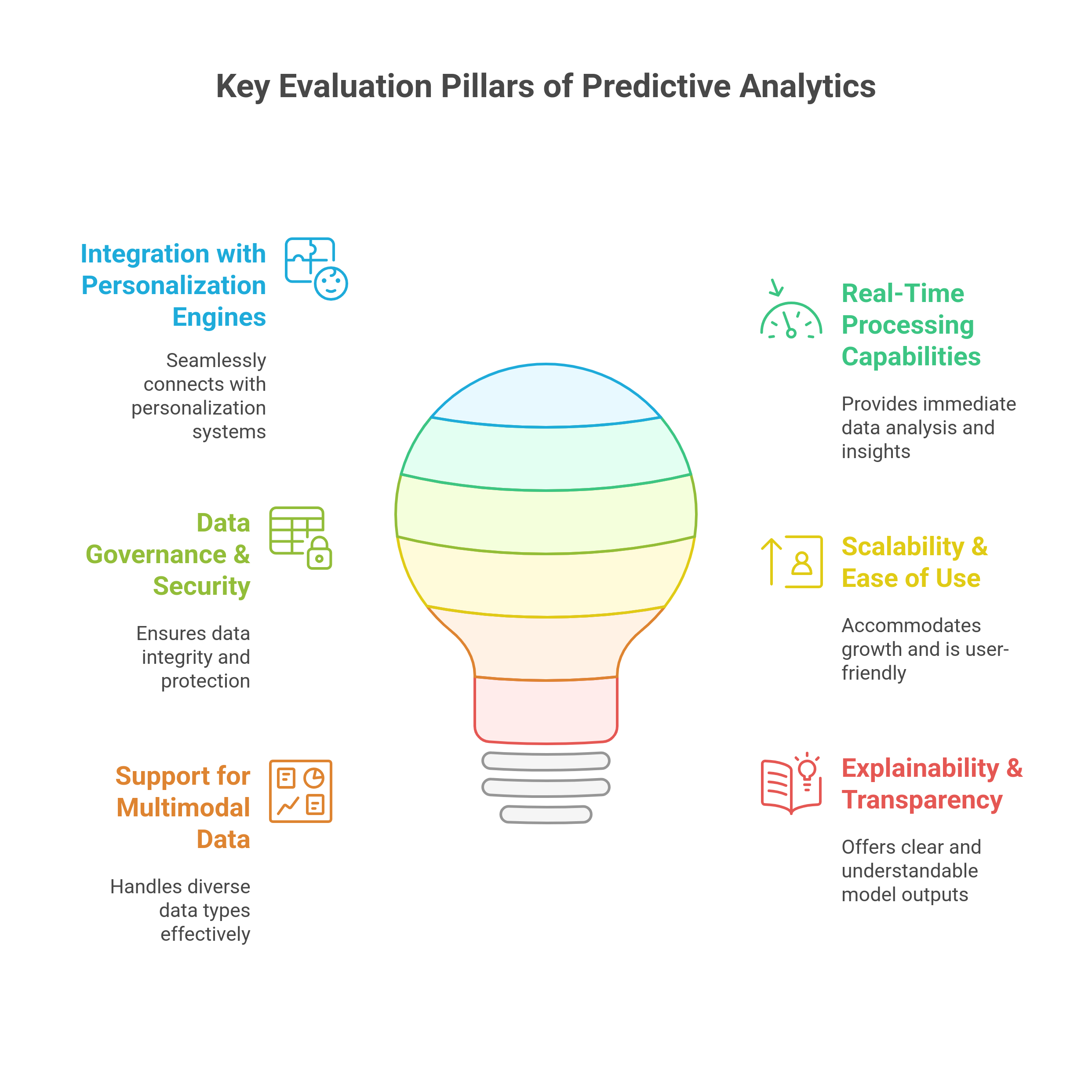
Integration with Personalization Engines
The analytics tool you choose should communicate in the same tongue with the marketing stack, that is, the Customer Data Platform, the CRM, or the Web personalization engine. The ability to get predictions injected into live experiences can never be compromised. So, look for tools that support strong APIs, native connectors, or smooth data pipeline integrations into platforms like HubSpot, Salesforce, and Adobe Experience Cloud.
Real-Time Processing Capabilities
The nimble hour is the new edge of competition. The ideal predictive platform should be processing, scoring, and returning insights on its live or streaming data. This becomes even more important for instances with usage such as next-best-action recommendations, lead prioritization, or behavioral segmentation on the move.
Data Governance & Security
With increasing regulatory scrutiny on data privacy, the tool should meet the requirements laid down by the respective regulations (GDPR, HIPAA, SOC 2, etc.). From our point of view, standard features such as role-based access, data lineage, audit trails, and encryption at rest/in motion would be a must-have, especially if you operate in any regulated industry.
Scalability & Ease of Use for Non-Data Scientists
Not every team has a data science department—and they shouldn’t have to. The best predictive analytics software offers no-code/low-code interfaces, drag-and-drop modeling, and guided workflows so marketers and analysts can act independently while scaling models across large datasets.
Support for Multimodal Data
Your insights are only as good as your inputs. Make sure your tool can ingest and analyze diverse data types—structured and unstructured—including CRM logs, product telemetry, time series, clickstream data, and natural language content. The ability to unify and model these sources is what separates real intelligence from surface-level reporting.
Explainability & Model Transparency
Black-box AI won’t fly in enterprise environments. Your team—and your compliance officers—need to understand why a model made a prediction. Prioritize tools that offer interpretable outputs, confidence scores, feature importance charts, and the ability to audit decision logic.
The 10 Best Predictive Analytics Tools for 2025
Explore the top enterprise-ready predictive analytics platforms transforming marketing in 2025. From AI-driven modeling to real-time personalization, these tools are built to help B2B marketers make smarter, faster decisions—at scale.
SAS Advanced Analytics
SAS Advanced Analytics belongs to this list due to its unparalleled maturity, depth, and credibility regarding enterprise-grade data science. Long regarded as the gold standard for statistical modeling in such sectors as banking, insurance, and government, SAS has come of age as a fully-fledged predictive analytic suite with its sights set on 2025. Trust, transparency, and high-performance analytics are paramount to SAS and make it truly suited for organizations where decisions need to be defensible and data driven. Marketing is perhaps one particularly salient case of application for SAS churn prediction and customer lifetime-value modeling. Enabling B2B companies with large customer bases to build models that are highly granular with respect to product usage metrics, engagement history, contract behavior, and external firmographic data, SAS is positioning its clients to leverage extremely targeted retention strategies and outreach programs long before a customer signals intent to leave.
SAS is unique, owing to the fact that it maintains an end-to-end approach to data analysis, including data preparation, model training, deployment, and monitoring. High-performance computing capabilities in SAS enable it to deal with various large datasets in distributed environments, while its visual interfaces bring accessibility to business analysts. Furthermore, SAS Viya, the company's cloud-native platform, promises agility and scalability so that teams can easily build and iterate models without compromising governance and security. On the personalization front, SAS really delivers. Its predictions can feed directly into personalization engines and content orchestration platforms to trigger customized journeys in real time. And the focus on explainable AI means marketers know not just whom to target but also why—leading to a higher level of precision in terms of messaging and its fit within brand strategy. Certainly, for enterprises in search of a battle-proven platform that embodies significant analytical prowess with equally strong governance, SAS unquestionably remains a top contender.
Microsoft Azure
Microsoft Azure Machine Learning will definitely be featured on this list because it provides a scalable, cloud-native AI ecosystem that offers great flexibility while being powerful enough for enterprises. Normally part of the wider Azure cloud platform, it's distinguished not just by what we'll talk about next, machine learning; it integrates so snugly into Microsoft's suite of tools-Power BI, Dynamics 365, and Azure Synapse-which would make it a great choice for businesses that are already invested in the Microsoft ecosystem. With the close connectivity to generative AI models and advanced automation workflows, the program is shaping up to be best positioned in 2025 as a forward-looking service for enterprises looking to operationalize scale data science. For marketers, Azure ML shines in high-impact use cases like lead scoring, cross-sell recommendation engines, and dynamic pricing models. For instance, B2B organizations can leverage Azure ML to establish predictive models to determine which leads will convert most likely and seamlessly push those insights to a CRM system like Dynamics or Salesforce for prioritizing sales and targeting campaigns. Experimentation becomes easier with AutoML, allowing teams to quickly try many different algorithms and pipelines without requiring deep coding skills perfect for iterative optimization in fast-moving marketing environments.
One of the strongest points in Azure ML is flexibility: Python, R, and a myriad of other ML frameworks like PyTorch, TensorFlo,w, or XGBoost are covered. Its MLOps feature can be considered most robust, capable of fully managing the entire model lifecycle, complete with versioning and CI/CD integration for predictive workflows. Add to that its governance and security infrastructure, being based on role access and adding up to the enterprise-ready level for AI solutions speed or usability. Apart from these, Azure ML also possesses highly competent features for personalization. It can power engines of real-time personalization by means of REST APIs and event-driven architectures that allow marketers to trigger content, product recommendations, or emails based on predictive insights. The outputs are readily embeddable into web apps, chatbots, or customer data platforms, proving a strong choice for teams looking to infuse predictive intelligence into omnichannel experiences. Briefly, a horsepower for the companies going to scale their AI-driven personalization confidently.
IBM SPSS Modeler
IBM SPSS Modeler makes it on this list with its long-standing reputation in statistical analysis and, most recently, as an AI-native platform. Originally for academic and industry research, it became the powerhouse of predictive modeling—an application trusted by enterprises that require reliable and repeatable insights from datasets so massive that they are mostly trusted. In 2025, its integration into IBM Watson deepened these capabilities, particularly in industries such as finance, healthcare, and B2B tech, where data trust and explainability matter just as much as accuracy. An exciting use case for the SPSS Modeler in marketing will be to do behavioral segmentation on a grand scale. For instance, B2B marketers may cluster audiences based on nuanced behavioral signals, content engagement patterns, velocity in their lifecycle stage, or trends in multichannel activity and apply such segments to target personalized experiences across web and email touchpoints. SPSS Modeler's drag-and-drop environment is explicitly designed for those analysts and marketers who wish to build advanced models without going through code while still opening a window for simulation and further custom scripting for data scientists if needed.
Its personality lies in depth and breadth concerning algorithms, albeit mainly decision trees, regression models, time series forecasting, and text analytics. Strong governance features, some of which allow for complex workflows with auditability, have kept its appeal in the regulated enterprise environment; settings where it is never easy to win will always find a sponsor. Unstructured data handling is another differentiator that helps marketers derive insights from call transcripts, customer feedback, etc., to identify predictive signals that would be otherwise missed. In this area concerning personalization applications, the IBM SPSS Modeler shines. Its output connects easily to personalization engines through IBM Watson Studio or via third-party integration. More importantly, those capabilities support the kind of explainable AI and probabilistic modeling that is key to building trust among the sales and CX teams. Where predictive accuracy must also be human-readable, SPSS Modeler stands out by delivering both analytical rigor and appeal to the marketing team.
SAP Predictive Analytics
SAP Predictive Analytics has made this list due to its strategic view of embedding predictive intelligence directly into core business functions. It is increasingly looking to find its footing by 2025 amongst enterprises that run on SAP ecosystems—especially those wanting to merge data analytics with supply chain, finance, sales, and customer experience workflows. Rather than positioning itself as a stand-alone data science platform, SAP has tightly integrated predictive capabilities with its broader Business Technology Platform (BTP), which gives them unparalleled usability when it comes to driving decisions for large complex enterprise systems.
An important marketing-oriented use case for SAP Predictive Analytics is intelligent account scoring and deal forecasting for enterprise sales cycles. By extracting data from SAP CRM, ERP, and other external touch-points, marketers and revenue teams can analyze which accounts are showing strong buying signals—and which might be most likely to stall. These insights can fuel hyper-targeted ABM strategies, dynamic content delivery, or sales enablement playbooks tailored by vertical, geography, or buyer role. What distinguishes SAP is the seamless integration and end-to-end visibility it provides across an organization. Predictive models operate on top of enterprise data lakes and operational systems, obviating the need for heavy ETL pipelines or complex handoffs. This minimizes latency and risk and allows cross-functional teams to align easily around a single version of the truth. The platform supports a wide variety of modeling techniques ranging from regression, clustering, and time series to classification and includes automation features geared toward enabling non-technical users to quickly generate insights. In terms of personalizing readiness, SAP Predictive Analytics is well-armed—especially when married to tools like the SAP Customer Data Platform and SAP Emarsys. Predictions generated within SAP can be instantly activated across the customer journey—from email personalization to e-commerce experiences. The true value proposition, though, is the native flow of the tool into enterprise-grade personalization workflows, wherein predictive insights effortlessly traverse from model to message. This is an obvious and high-performing solution for SAP-centric organizations.
Oracle Advanced Analytics
Oracle Advanced Analytics is included in this list, as it provides a deeply integrated and secure predictive analytics environment for organizations with an appetite for data. The integration of this platform within the Oracle Database and Oracle Cloud Infrastructure (OCI) allows enterprises to run advanced analytics at the data-layer interface of objects-nothing gets moved, and latency is reduced and scalability enhanced. In 2025, its worth is exhibited clearly for enterprises that require real-time insights embedded with transactional workflows, and this is specifically true for telecom, finance, and B2B SaaS companies. A clear-cut application of Oracle in marketing is that of predictive lead qualification, which is embedded into customer data systems. With models running within the database, marketing teams can generate scoring and classification without data export, a process that hugely smoothens the path from modeling to action. So, scoring models for inbound leads, upsell readiness, or churn risk can directly power campaign logic and sales handoffs without a hitch, with no risk of data compliance or other issues. For huge enterprises that deal with sensitive data and with highly complex data pipelines, this type of embedded intelligence is a game-changer.
The strengths of Oracle Advanced Analytics lie in its database-oriented architecture and highly efficient in-database algorithms. It provides machine learning support within Oracle SQL via a complete range of functions for classification, clustering, regression, anomaly detection, etc. For organizations already engaged with Oracle, the advantages of discontinuous infrastructure, simple governance, and keeping performance at a large scale are compelling. Added to all this is its great synergy with Oracle's cloud services and enterprise applications, thus providing it with great operational agility. Oracle is spot-on with a differentiation strategy. Outputs can be routed through REST APIs to feed directly into Oracle Marketing or Eloqua or other external systems-enabling marketers to make real-time decisions and adjust campaigns on predictive trigger grounds. The platform encourages explainable AI and audit trail capability so that personalization strategies are transparent and accountable. This presents a default option for enterprise marketing teams to weave predictive machinery into the personalization pipeline within Oracle's ecosystem.
Tableau + Einstein Discovery
Notably, advancing its predictive analytics is Tableau + Einstein Discovery, which tops the list and brings some world-class data visualization and advanced predictive analytics powered by Salesforce's Einstein AI. This solution neatly bridged the gap between business intelligence and predictive insights by integrating the AI capabilities of Salesforce along with Tableau's visual interface. In 2025, it will be known far and wide, not only for its predictive capabilities but also for its ability to bring machine learning closer to the masses so that marketers, analysts, and decision-makers can gain actionable insight without requiring extensive technical background. One of the good use cases is the sales prediction and churn prediction from customers using Tableau + Einstein Discovery. This provides B2B teams with predictive models built around historical sales data, customer interactions, and signals from beyond. These predictive models can be shown and explored within Tableau's interactive dashboards to help marketing teams find answers where opportunity and risk exist as well as take proactive measures for customer retention or pipeline acceleration. Integrating predictive analytics with real-time data visualization seems to give users an open invitation to try out various hypotheses and adapt their tactics on the go.
The main strength of Tableau + Einstein Discovery is the easy-to-use interface that blends stellar data visualization by Tableau and robust predictive analytics by Einstein. The integration opens up a highway from data exploration to actionable insights for marketers. Built-in features such as automatic insights, trend detection, and anomaly spotting can easily be understood by anyone beyond mere technical expertise. Further, this fact it is completely cloud-native and, therefore, scales seamlessly and across large organizations, as well as making it extremely collaborative for sharing and acting upon insights together. Tableau + Einstein Discovery is a really good recipe when it comes to personalization capability. Marketers use predictive insight to influence personalized recommendations, delivery of content, and engagement with customers across channels, driving precision in their marketing. Predictive analytics are easy to integrate with Tableau's user-centric interface, and, therefore, easy to implement dedicated marketing efforts targeting specific customer segments, whether by targeted email campaigns, personalized web experiences, or dynamic advertising. Explainable AI and transparent models also make stimulation normally preferred by marketers, who want to prove with visible logic behind their recommendations to stakeholders or customers, feel at ease.
RapidMiner
The RapidMiner software, now consolidated into Altair's AI Studio, rightfully finds its place on this list, given the strong commitment the tool has shown toward democratizing data science and predictive analytics. The visual workbench, designed for all levels of users, enables data scientists and business analysts to develop, deploy, and monitor predictive models with little to no coding. Origins in open-source software and powerful community support, combined with features worthy of enterprise-level applications, ensure that RapidMiner will be a strong contender for an organization looking to scale its predictive analytics in a flexible manner. In this regard, the RapidMiner offering will further appeal to enterprises in tech-enabled and data-driven industries with its integration features across Altair's full suite of tools as of 2025. Predictive content recommendation is an important marketing application of RapidMiner. For the B2B space, it is an extremely powerful tool for predicting customer preferences and then personalizing web, email, and other touchpoint content based on past behavior patterns, demographic insights, and even some external signals. RapidMiner, in fact, is flexible enough to allow teams to play with different algorithmic options to tune their recommendation engines, all to help marketers deliver the right content to the right audience at the right time.
RapidMiner's major strengths are its multifunctionality and user-friendly interface. Unlike conventional data science platforms that require coding expertise, RapidMiner allows marketers and business analysts without much technical background to use it. It has a huge variety of algorithms from machine learning models to neural networks, advanced data prep, and text and web mining tools that allow teams to build predictive models for almost all conceivable use cases. RapidMiner's other important strength is seamlessly interfacing with other data platforms, including SAP, Salesforce, and Tableau, making it easy for enterprises to fit into their environment. On the personalization front, RapidMiner (via Altair AI Studio) effectively enables personalization-ready solutions that scale to real-time. Predictive outputs from the RapidMiner solutions can be easily injected into web and email personalization engines; this enables marketers to show personalized content, offers, and recommendations based on live user data. The parallel, scalable execution of models guarantees that customer experiences remain highly relevant and dynamic; transparent modeling and interpretability provide assurance that insights will be actionable and easily comprehensible, fostering trust with the stakeholders involved.
Alteryx
Alteryx finds its way to this list due to its capacity to enable companies to develop from raw data to actionable insight fast and effectively overall end-to-end analytics capabilities. Known for its powerful data preparation tools, Alteryx provides a means for building complex data workflows accessible to users without a heavy technical background. In 2025, it continues to be seen as an easy-to-use platform for democratizing advanced analytics and predictive modeling, thus allowing marketing teams to leverage predictive insights without relying on specialized data science resources. Customer segmentation and predictive scoring stand out as some of the best use cases for Alteryx in marketing. With Alteryx, marketers can process and analyze large, disparate data sets—from CRM data to web interactions and transaction histories—to locate the high-value customer segments. Using its predictive tools, Alteryx helps teams forecast customer behavior—such as identifying prospects most likely to convert, customers at risk of churn, or ones that are ripe for upselling. This enables marketing teams to target their efforts with laser precision, driving greater efficiencies for the acquisition-and-retention campaigns.
Alteryx is versatile and scalable; it is precisely for that strength. It provides a variety of tools for data preparation, blending, and analytics that can either be orchestrated through a visual, drag-and-drop interface or custom-scripted by the more technically inclined users. In this case, the custom scripting includes advanced machine learning models. Due to integrations with cloud platforms, data warehouses, and BI tools like Tableau, insights can be passed seamlessly through teams and systems for faster organization-wide decision-making. Along with its ability to automate what would otherwise be very complex workflows, this proves to be a huge plus, saving a lot of time and money too. On the personalization front, Alteryx is especially good at real-time, data-driven marketing actions. Marketing teams can automatically activate personalized content and offers based on behavioral patterns, demographics, or engagement signals, thanks to the predictive models that Alteryx provides. Whether it's surfacing the right product recommendation on an e-commerce site or sending a targeted email campaign, Alteryx's integration capabilities allow insights to be actioned straight away. From the standpoint of team collaborations, further confidence in using Alteryx stems from the transparency and explainability it accords in ensuring that its predictive models are understood and can, therefore, defend their decisions.
Adobe Analytics
Adobe Analytics finds itself in this list due to its unique position at the intersection of real-time digital behavior tracking and predictive intelligence. As part of the Adobe Experience Cloud, it combines advanced data-gathering methods with AI-based analytics to provide deep insights into customer journeys. In 2025, Adobe Analytics will be more than a reporting tool; it will have become a prediction engine woven into the very fabric of customer experience. Native integration with Adobe Sensei, the AI/ML layer of the Adobe ecosystem, has now enabled marketing and experience teams to move beyond asking “what” into answering “what’s next” with speed and precision. An important use case for Adobe Analytics is predictive personalization across digital touchpoints. For instance, a B2B SaaS company may use Adobe to analyze past web behavior, product usage, and campaign engagement to predict churn risk or upsell opportunities. These predictions could then be immediately leveraged to personalize content, messaging, and offers across email, site activities, and paid media without switching platforms. Adobe’s Real-Time CDPs empower marketers further by creating intelligent segments and triggering personalized journeys based on predictive signals.
The strengths of Adobe Analytics include tight ecosystem integration with real-time processing and AI-assisted analysis features. It automatically surfaces anomalies, trends, and conversion drivers without any manual intervention, thus saving analysts hours while presenting opportunities that could have been missed by human analysts. It features intuitive visualizations, while its prowess in multichannel, web, mobile, CRM, social, and others are perfect for a large marketing team wanting to excel in omnichannel practices. For enterprise organizations with investments in customer experience and content marketing, Adobe provides unmatched insight-to-action linkage. Adobe Analytics has all of its supporting architecture working together for personalization purposes. With the predictive models driven by Adobe Sensei and real-time content adaptation enabled through Adobe Target, the entire system ensures contextually aware, dynamic experiences. Marketers can act on predictive insights within seconds, personalizing content based on intent, behavior, or likelihood to convert. The capability to unite all data, develop predictions, and deliver personalization all in the same environment propels Adobe Analytics to be one of the most personalization-ready platforms in today’s market.
Spotfire
With excellent features in advanced analytics, real-time data visualization, and predictive modeling, Spotfire by TIBCO completes this list. Renowned for creating a unique value proposition that marries both data science and business intelligence in one interface, Spotfire, in 2025, is a tool of choice for firms that need to make quick, accurate decisions within complex data environments. Spotfire thrives in scenarios where time-sensitive insights, operational forecasting, and interactive explorations are key, making it a powerful tool to wield for marketing and revenue teams navigating markets with volatile conditions or high-stakes journeys. The most compelling application of Spotfire would be in pipeline health diagnostics and campaign ROI forecasting within B2B marketing environments. Pulling data from CRMs, advertisement platforms, website behavior, and even third-party sources, Spotfire gives insights on the performance of exciting opportunities as well as where they fall short in a funnel. Adding predictive models makes these data streams forecast deal velocity, measure content attribution, and prioritize accounts using lead behaviors and historical win data; hence, what results is the previously described data-informed roadmap as to where to encourage activity to grow and close gaps.
Spotfire's primary strength lies in its real-time analysis engine with built-in support for both statistical and machine-learning models, along with visualization flexibility unmarred by any other app in the market. It supports R, Python, and TIBCO's native analytics language; thus, technical and non-technical users alike can perform thorough-going analysis without leaving the platform. Its robust data-wrangling capabilities, as well as automated recommendations, decrease the burden of unearthing insights from either messy or high-volume sources of data within teams. With streaming analytics and support for time series forecasting, it is a good fit for fast-paced market scenarios, well worth its salt. Spotfire is also quite flexible concerning readiness for personalization. It can be integrated with customer data platforms and marketing automation systems, thus allowing predictive outputs such as content propensity scores or churn risk levels to impact real-time personalization strategies, making it also possible to customize web content for ABM campaigns or to change outreach cadences based on predictive engagement signals. Spotfire actually brings in the insight layer that powers intelligent automation, be it for personalized web content in ABM campaigns or for different outreach cadences based on predictive engagement signals. Strong arguments would thus be made for marketers developing data-driven personalization engines through their capabilities to explain the results of a model and visualize it in attractive dashboards to stakeholders.
Conclusion
In an ever-evolving world of data-driven marketing, predictive analytics is no longer a nice-to-have; it has transitioned into the realm of non-negotiability. Nowadays, being able to predict customer behavior, anticipate changes in the market, and act on insights in real time are the very tenets of competitive advantage. But as we have since learned, not all predictive analytics tools are created equal. The best-in-class predictive analytics tools of tomorrow are going to be high-tech as well as strategically aligned with the needs of B2B marketers: personalization-ready, integration-friendly, scalable, and transparent.
Whether you are a CMO wanting to accelerate pipeline velocity, a marketing ops leader wanting to operationalize AI, or a digital strategist building a future-proof tech stack, these platforms provide enterprise-grade power without the loss of agility. The predictive analytics platforms we have reported on are built for anything from real-time web behavior modeling to intelligent campaign orchestration, far beyond dashboards, in order to achieve real business outcomes. The platform selection should not be based on buzzwords but on alignment with your data maturity, personalization aspirations, and overarching strategic goals. While evaluating these tools, seek the ones that enable your team to do more than analyze; to act. Because in 2025, predictive intelligence will not only tell what is coming next, it will create it.


