Introduction
"A/B tests are not all the same." The sophistication in digital marketing has also seeped into the systems of optimization of user experiences. Businesses seeking high conversion rates have turned to A/B testing for more concrete determinations of which version of a webpage, email, or ad is most effective. Yet, as the complexity of user behavior grows and the demand for personalization increases, certain traditional methods of A/B testing may not answer all inquiries within a marketer's purview.
Traditional A/B testing is basically an examination based on a frequentist principle with a fixed sample size, opting for a defined threshold in order to determine at what point the outcome will be deemed statistically significant. This method has been around for decades and is well known within the conversion optimization community, but it can be somewhat inflexible and slow to respond to changing data patterns. Unlike this, Bayesian testing has a more dynamic and probability-driven approach whereby it continually updates insights whenever new data flows into the system for making intelligent and fast decisions.
The blog will describe the main differences between these two approaches and set their advantages and disadvantage,s and guide selection of the most effective method according to your optimization goals. In optimizing landing pages, rolling out new features, or fine-tuning personalization strategy, smartly understanding the nuances between Bayesian and traditional A/B testing is the key to maximizing marketing impact.
Understanding A/B Testing Frameworks
As businesses strive to improve conversion rates and develop strategies for conversion optimization, deciding on the right A/B testing framework becomes crucial. Understanding the core principles behind traditional A/B testing and Bayesian testing will enable marketers to interpret test results correctly and take the right decisions. Here’s how both approaches work.
Traditional (Frequentist) A/B Testing: How It Works
Frequentists conduct A/B testing with fixed sample sizes and unyielding stopping rules in order to assess results. Comparisons of variations to evaluate test results against some null hypothesis that there is no difference between the control and test group assumptions. Observed results are then compared with a preselected level of statistical significance, at a threshold above accepted null hypothesis is evidence against the variation having a measurable effect.
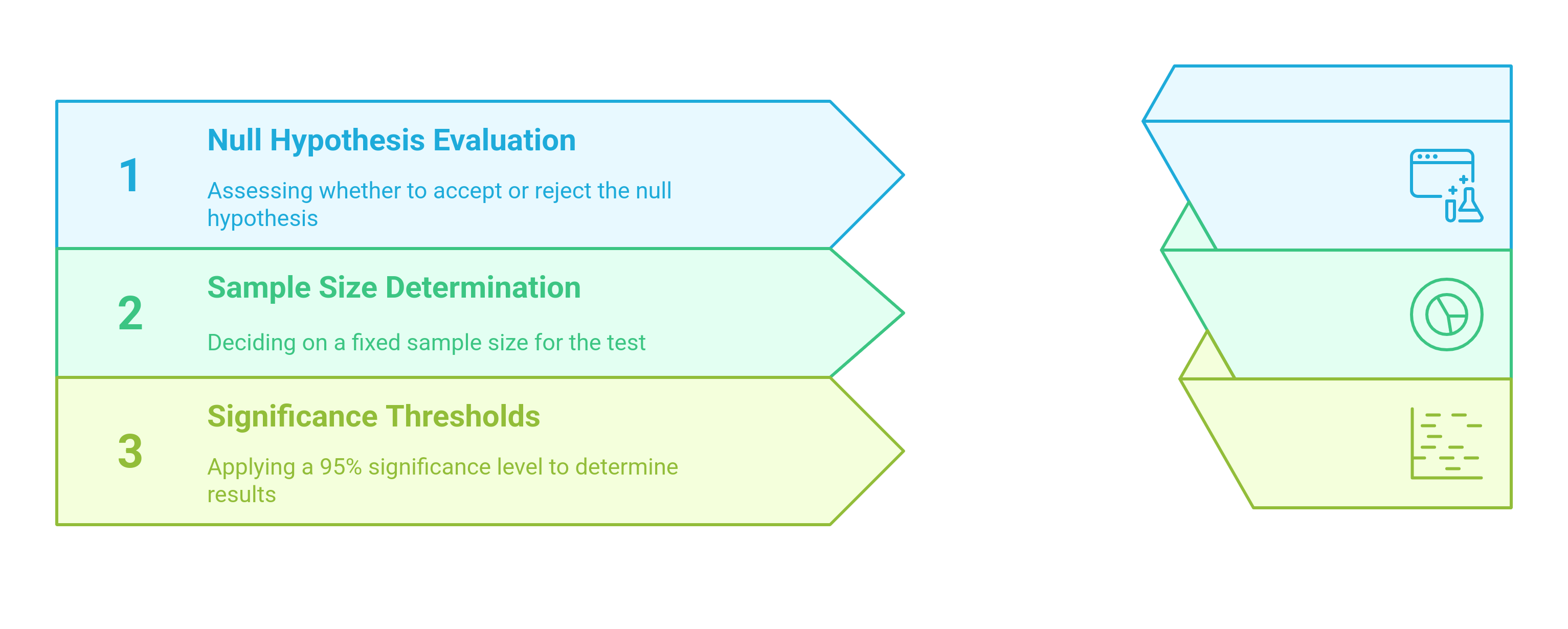
- Null Hypothesis and P-Values: Within a frequentist framework, results are evaluated against p-values, which determine whether the observed difference between variants results from chance or is due to a true effect. As a general rule, p-values are regarded as statistically significant when they are below 0.05 (or 5%), making them the cutoff level for significance.
- Fixed Sample Size Requirement: The frequentist tests will be defined by size predetermined before the biopsy. Sample sizes are chosen such that tests have sufficient power to identify a meaningful difference with the minimum risk of Type I (false-positive) and Type II (false-negative) errors.
- Significance Thresholds: The traditional application of A/B tests used a 95% (or higher) confidence level for determining whether the result should be considered statistically significant. However, this view could be interpreted rather rigidly, since the results might become distorted and misleading conclusions drawn from the test if it is stopped too early or continued too long.
Bayesian A/B Testing: How It Works
Bayesian A/B testing takes an approach to uncertainty as developing probability rather depending on a binary decision. Therefore, instead of the singular statutory threshold for significance, probabilities that one variation is better than another are continually updated as data is accumulated. This makes it better for real-time decision-making through Bayesian testing.
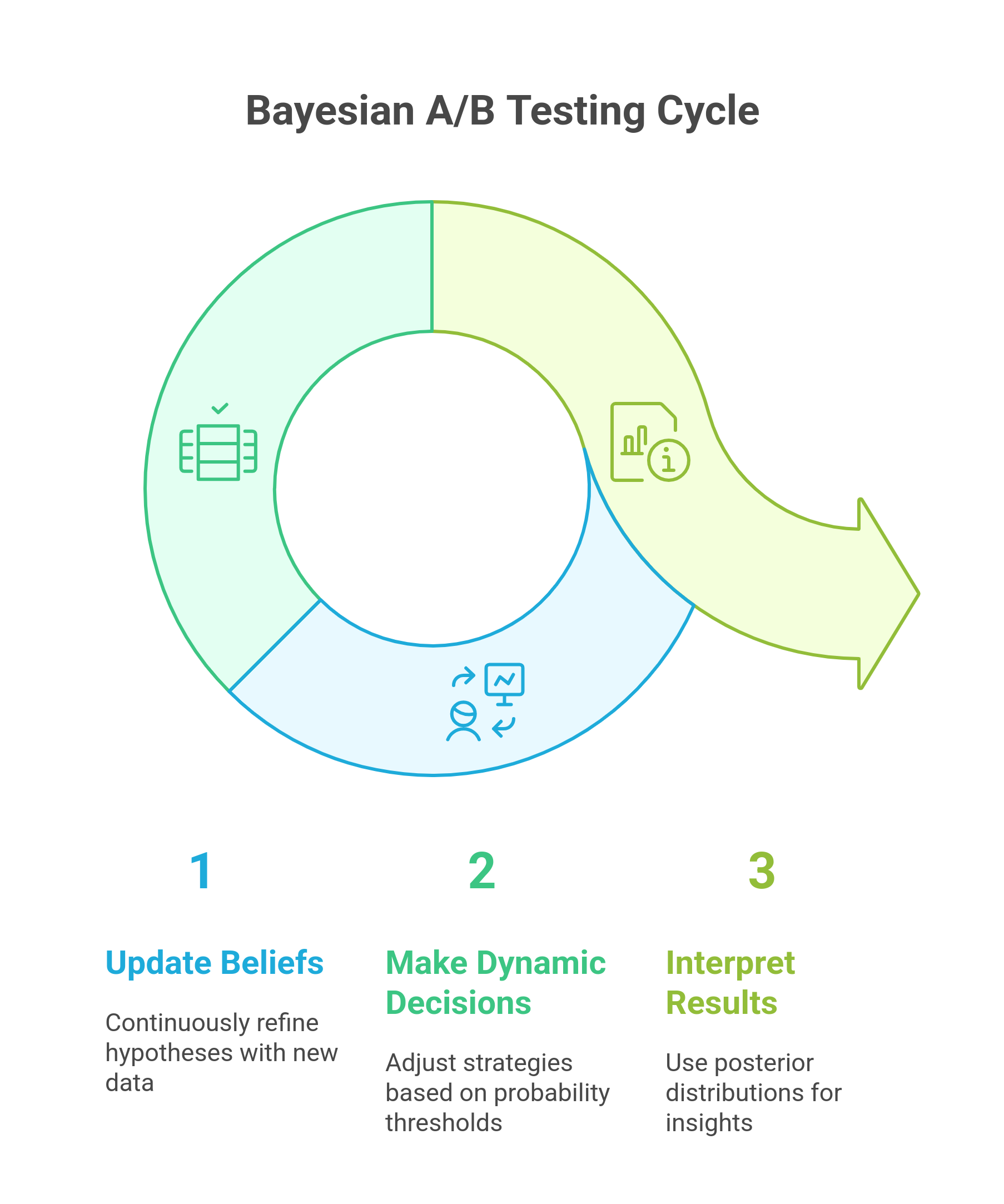
- Probability Over Certainty: Given that Bayesian testing produces results in terms of probability rather than certainty, it would be possible to ask questions such as "What is the probability that Variant B is better than Variant A?" This clarifies and provides a clearer and more intuitive understanding to the evaluation of changes in conversion rates associated with variants without being tied by rigid thresholds.
- Dynamic decision-making: Contrary to frequentist methods, Bayesian testing has dynamic stopping criteria. In this case, marketers may halt an experiment when the probability of one variant outperforming the other crosses a certain threshold set for them, meaning that they would not be exposing their tests to unnecessary traffic or time.
Bayesian models produce posterior distributions, representing the probability of outcomes depending on the observed data and prior knowledge. In lieu of confidence intervals, Bayesian analysis employs credibility intervals, which provide marketers with a more intuitive measure of uncertainty and give them a clear idea of the likely range of outcomes.
Key Differences: Bayesian vs Traditional A/B Testing
When it comes to A/B testing for conversion optimization, the underlying methodology, interpretation of results, and decision-making criteria can significantly impact outcomes. While both traditional (frequentist) A/B testing and Bayesian testing aim to identify the best-performing variation, they operate on fundamentally different principles. Let’s break down the key differences between these two approaches.
Methodology and Philosophy
With the frequentist A/B testing, you decide outcomes by long-term frequency of results. It tests a null hypothesis, usually assuming there is no difference between variants, seeking to determine if the results are statistically significant enough to be rejected. It treats every experiment as a unique event, where one could draw conclusions only after reaching the predetermined sample size.
Philosophy: Frequentist methods are intended to control the error rate over many hypothetical repetitions of the experiment with results being interpreted something like "if we did this experiment infinitely many times, we would expect to see this kind of outcome X% of the time-and completely ignore the outcome of the current experiment."
Bayesian A/B Testing, in contrast, is under Bayesian probability theory, which continuously updates beliefs (or prior knowledge) as new data comes in the door. Bayesian methods calculate the probability that one variant is better than another rather than asserting that the null hypothesis can be rejected, making this a more intuitive and fluid way of making decisions.
Philosophy: Bayesian methods make data a form of refinement of prior beliefs, thus enabling the continual improvement of decision accuracy as the experiment progresses for marketeers.
Interpretation of Results
Frequentist A/B Testing works on p-values and confidence intervals to assess the statistical significance of results. The problem with p-values is that they are misinterpreted. They represent the probability of observing the results under a given null hypothesis—not the probability that a variant is better. Confidence intervals might suggest a definite range in which one believes that a true effect lies; however, this may yield an overconfident estimate of effect size.
Interpretation Challenge: A p-value below 0.05 does not mean that a variant is definitively better; it simply indicates that the observed difference is unlikely to have occurred by chance. However, in real-world marketing situations, this quite often turns into overconfidence or, worse, false conclusions.
Bayesian A/B Testing enables far more intuitive interpretations by providing direct probability statements. Thus, while traditional statistical tests rely on p-values, some Bayesian results can state, for example, “There is an 87% probability that Variant B will outperform Variant A.” Hence, marketers can better understand the likelihood of one variation leading to increased conversion rates without having to resort to some abstract statistical jargon.
Interpretation Advantage: Bayesian methods yield clear insights actionable to the market, thus enabling the marketers to become confident and data-driven.
Stopping Criteria and Flexibility
Frequentist A/B Tests require the sample size they pre-determined for valid results-the earlier termination or prolongation of the test from this planned timeframe causes biased outcomes or false positives. These frequentist models calculate results for a particular sample size-fixed, hence the rigidity concerning real-time changes.
Stopping Rigidly: Marketers have to wait until the predetermined sample size is reached, even when an emerging winning variant is already visible.
On the other hand, Bayesian A/B Testing permits dynamic conditional stopping criteria into it. Since Bayesian models continuously update beliefs, tests can be stopped upon sufficient credibility being accorded the results, thereby saving time and resources. As soon as the chance that one variant will perform better than another passes the acceptable threshold, the test can be ended without conveying the loss of accuracy.
Adaptive Stopping: Such adaptation renders it possible to apply testing directly to fast-paced environments that require prompt and effective issue resolutions.
Risk Mitigation and Error Handling
Frequentist A/B Testing is vulnerable to Type I (false positive) and Type II (false negative) errors, especially if assumptions about sample size, randomness, and significance thresholds are not strictly followed. Since the framework doesn’t account for prior knowledge, unexpected data patterns can skew results.
Higher Risk of Errors: Deviations from predefined rules can increase the likelihood of making incorrect decisions, impacting conversion rate outcomes.
Bayesian A/B Testing mitigates these risks by incorporating prior data and dynamically adjusting error thresholds. Since Bayesian models update probabilities continuously, they are less prone to false positives and can detect meaningful differences even with smaller sample sizes. This adaptability lowers the risk of errors, making Bayesian testing a more reliable approach for ongoing conversion optimization.
Lower Error Probability: By continuously learning and adjusting, Bayesian models reduce the risk of making erroneous decisions, ensuring more accurate and reliable outcomes.
Advantages and Limitations: Choosing the Right Approach
When it comes to A/B testing for conversion optimization, understanding the strengths and weaknesses of each approach is essential for making informed decisions. While both traditional (frequentist) A/B testing and Bayesian testing aim to identify the best-performing variation, they offer distinct advantages and come with their own set of limitations. Let’s explore the pros and cons of each approach to help you determine which is best suited for your testing environment.
Advantages of Traditional A/B Testing
Traditional (frequentist) A/B testing has long been the industry standard, offering a structured, statistically rigorous framework that is easy to implement and interpret. It is particularly effective for situations where binary decisions (such as “win or lose”) are required, and confidence in the final outcome is paramount.
Established Framework with Decades of Statistical RigorFrequentist A/B testing is built on well-established statistical foundations. With decades of use in marketing, clinical trials, and product development, it remains a trusted and validated method for hypothesis testing.
Easier to Implement with Standardized Statistical PackagesPopular tools such as Google Optimize, Optimizely, and VWO offer built-in frequentist testing models. Since these platforms follow standardized procedures, marketers can easily set up and analyze tests without needing advanced statistical knowledge.
Suitable for Binary “Win/Lose” Decisions Where Confidence is ParamountWhen the goal is to determine whether a specific variation outperforms another with high statistical significance, frequentist A/B testing excels. For high-stakes decisions, where controlling Type I errors is essential, this method provides a rigorous framework for minimizing false positives.
Advantages of Bayesian A/B Testing
Bayesian A/B testing offers a more flexible and intuitive approach, making it particularly well-suited for real-world decision-making and ongoing conversion optimization efforts. Bayesian models provide dynamic, probability-driven insights that enable marketers to act faster and adapt their strategies as data evolves.
More Intuitive and Adaptable for Real-World Decision-MakingUnlike frequentist methods, Bayesian testing presents results in terms of probability—answering questions like, “What is the likelihood that Variant B is better than Variant A?” This makes the results easier to interpret and apply in practical scenarios, reducing the risk of misinterpretation.
Provides Actionable Insights Faster, Allowing Dynamic ExperimentationBayesian models continuously update probabilities as data accumulates, allowing for dynamic stopping criteria. Marketers can stop tests early once a high probability threshold is reached, enabling faster decision-making without waiting for a pre-defined sample size to be met.
Ideal for Environments with High Variability or Where Personalization is OngoingFor dynamic digital environments—such as e-commerce websites, SaaS platforms, or personalized user journeys—Bayesian A/B testing thrives. It adapts well to changing traffic patterns and evolving customer behaviors, making it ideal for organizations that prioritize personalization and real-time adjustments.
Limitations and Pitfalls
While both approaches have clear advantages, they also come with limitations that marketers need to be aware of to avoid misinterpretation and erroneous decisions.
Frequentist A/B Testing: Over-Reliance on P-Values and False Confidence
Over-Reliance on P-Values: P-values, the cornerstone of frequentist analysis, are often misunderstood or misused. Marketers may interpret a p-value below 0.05 as definitive proof that a variation is better, ignoring the nuances of sample size, randomness, and variance. This over-reliance on p-values can lead to misplaced confidence in results that may not be replicable.
Inflexibility in Stopping Criteria: Since frequentist tests rely on fixed sample sizes and strict stopping rules, stopping a test early or extending it beyond the intended timeframe increases the risk of false positives or negatives, compromising the validity of the results.
Bayesian A/B Testing: Computational Complexity and Prior Assumptions
Computational Complexity: Bayesian models involve more complex mathematical computations, often requiring specialized statistical knowledge and more computational power. While many modern platforms are starting to integrate Bayesian testing, implementing it manually can be resource-intensive.
Need for Strong Prior Assumptions: Bayesian models rely on prior distributions to guide the interpretation of new data. If the priors are poorly chosen or not representative of the real-world scenario, they can bias the results and lead to inaccurate conclusions. Ensuring that prior assumptions are realistic and align with business goals is crucial for maintaining accuracy.
When to Choose Which?
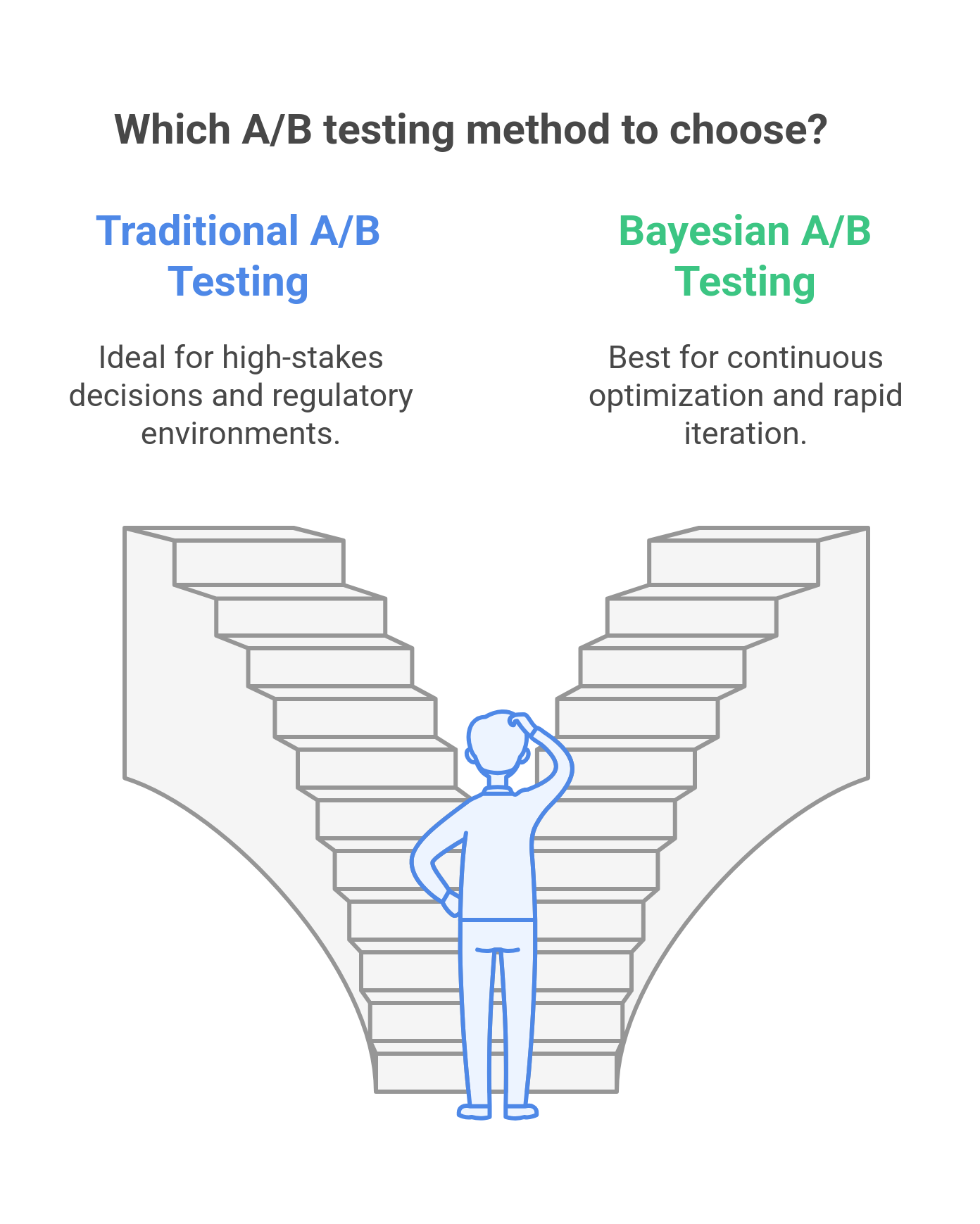
- Frequentist A/B Testing: Ideal when binary, high-stakes decisions need to be made with high statistical confidence. Best suited for regulated industries or scenarios where minimizing false positives is critical.
- Bayesian A/B Testing: Perfect for dynamic environments where faster, probability-driven insights and ongoing personalization are required. Ideal for companies that prioritize adaptive learning and agile decision-making.
Real-World Application: When to Choose Which
Opting for an A/B testing framework suitable for one's needs is one of the key impacts on the success of conversion optimization activities. Both traditional (frequentist) A/B testing and Bayesian testing have their strengths, but understanding the practical scenarios where each outweighs the other allows marketers to align their testing approach with business objectives. Here is when to choose each method based on real-world situations.
Traditional A/B Testing is Ideal When…
Frequentist A/B testing thrives in high-stakes environments where maintaining rigorous control over decision-making is essential. It provides statistically sound results for scenarios where binary outcomes and strict compliance are non-negotiable.
High-Stakes Decisions Where Strict Control is Required: When the cost of making an incorrect decision is high—such as in pharmaceutical trials, financial models, or mission-critical software rollouts—frequentist A/B testing provides a well-established, statistically rigorous framework. Its focus on minimizing Type I and Type II errors makes it ideal for environments where the stakes are too high to leave room for error.Example: A fintech company testing changes to its transaction verification process may prefer frequentist testing to minimize the risk of introducing errors that could compromise security.
Regulatory or Compliance-Driven Environments: Industries such as healthcare, finance, and legal services operate in highly regulated environments where strict adherence to compliance standards is required. In these cases, frequentist A/B testing is preferred due to its emphasis on statistical significance and pre-determined sample sizes, ensuring results are defensible in audits or compliance reviews.
Example: A healthcare provider conducting tests on changes to its patient data portal would use frequentist A/B testing to ensure compliance with HIPAA regulations.
Simple A/B Tests with Binary Outcomes: For straightforward experiments where the goal is to determine whether a variation outperforms a control (e.g., changing a CTA button color), frequentist testing remains a reliable choice. Its simplicity and well-documented methodology make it easier for marketers to implement and analyze results. Example: An e-commerce site testing whether a green “Add to Cart” button converts better than a red one would benefit from frequentist A/B testing.
Bayesian A/B Testing Excels When…
Bayesian A/B testing shines in fast-paced, dynamic environments where ongoing personalization, fluctuating traffic, and continuous optimization are critical. It allows marketers to update results in real time and make agile, data-driven decisions.
Continuous Optimization in Personalization and CRO Efforts: For brands that prioritize personalization and dynamic customer journeys, Bayesian testing offers the flexibility to refine user experiences continuously. Since Bayesian models update probabilities as data accumulates, they allow marketers to make decisions that improve conversion rates without waiting for rigid sample size thresholds to be met.Example: A SaaS company personalizing its onboarding journey based on user behavior can use Bayesian testing to refine the sequence dynamically, ensuring the best-performing flow adapts to user preferences over time.
Environments Where Rapid Iteration is Essential: In agile environments where frequent iterations and quick decision-making are necessary, Bayesian testing provides a faster, more adaptable alternative to traditional A/B testing. Its ability to dynamically stop tests once credible results emerge makes it ideal for growth-stage companies or teams running multiple experiments simultaneously.Example: A startup launching multiple landing pages for a new product can use Bayesian testing to quickly identify the best-performing design and iterate based on real-time results.
Testing with Smaller Sample Sizes or Fluctuating Traffic: Bayesian models excel in scenarios where traffic volumes fluctuate or where sample sizes are smaller. Because Bayesian testing accumulates data over time and updates probabilities dynamically, it can generate meaningful insights even with fewer data points. This makes it a valuable tool for companies with niche audiences or products with seasonal traffic patterns.Example: An online retailer testing different discount structures for a limited-time promotion with variable traffic can use Bayesian testing to quickly identify the optimal offer without waiting for a large sample size.
Pro Tip: Hybrid Approaches for Maximum Impact
For those businesses operating in regulated environments and fast-moving digital spaces, a hybrid approach may offer the best of both worlds. Frequentist A/B testing can then be applied in high-stakes situations, whereas Bayesian testing can be conducted in the background for personalization and iterative optimization.
Thus, as marketers consider these real-world implementations, they can start to meaningfully weigh the options of which testing framework best fits the bill-all in the name of conversion optimization through rigid control versus personalization via nimble, data-informed insights.
Best Practices: How to Implement the Right Testing Framework
Selecting the right A/B testing approach requires more than just understanding the theoretical differences between frequentist and Bayesian testing. To maximize conversion optimization and ensure meaningful outcomes, businesses should align their testing strategy with their objectives, risk tolerance, and operational environment. Here’s a practical guide to implementing the right framework for your needs.
Define Your Objective and Risk Tolerance
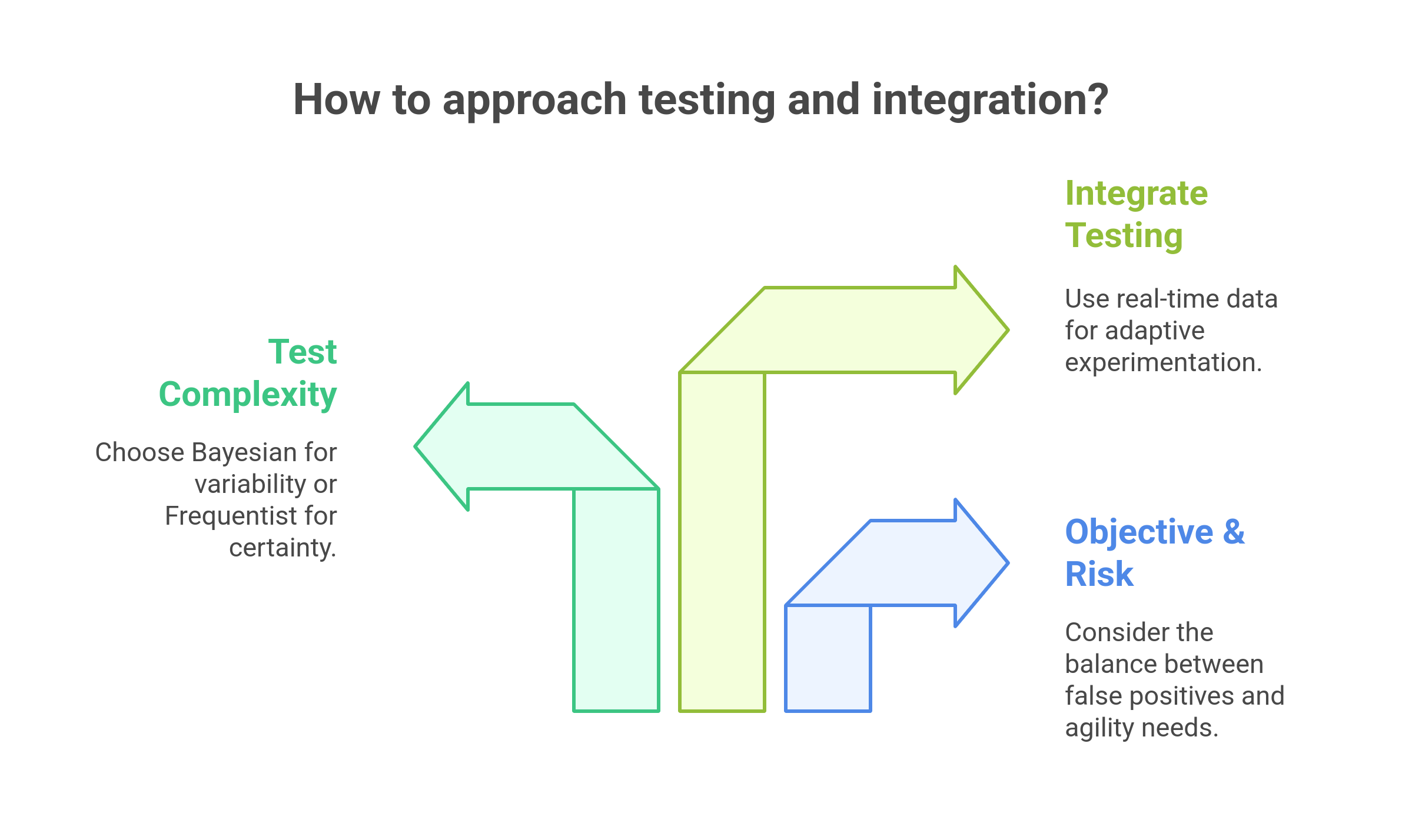
Before opting for a testing framework, one ought to state their intention and put their risk appetite through an assessment. Are you about to make high-stakes decisions where statistical significance is imperative? Or are you weighing speed and flexibility in a fast-changing world?
Frequentist A/B Testing: The most suitable test to run when the consequence of a Type I error is very costly, and unshaken confidence is required before rolling out any changes. In such a case, industries working under compliance requirements or where decisions cannot be undone would face a blessing.
Bayesian Testing: More appropriate in situations where speed and fast iteration are valued more than high confidence. When Type II error minimization really becomes core, Bayesian testing ensures faster insights, rendered in predictive probabilities that facilitate instant and dynamic decision-making.
Pro tip: Further consider the ramifications of such errors on your business model - for highly personalized and adaptive experiences, Bayesian models have much higher operational speed and flexibility.
Test Complexity and Expected Variability
The best testing framework is obviously influenced by the structural complexity of the tests and the variability in the environment being subjected to tests.
Bayesian for Dynamic Environments with High Variability: Bayesian models are meant for environments where traffic patterns, customer behavior, or external influences change very frequently. The adjustment of probabilities to real-time situations makes the Bayesian approach useful for online personalization and changing paths of user journey contexts. Example: An e-commerce platform optimizing product recommendations based on rapidly changing customer preferences will benefit from the real-time adaptability of Bayesian testing.
Frequentist When Certainty Is Needed: If your experiment does not change under any condition and gives an output with a definite binary outcome, frequentist A/B testing is the simplest and most statistically sound platform that it is possible to choose. This is right for simple tests with major business impacts that risk drawing the wrong conclusions. Example: Frequentist testing would be chosen by a bank testing changes to its online payment gateway due to increased assurance in the results to meet reliability and regulatory standards.
Integrate Testing Seamlessly with Personalization Engines
To extract every last drop of juice from conversion optimization, A/B testing frameworks should be steeped in personalization engines to exploit their real-time data and behavioral insights. This kind of dynamic experiment, adapting to user preferences, will enable the presentation of more relevant and personalized experiences.
Leverage Real-Time Data for Adaptive Experimentation: Bayesian testing pairs extremely well with AI-powered personalization engines because it has the ability to incorporate real-time behavioral signals in order to continuously refine experiments on the fly. This enables marketers to personalize experiences at scale while creating ongoing improvements in outcomes.
Sync Frequentist Testing for Controlled Iterations: This means that frequentist testing may not be the most adaptive technique for adaptive experimentation, but because the test can integrate with personalization platforms, this may help establish a baseline controlled for some larger strategic changes. This hybridized approach leans toward control but allows for some measure of adaptability, so the rigorous long-term experiments can maintain statistical soundness while allowing short-term personalization to remain dynamic.
Conclusion
Conversion optimization will gradually become an increasingly dynamic discipline, and choosing between frequentist and Bayesian A/B tests would require aligning your experimentation framework more with business goals than with personal preference. As a result of their more structured and statistically rigorous approach, frequentist methods are better suited for high-stakes, compliance-driven decisions, whereas faster, adaptive insights from Bayesian tests thrive in dynamic data-rich environments that constantly require personalization. As companies understand what each has to offer and their respective limitations and then strategically mix the two systems, decision-making will sharpen while improving conversion rates and customer experiences continuously.