Introduction
In today’s fast-paced digital world, standing still is not an option. Businesses that thrive are the ones that continuously evolve, adapt, and improve to meet their audience's needs. A/B testing has emerged as a cornerstone methodology for achieving this, enabling companies to test their hypotheses, refine their strategies, and optimize user experiences based on data, not guesswork.
At its core, A/B testing is a simple but powerful experiment: it compares two or more versions of a webpage, email, app feature, or any digital asset to determine which one performs better. The insights derived from A/B testing can drive higher engagement, conversions, and user satisfaction, all while reducing the risks of implementing changes that might miss the mark. But A/B testing isn’t just a one-time strategy—it’s a mindset of continuous improvement. In a landscape where user behavior, technology, and market trends are constantly shifting, ongoing experimentation is key to staying relevant and competitive.
This blog will walk you through best practices for using A/B testing as a tool for iterative success. Whether you’re just starting with experimentation or looking to refine your approach, these strategies will help you maximize results, minimize pitfalls, and harness the true potential of A/B testing.
Understanding the Continuous Improvement Mindset
In the digital realm, the key to success lies in constant evolution. The continuous improvement mindset refers to the ongoing process of optimizing and refining digital experiences through regular iterations. Instead of relying on a single, one-time solution, businesses adopt a philosophy where every decision, whether big or small, is a chance to improve. In the context of digital experiences—websites, apps, emails, or even entire user journeys—this means consistently analyzing user data, testing hypotheses, and making incremental improvements that collectively drive better outcomes.
A/B testing plays a crucial role in this cycle. By testing different variations and measuring real-time user reactions, A/B testing empowers businesses to make data-backed decisions that shape user experiences. Rather than relying on assumptions or traditional methods that might be outdated or inaccurate, A/B testing gives a direct insight into what users truly want and how they interact with digital touchpoints. It's about optimizing for the best possible version of the user experience, constantly tweaking and improving based on evidence.
While one-off experiments may provide a snapshot of how users react to a particular change, an ongoing testing strategy is far more impactful. Continuous testing means continuous learning. It allows businesses to build a deeper understanding of their users over time, improving not just one aspect of the experience, but the entire journey. Here are a few key benefits of adopting an ongoing testing strategy:
- Data-Driven Decision Making: Instead of relying on guesswork or intuition, an ongoing A/B testing approach helps you make decisions based on real-time data and measurable outcomes, leading to more effective optimizations.
- Increased Adaptability: In a world where user behavior and preferences evolve rapidly, continuous testing keeps you agile. You can quickly adjust your strategies based on the latest insights, ensuring your digital experiences always align with your users' needs.
- Compounding Results: The beauty of continuous improvement is in its cumulative effect. Small, incremental improvements build up over time, leading to significant gains in user engagement, conversions, and overall satisfaction.
- Risk Reduction: A/B testing allows you to test changes before committing to them fully, minimizing the risk of implementing drastic updates that may negatively impact user experience.
Key Prerequisites for Effective A/B Testing
To harness the full potential of A/B testing, it’s crucial to establish a solid foundation. Without a clear framework in place, even the most well-intentioned experiments can fail to deliver meaningful results. Here are the key prerequisites for running effective A/B tests that drive real impact:
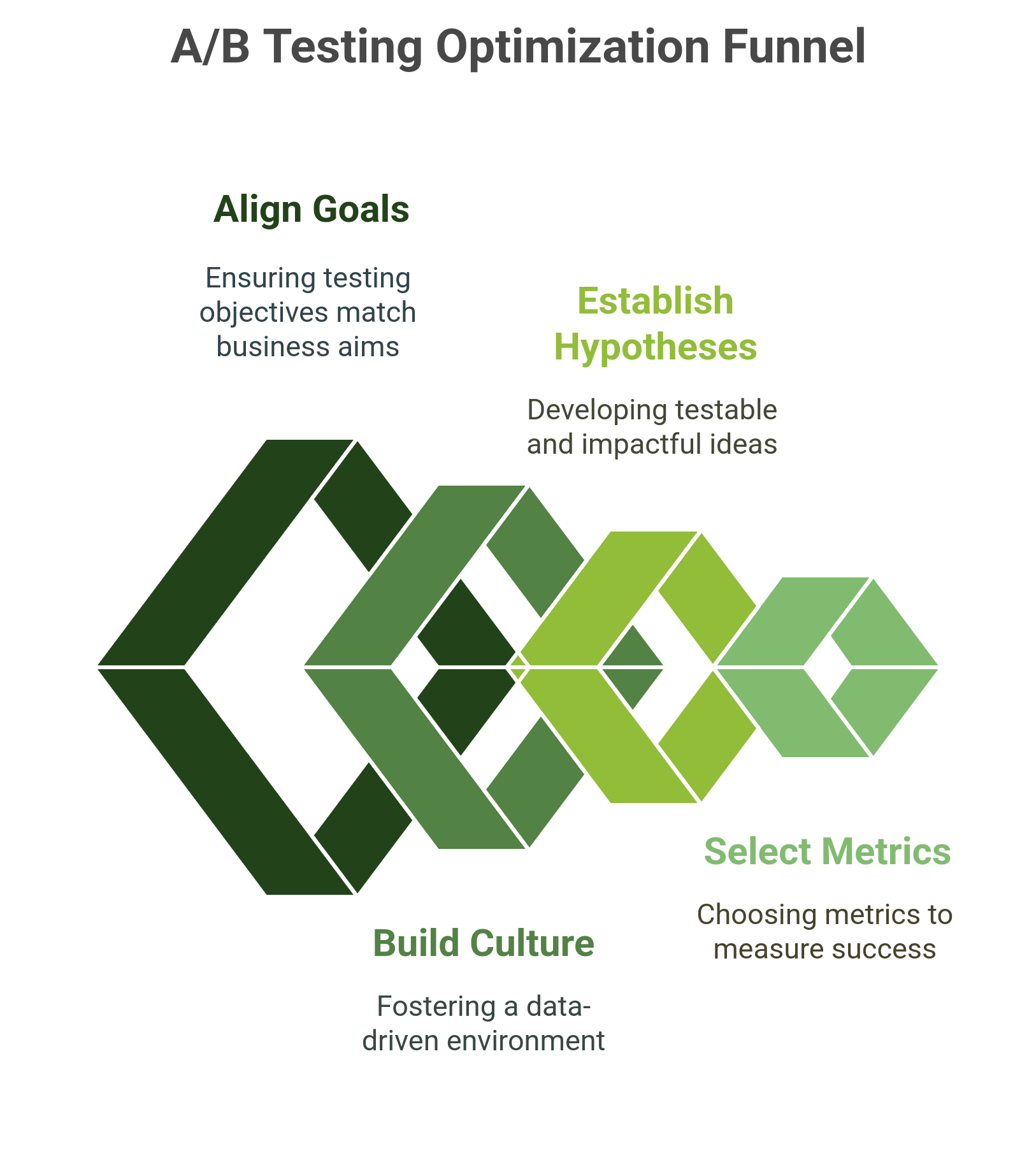
Aligning A/B Testing Goals with Broader Business Objectives
Every A/B test should serve a purpose that ties back to your organization’s overarching goals. Whether it’s increasing conversions, improving user retention, or boosting engagement, the objectives of your experiments should align seamlessly with your strategic priorities. Start by asking:
What business challenge are we trying to address?
How will the results of this test contribute to our growth?
For example, if your business goal is to enhance customer lifetime value, your A/B tests might focus on optimizing onboarding flows or improving upsell opportunities. When your testing goals reflect your broader objectives, the insights you gather will have greater relevance and impact.
Building a Data-Driven Culture
A successful A/B testing strategy thrives in an environment that prioritizes data over assumptions. Building a data-driven culture involves:
Collecting Quality Data: Ensure you have robust tracking mechanisms in place to gather user behavior data across touchpoints. Tools like Google Analytics, Mixpanel, or dedicated A/B testing platforms are invaluable here.
Making Data Accessible: Share insights across teams so everyone—from marketers to product managers—can collaborate and act on findings.
Encouraging Curiosity: Foster a mindset where teams continuously question the "why" behind user actions and seek evidence-based answers.
When data drives decisions, you eliminate guesswork and set the stage for meaningful experimentation.
Establishing Clear Hypotheses
A well-defined hypothesis is the cornerstone of any effective A/B test. Without one, your experiments risk becoming aimless trials rather than structured investigations. To frame testable and impactful hypotheses, follow these steps:
Identify the Problem: Pinpoint a specific challenge or bottleneck in the user journey. For instance, “Users are dropping off at the checkout page.”
Propose a Solution: Based on data or user feedback, suggest a change that could address the issue. Example: “Simplifying the checkout form will reduce friction.”
Define Expected Outcomes: Clearly state the result you expect to see if the change is successful. Example: “Reducing form fields will increase completed checkouts by 10%.”
A clear hypothesis not only guides your test design but also ensures that results are actionable and tied to specific improvements.
Selecting the Right Metrics to Measure Success
Metrics are the compass that guides your A/B testing journey. Choosing the right ones ensures you’re evaluating what truly matters. Here’s how to identify the most relevant metrics:
Tie Metrics to Goals: Ensure your metrics reflect the desired outcome of the test. For example, if your goal is to improve engagement, track metrics like click-through rates or session duration.
Focus on Primary and Secondary Metrics: Your primary metric is the main outcome you want to measure (e.g., conversion rate). Secondary metrics provide additional context (e.g., average order value, bounce rate).
Avoid Vanity Metrics: Be wary of metrics that look good on paper but don’t provide actionable insights, like total page views without a clear connection to your goals.
Best Practices for Designing A/B Tests
Designing effective A/B tests requires precision and a thoughtful approach. A well-structured test not only yields meaningful insights but also ensures that your results are reliable and actionable. Below are the best practices to follow when designing your A/B tests:
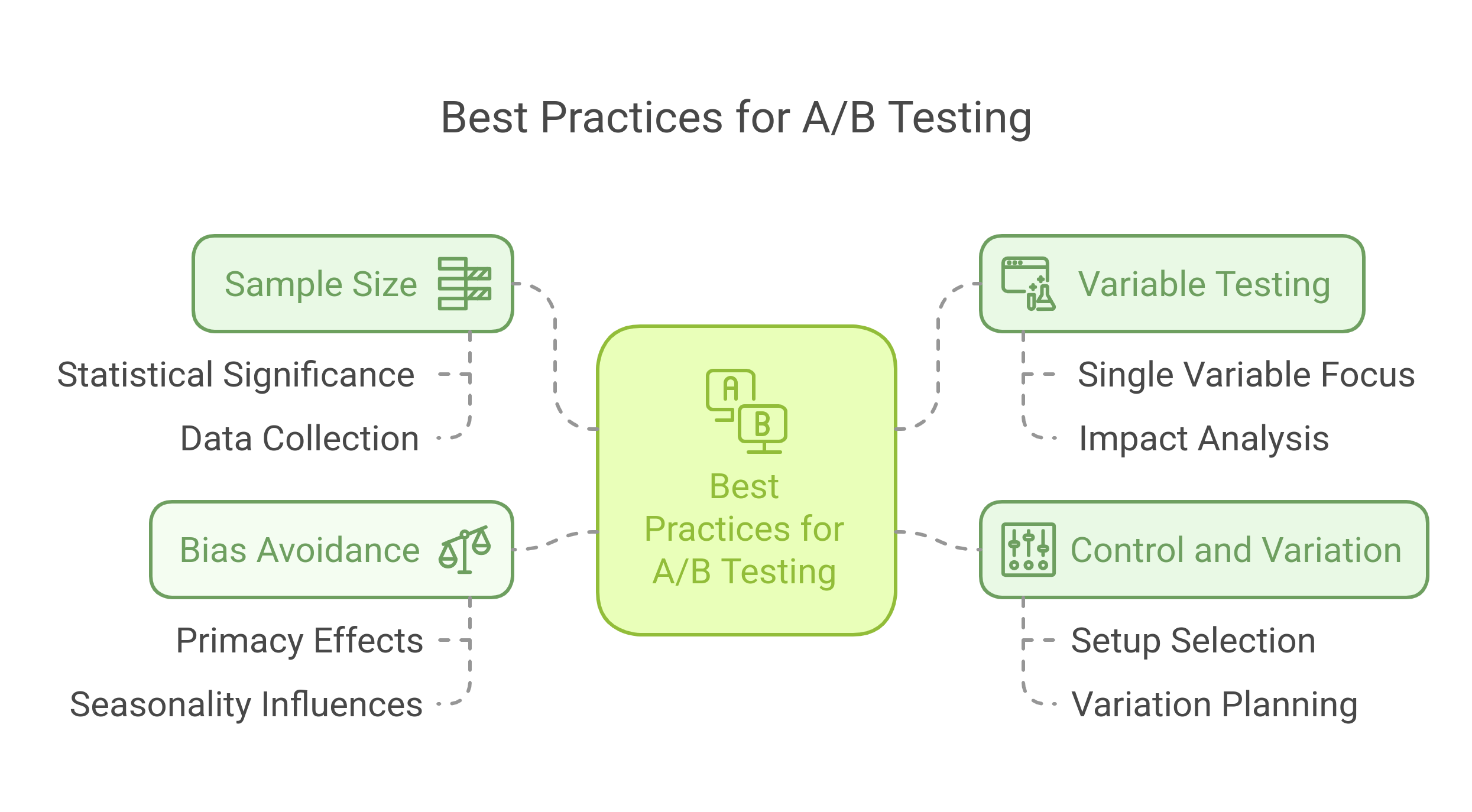
Ensuring a Solid Sample Size for Statistical Significance
One of the most common pitfalls in A/B testing is drawing conclusions from too small a sample size. To confidently determine whether a variation performs better than the control, you need enough data to achieve statistical significance.
Why It Matters: Without adequate sample size, you risk making decisions based on noise rather than meaningful patterns.
How to Calculate It: Use an online sample size calculator or tools integrated into A/B testing platforms. Input variables like baseline conversion rate, expected uplift, and confidence level to estimate the required sample size.
Avoid Cutting Tests Short: Even if you see early trends, ending a test prematurely can lead to false positives or negatives. Patience is key to gathering robust insights.
Testing One Variable at a Time to Isolate Impact
To truly understand what drives a change in performance, test one variable at a time. This isolates the impact of a single element and avoids confusion over what caused the observed effect.
For Example: If you’re testing button text, changing the color, size, and wording simultaneously makes it impossible to determine which adjustment influenced user behavior. Instead, test variations of one aspect—such as “Buy Now” vs. “Get Started”—before moving to other elements.
When to Use Multivariate Testing: While single-variable tests are ideal for clarity, multivariate testing can be used when you want to assess the combined impact of multiple changes. However, it requires a much larger sample size to achieve meaningful results.
Choosing Control and Variation Setups Wisely
A thoughtful control and variation setup is essential for reliable testing outcomes.
The Control: This is your baseline experience, representing the current version that users interact with. Choose a control that reflects the status quo to measure the true impact of changes.
The Variation(s): These are the adjusted versions you’re testing. Ensure the variations are meaningfully different from the control to avoid insignificant outcomes. For example, testing subtle changes like moving a button a few pixels may not yield actionable insights.
Balanced Randomization: Ensure users are randomly assigned to control and variation groups to minimize selection bias and maintain test validity.
Avoiding Common Biases and Pitfalls
Even the most carefully designed A/B tests can fall prey to biases that skew results. Be mindful of these common challenges:
Primacy Effects: When testing elements like navigation menus or product listings, users often gravitate toward items placed at the top. Consider rotating the order to account for this bias.
Seasonality Influences: Test results can be affected by timing factors like holidays, sales periods, or weekdays vs. weekends. Plan tests during typical business cycles for more reliable insights.
External Factors: Watch for unexpected changes (e.g., a competitor launching a major campaign) that could influence user behavior during your test period.
Continuous Optimization Through Iterative Testing
A/B testing is not a one-and-done process—it’s an iterative cycle where each test builds on the insights of the last. By embracing this mindset, businesses can drive ongoing improvements, adapt to changing user behaviors, and maximize the impact of their optimizations. Here’s how to sustain momentum through continuous iteration:
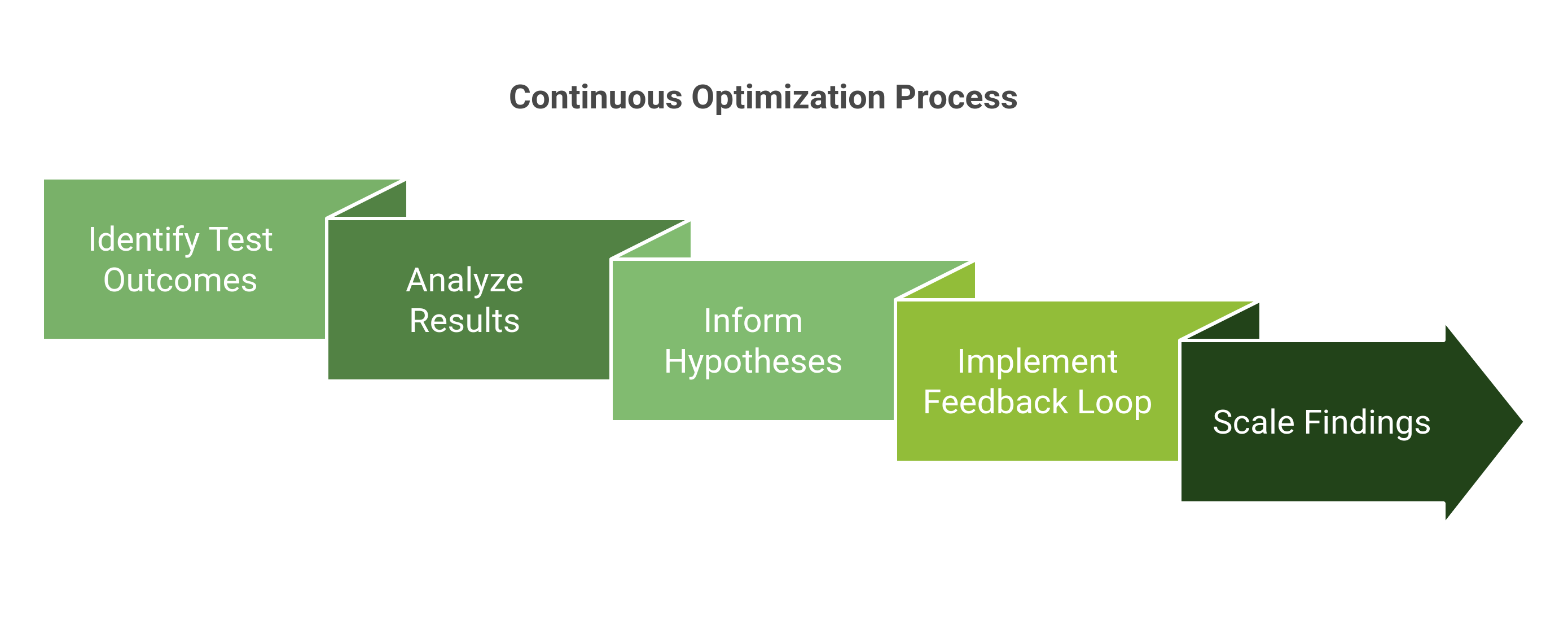
Importance of Learning from Both Winning and Losing Tests
Every A/B test, whether it produces a "winner" or a "loser," is an opportunity to learn.
Winning Tests: When a variation outperforms the control, the results validate your hypothesis and provide actionable insights into what resonates with your audience. But don’t stop there—ask why it worked and consider how to apply the underlying principle to other areas of your digital experience.
Losing Tests: A failed test is not a failure; it’s a step toward improvement. Losing tests reveal what doesn’t work, saving you from implementing ineffective changes. Analyze these results to refine your understanding of user behavior and craft more informed hypotheses for future tests.
Every outcome—positive or negative—adds to your repository of knowledge, helping you make smarter decisions over time.
Using Results to Inform Subsequent Test Hypotheses
The true power of iterative testing lies in using the findings from one experiment to shape the next. After analyzing test results, ask:
What did we learn? Did the test confirm or disprove your hypothesis? What new user behavior patterns emerged?
What’s next? Use these insights to design follow-up experiments that dig deeper into user preferences. For example, if a headline change boosted clicks, your next test might explore tone variations or accompanying visuals.
By letting data drive your next steps, you ensure that each test builds on previous learnings, creating a snowball effect of continuous improvement.
Implementing a Feedback Loop for Ongoing Ideation and Experimentation
To keep your testing program dynamic, establish a feedback loop that fuels a constant stream of new ideas and experiments. Here’s how:
Cross-Team Collaboration: Encourage teams—marketing, product, UX, and data analytics—to share observations and insights. A diverse range of perspectives can spark innovative test ideas.
Regular Retrospectives: Periodically review past tests to identify patterns and recurring themes. This practice ensures lessons learned are not forgotten and can inspire fresh hypotheses.
Incorporating User Feedback: Combine A/B testing results with qualitative insights from user surveys or usability tests to form a more holistic understanding of your audience.
A well-oiled feedback loop not only keeps your testing strategy alive but also ensures it evolves alongside user behavior and business goals.
How to Scale Findings to Similar Campaigns or Audiences
Scaling is where the real magic happens—taking what you’ve learned and applying it across other campaigns, platforms, or user segments. Here’s how to do it effectively:
Segment-Specific Insights: Analyze whether the results of your tests apply universally or are specific to a particular user group. For instance, a test that worked well for mobile users might need adjustments for desktop users.
Replicating Success: If a certain change drives results in one campaign, roll it out across similar campaigns. For example, a successful email subject line test can inform future email campaigns or even social media copy.
Testing at Scale: Before fully implementing a change based on one test, validate it with a broader audience to confirm its effectiveness across different segments or geographies.
Automating Learnings: Use tools and platforms to automate the rollout of successful experiments. Many A/B testing platforms can deploy winning variations across your digital assets seamlessly.
Leveraging Advanced Techniques for Better Results
As your A/B testing program matures, incorporating advanced techniques can unlock deeper insights and deliver even greater results. These methods allow you to tackle complex scenarios, refine your strategies, and stay ahead in a competitive landscape.
Multi-Variate Testing for Complex Scenarios
While A/B testing focuses on comparing two variations, multi-variate testing (MVT) allows you to test multiple elements simultaneously. This is particularly useful when you want to understand the combined impact of various changes.
How It Works: In MVT, you test combinations of changes (e.g., headline, image, and CTA) to determine which combination performs best. For instance, if you’re testing three headlines and two images, you’ll evaluate all six possible combinations.
When to Use: Use multi-variate testing when you have sufficient traffic to support testing multiple variations without compromising statistical significance.
Benefits: MVT helps uncover interactions between different elements, giving you insights into how changes work together rather than in isolation.
Sequential Testing to Refine Winning Variations
After identifying a winning variation in an A/B test, it’s often tempting to implement it immediately. However, sequential testing can help you refine and validate that variation further.
How It Works: Sequential testing involves running follow-up experiments that build on the insights from your original test. For example, after finding a winning CTA button color, you could test variations of the button text to further optimize performance.
Why It Matters: This iterative approach ensures that your optimizations are not just effective but also comprehensive. It minimizes the risk of leaving additional opportunities for improvement untapped.
Incorporating Personalization Within A/B Tests
Today’s audiences expect tailored experiences, and personalization can significantly enhance the effectiveness of A/B testing. By segmenting your audience and delivering targeted variations, you can better cater to diverse preferences.
Segment-Based Testing: Divide your audience into meaningful segments based on demographics, behavior, or purchase history. For example, test different landing page designs for first-time visitors versus returning customers.
Dynamic Personalization: Use tools that allow you to dynamically adjust content within your A/B tests based on user attributes (e.g., location, device type, or past interactions).
Benefits: Personalization ensures that your experiments are not “one-size-fits-all,” leading to more relevant experiences and higher engagement across different audience groups.
Identifying High-Impact Test Opportunities
Advanced technologies like predictive analytics and AI are transforming A/B testing by identifying where to focus your efforts for maximum impact.
Predictive Analytics: By analyzing historical data and user behavior trends, predictive analytics can highlight key areas of your digital experience that are ripe for optimization. For example, it might identify a checkout process bottleneck where users frequently drop off, signaling an opportunity for testing.
AI-Powered Experimentation: AI tools can automatically generate and prioritize test ideas based on patterns in user data. They can also predict which variations are most likely to succeed, helping you allocate resources more efficiently.
Real-Time Adaptations: Some AI-driven platforms can adapt variations in real time based on user interactions, effectively combining the power of A/B testing and personalization.
Tools and Technologies to Streamline A/B Testing
Effective A/B testing doesn’t just rely on strategy—it requires the right tools and technologies to streamline the process, ensure accuracy, and deliver actionable insights. Here’s how to evaluate and leverage tools to maximize your testing efforts:
Overview of Key Features to Look for in A/B Testing Tools
Not all A/B testing platforms are created equal. When choosing a tool, prioritize features that align with your goals and simplify your workflow:
Ease of Use: Look for a user-friendly interface that allows marketers, product managers, and developers to collaborate effortlessly.
Robust Targeting Options: The ability to segment audiences based on behavior, demographics, or custom attributes ensures your tests are highly relevant.
Comprehensive Analytics: Advanced reporting capabilities, such as real-time tracking, statistical significance calculators, and breakdowns by audience segment, are essential for actionable insights.
Cross-Platform Testing: Tools that support testing across web, mobile, and email channels allow you to optimize the entire user journey.
Integration Capabilities: Seamless integration with existing tools, such as Google Analytics, CRM systems, or customer data platforms (CDPs), enhances data consistency and collaboration.
Examples of popular tools include fragmatic and Google Optimize, each offering a range of capabilities to meet diverse testing needs.
Benefits of Integrating Testing Platforms with Customer Data Platforms
Customer data platforms (CDPs) serve as a centralized hub for collecting, organizing, and analyzing user data. Integrating your A/B testing tool with a CDP unlocks several benefits:
Enhanced Segmentation: Leverage rich customer data to create highly specific audience segments, such as high-value customers or dormant users.
Unified Insights: Consolidating testing data with broader customer data provides a holistic view of user behavior, making it easier to spot patterns and trends.
Personalized Testing: CDP integration enables dynamic personalization, allowing you to test variations tailored to individual user profiles for maximum impact.
Faster Iteration: Access to real-time, unified data reduces delays and accelerates the testing and optimization cycle.
By linking your A/B testing platform with a CDP, you transform raw data into actionable insights that fuel smarter testing and more effective decision-making.
The Role of Automation in Scaling Tests and Analyzing Results
As your testing strategy grows in complexity, manual processes can become a bottleneck. Automation helps scale your efforts while ensuring consistency and efficiency:
Test Deployment: Automated platforms allow you to schedule, deploy, and monitor multiple tests simultaneously across different touchpoints.
Dynamic Adjustments: Some advanced tools use machine learning to adapt variations in real time based on user behavior, combining automation with personalization.
Faster Analysis: Automated statistical calculations ensure results are accurate and delivered promptly, freeing up time for deeper strategic analysis.
Prioritization of Tests: AI-driven tools can suggest which tests to run first based on potential impact, saving you the guesswork of prioritization.
Automation not only accelerates your testing processes but also minimizes errors, allowing teams to focus on strategic improvements rather than manual tasks.
Conclusion
A/B testing is one of the most powerful tools for driving growth and improving digital experiences. By testing iteratively, learning from results, and scaling successes, you can create a culture of continuous improvement that adapts to user needs and market dynamics. In a fast-paced digital landscape, the ability to test, learn, and iterate quickly is a competitive advantage. A/B testing empowers businesses to move beyond assumptions and make data-driven decisions that directly impact growth and user satisfaction. Start small—choose one element to test, analyze the results, and build on those insights. Over time, expand your testing program, embrace advanced techniques, and evolve your strategies to keep pace with user expectations. The key to success lies in continuous improvement—so experiment, learn, and grow!