Introduction
The line between personalization and intrusion seems to be almost invisible in today's data-driven marketing world, where every click, scroll, and form submission can be harvested, analyzed, and transformed into marketing opportunities. Corresponding to this unprecedented access to private information, however, is a responsibility that cannot be ignored-that of ethical marketing. The touchstone here is not compliance with laws like GDPR or CCPA, but rather the application of data ethics principles in the strategies to ensure that they are not just profitable, but respectful of the people whom they serve.
Data ethics in marketing covers how people ethically collect, store, and use customer information. It asks marketers to go beyond the letter of the law and consider the broader implications of their actions - for customer trust, brand reputation, and societal impact. Data ethics definition may sound simple in definition, but it demands balancing giving insights for business growth against preserving the dignity and autonomy of every individual.
Brands that will dominate the next decade are not only the brands possessing a super-targeting algorithm, but also the brands whose consumers feel right trusting them. Data ethics just isn't extra versus understanding competition: It's part of a competitive advantage. For example, by "embedding ethics in the marketing decision at the outset," one can design programs that convert while creating long-term loyalty. That is how profitability and responsibility can bloom together, not necessarily contradictory.
What is the Real Purpose of Data in Marketing?
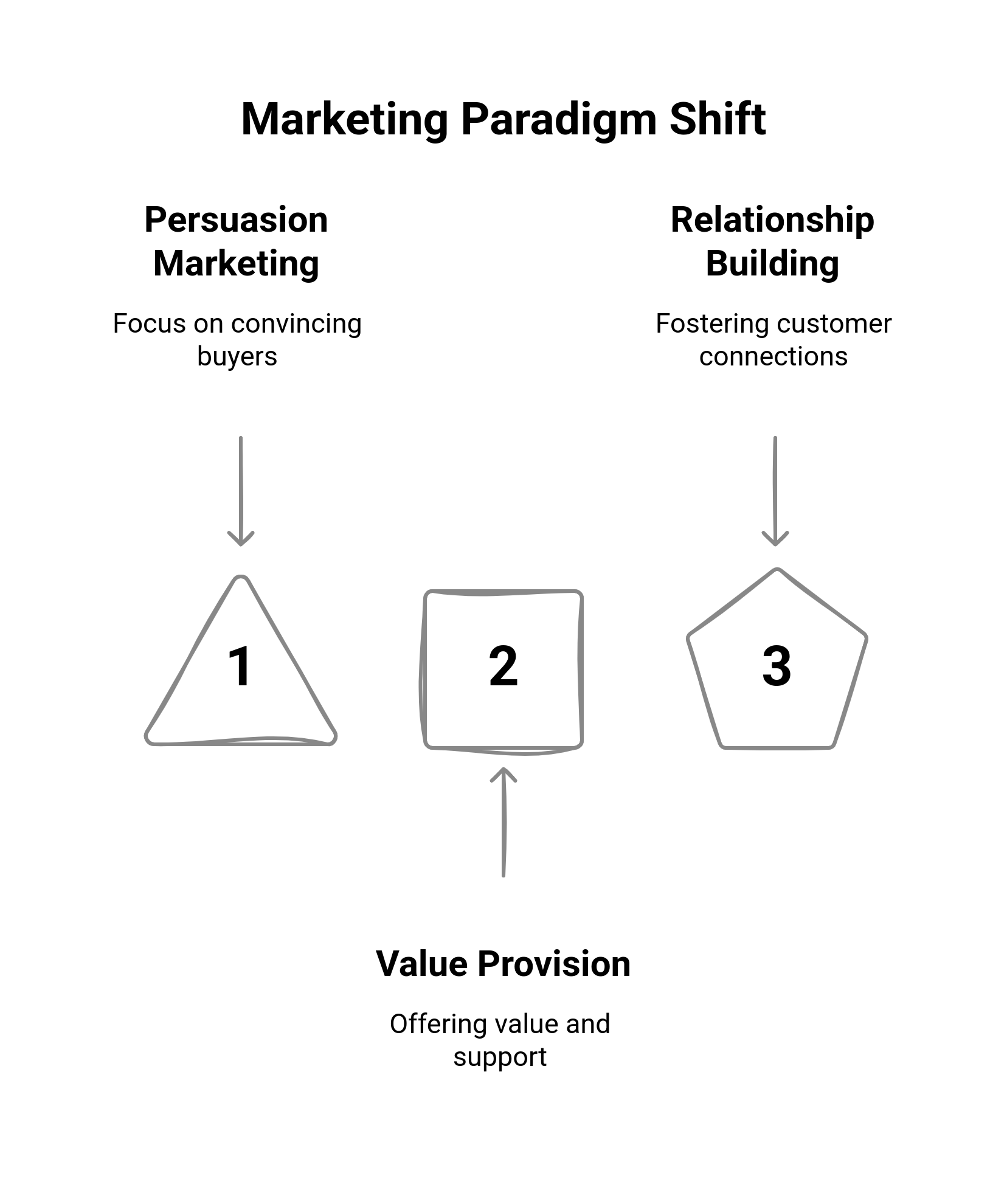
Data is more than a random heap of numbers dumped in the corners of some analytics dashboards; it is the foundation for making decisions on a sound footing. In marketing, its real purpose is to relieve uncertainty, provide intelligent strategic choices, and allow brands to legitimately create value for their audience. This section examines how value systems shifted within marketing, from the persuasion paradigm of marketing to service-centric marketing, and why building trust through ethical data practices leads more towards sustainable profitability than rewarding short-term gains with aggressive collection tactics.
Data as a Tool to Reduce Uncertainty
To put it bluntly, the key to marketing data becomes taking away the guesswork towards some sordid actions. Otherwise, brands would be quite literally flying blind on all fronts: instinct, assumption, and the old-time playbook of customer behavior. The moment data collection is put into effect while keeping data ethics at the forefront, that becomes the lighthouse steering towards predictive acceptance. For example, a review of engagement patterns might tell marketers what messages resonate most with segments so they can better direct their budgets to areas where it counts.
And this element of ethics is vital. A marketer pursuing every possible data point without a thought for why they’re collecting it will, in so doing, create a Gmail inbox nobody wants to use — an inbox rife with privacy-violating offers and an avalanche of marketing messages that totally miss the target. An ethical march will offer some discipline: gather only that which you truly need to gain insight into serving your customers better. Thus, it contributes to the smooth and fast working of your people. It buys confidence in your customers that you respect their privacy—an extremely powerful differentiator in markets stamped with intense competition.
From Persuasion to Service
In yesteryears, marketing was primarily about manipulation through well-crafted messages directed to prospective consumers. While it will always hold a place, persuasion in modern times gives way to a service-first approach so that brands can use customer insights to forecast needs, eliminate friction, and offer value to customers even before a transaction takes place. This is the moral aspect of marketing to use data for service rather than manipulation.
Looking at a SaaS entity that utilizes behavioral data. It would be one thing to reach out when they visualize a customer struggling with a feature to send a generic upsell email, but they would rather take the initiative by sending a how-to guide and setting up a one-on-one walkthrough. That is marketing as service-and that is good ethics in marketing-focused on what's best for the customer. Service-driven marketing increases loyalty and becomes a foundation for revenues in the future.
The Trust Gap in Personalization
Data relating to the way brands are doing things could improve customer experiences; however, there exists a deep-seated distrust between the brands and their consumers. The research done by McKinsey tells us that 71% of consumers are frustrated when their shopping experience is impersonal, yet this should be relatively easily mended with personalization. Paradoxically, 63% will refrain from buying from brands that utilize bad personalization. Essentially, getting personal wrong hurts worse than not getting personal at all.
Why? Bad personalization was borne from overzealous, unclear, and downright negligent data collection. Customers probably don't mind their personal data being used for creating real value; they just object to it when it seems intrusive or random. Such perfectly explains why understanding the very importance of data ethics is a non-negotiable. In an overpopulated market, those brands that are truly dressed in optimism while clear on what they do with the data they have, collecting only what is necessary and ensuring that every personalized touchpoint actually provides some value, will come out on top. Over time, that trust will convert indifferent buyers into loyal supporters and turn data from a transactional asset into a relationship-building tool.
How Marketers can go beyond the Illusion of consent in data collection
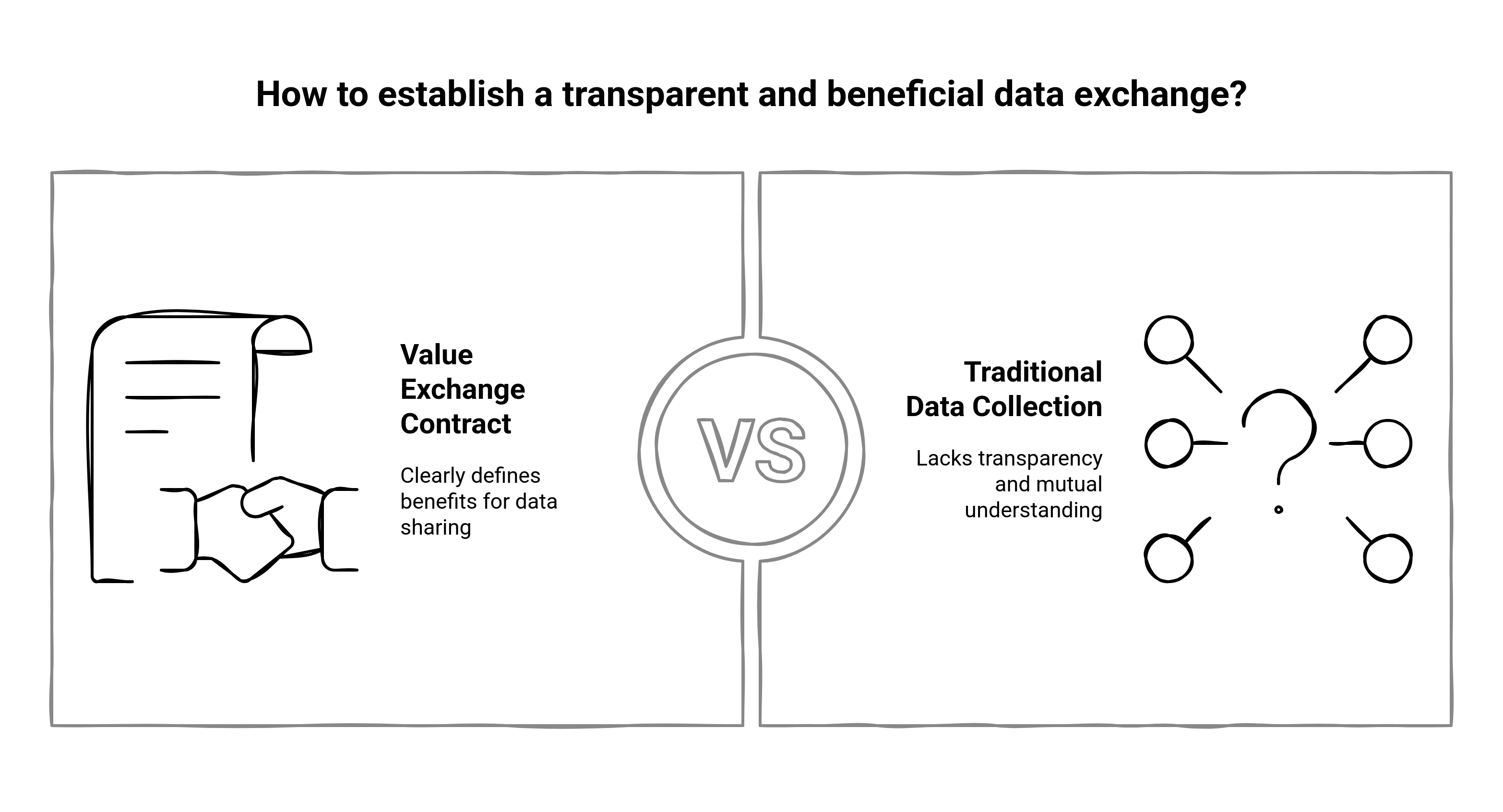
This section elaborates on why consent — commonly perceived in practice as merely the box to check, collect, store, and forget about — is more than a legal formality. It outlines how marketers can create true user understanding through a real, legally enforceable "value exchange contract" respectful of customer autonomy instead. Further, exemplary ethical and transparent data practices are highlighted, shifting control back to users while still facilitating impactful marketing.
The Problem with Checkbox Consent
The notion that checking a box equals informed consent has long been an underpinning of online marketing. But the truth is, for the most part, that consent is an illusion to users. Most users tend to click "I agree" without even reading what they are agreeing to, just to get to the content. It is difficult enough to read the boilerplate legal jargon of the privacy statements. However, privacy statements and terms of service rarely resemble a real-world conversation between the brand and the customer.
That disconnect is not a figment of their imagination. As per a recent survey, 63% of worldwide consumers feel that most companies are not transparent about how their data is used, while 61% of U.S. respondents agree that privacy policies do not explain this. This is an alarming trust deficit — one affecting the extent to which brands could authentically build lasting relationships. In ethical marketing, consent must not only aim at meeting legality. It ought to be a mutual understanding into which the customer enters with absolute knowledge of what is being collected, for what reason, and how it works for him.
Introducing the “Value Exchange Contract”
Reframing data collection as a kind of value exchange contract is one way to escape the mirage of consent. The idea is simple: with every specific data point that a brand asks for, there should be clarity in what value the customer gets in return. This is where data ethics caveats become practical and tangible.
- For example, if a retailer were to ask for the purchase history of the customer, the value stated would be personalized product recommendations or perhaps exclusive discounts available to members. If a SaaS platform could provide a request for browsing behaviour information, the counterpart value could be a more tailored onboarding experience that moves the user more quickly toward achieving their goals.
This is how consent turns from a passive acceptance into an active choice: the user does not just give away information because it will be needed, but they willingly share it because they see the benefit right there and then. It's an ethical and mutually advantageous arrangement in keeping with the reason data ethics remains critical to modern marketing.
Examples of Transparent and Respectful Data Practices
Transparency shouldn't be complicated: in fact, the simplest way works wonders. Short, clear pop-up description of what data is being collected and for what reasons, in real time, is now used by some brands.
- For example, "We track your page visits so we can recommend the right resources when you are using the service." Other brands give their customers dashboards to view, edit, or delete the data captured by the brand, thus giving a sense of control rather than surveillance.
- Another example is context-based opt-ins. Instead of being buried in deeply set-up settings, a travel site would now ask for access to the location at the moment a user wants recommendations for a place nearby. Such an in-the-moment request feels much more organic, respectful, and holds a higher chance of true consent.
Hence, brands can superimpose ethical marketing strategies into the perceived whole “understanding” behind their marketing efforts instead of “tracking,” which is such a strong differentiator for future trust and loyalty.
Understanding the Hidden Costs of Unethical Personalization

Unethical personalization has far-reaching repercussions, going far beyond fines imposed by regulations such as those under GDPR. This section will delve into the often-ignored business ramifications-from trust erosion and customer churn to long-term brand damage. We'll also unpack the idea of "negative personalization," where either bad data or badly designed algorithms actively alienate customers and explore how weak data ethics can affect business intelligence for very expensive strategic missteps.
The True Price of Lost Trust
Undoubtedly, the greatest penalty for unethical personalization is not borne from monetary fines but from the loss of trust. Trust is a non-renewable resource in marketing; once lost, it becomes almost impossible to restore. Consumers are quick to abandon brands that seem overbearing, manipulative, or careless with their data. In the long run, this continues to add up to customers lost not only from those directly affected, but also from those hearing about the brand's situation through SMM or word of mouth.
Ethical marketing practices should offer personalization as a service and not as surveillance. Otherwise, it will damage the very loyalty it is trying to build. Brands that ignore data ethics principles might be able to generate revenues in the short run by means of a hyper-targeted campaign, but over time, the loss of credibility that will ensue will soon outweigh whatever gains have been made. Hence, data ethics becomes more than a moral argument as it becomes a business case.
Negative Personalization: How Data Works Against You
Not all forms of personalization are positive; actually, negative personalization happens when irrelevant, tone-deaf, or even offensive experiences arise from bad data or bad algorithms. Imagine a consumer buying something and then finding repeated advertising on the very article that he has just purchased, or worse, a person who finds recommendations linked with a painful event in his life. Those experiences are not only a failure in conversion; rather, they push customers further away.
Mostly, negative personalization is produced out of bad data hygiene, isolated systems, or dependence on algorithm-based decision-making with little or no human oversight. Here, the view of personalization as a cost rather than an asset illustrates that there are ethical safeguards that must be maintained not just for compliance but also in terms of relationships with customers.
How Bad Data Practices Undermine Decision-Making
Unethical personalization does not just infect relationships outside the organization; it even rots internal decision-making. Any marketing strategy that hinges upon incomplete, obsolete, or inaccurately collected data will yield erroneous intelligence. Executives begin making life-and-death decisions based on patterns that do not exist or trends that are actually misrepresented due to biased or incomplete datasets.
For instance, a badly devised attribution model may mislead a marketing team into over-investing in a low-impact channel purely so that tracking consent has been acquired in a misleading way that produces incorrect engagement data. It creates a ripple effect whereby wasted budgets, failed campaigns, and flawed strategies are created in the way forward. Simply put, ignoring data ethics could risk public backlash, but it may also silently sabotage the entire growth strategy of a company.
Role of Data Ethics in Marketing: Balancing Personalization with Privacy
The major issue of Data Ethics in Marketing is the balancing of giving customers personalization with imposing an infringement upon their right to privacy. Just as personalized marketing has become a standard by which customers evaluate marketing methods, an equal burden lies upon the company to protect customer privacy. The section looks at data ethics principles that help marketers draw the line between personalization that engages and one that disrupts, and where ethically based marketing becomes a competitive advantage.
Why Data Ethics is the Foundation of Responsible Personalization
Without doubt, this is done by putting data into action; not all data doings, however, are equal. Most people with an ethical challenge in marketing confront a very dark area and do in suggestion under a veil that dissolves all trust, which is built up, shaken, and shattered. Data ethics mean that every decision that has to do with data collection and storage and usage has to be approached from the angles of honesty, necessity, and justice. This means every time any personalization is going to be put into action, difficult questions must be answered: Is this data really needed for us to create a personalized experience for our customers? Do we give full disclosure for why this data is being collected? Will the customer see some actual value in return for sharing their information with us?
When brands engage actively in ethical marketing approaches, they move out of the realm of compliance because they have actually earned the right to create true personalization that is welcomed by customers — experiences that feel like a well-thought-out service instead of mere digital surveillance. This not only meets customer expectations but also strengthens the brand image of being trustworthy and respectful.
Striking the Balance Between Relevance and Respect
The boundaries between personalization and privacy often hinge on how much is “too much.” The customers love recommendations, changing content, and offers based on their preferences but only so long as it is based on data they shared knowingly and willingly. Violation can even occur subliminally, requiring questionable assumptions from further down the chain, such as using inferred data from unrelated activities or joining data sources without explicit consent.
Striking a balance between personalization and privacy should involve conscious consideration- tracking only pertinent interactions, anonymizing data wherever possible, and never storing more information than is required. The marketers can maintain a higher level of trust from the user by integrating data ethics principles directly into the personalization workflow.
Examples of Privacy-Respecting Personalization
Some brands are redefining privacy-respecting personalization. For example, a fitness app would recommend workout sessions based on user input regarding goals or selected preferences rather than collecting info via GPS tracking without proper user consent. An e-commerce site might allow a "privacy mode" where customers could receive recommendations based only on their session activity without the system keeping track of their long-term browsing history.
These practices embody why data ethics is important in modern marketing: they show that personalization and privacy do not fight against each other but are complementary in building a healthy relationship with the customer. Understandably, the right way is expected to empower marketing through ethical practices that make relevant and respectful experiences, thus developing loyalty and increasing brand appeal.
Building an Ethical Data Framework That Drives Profit
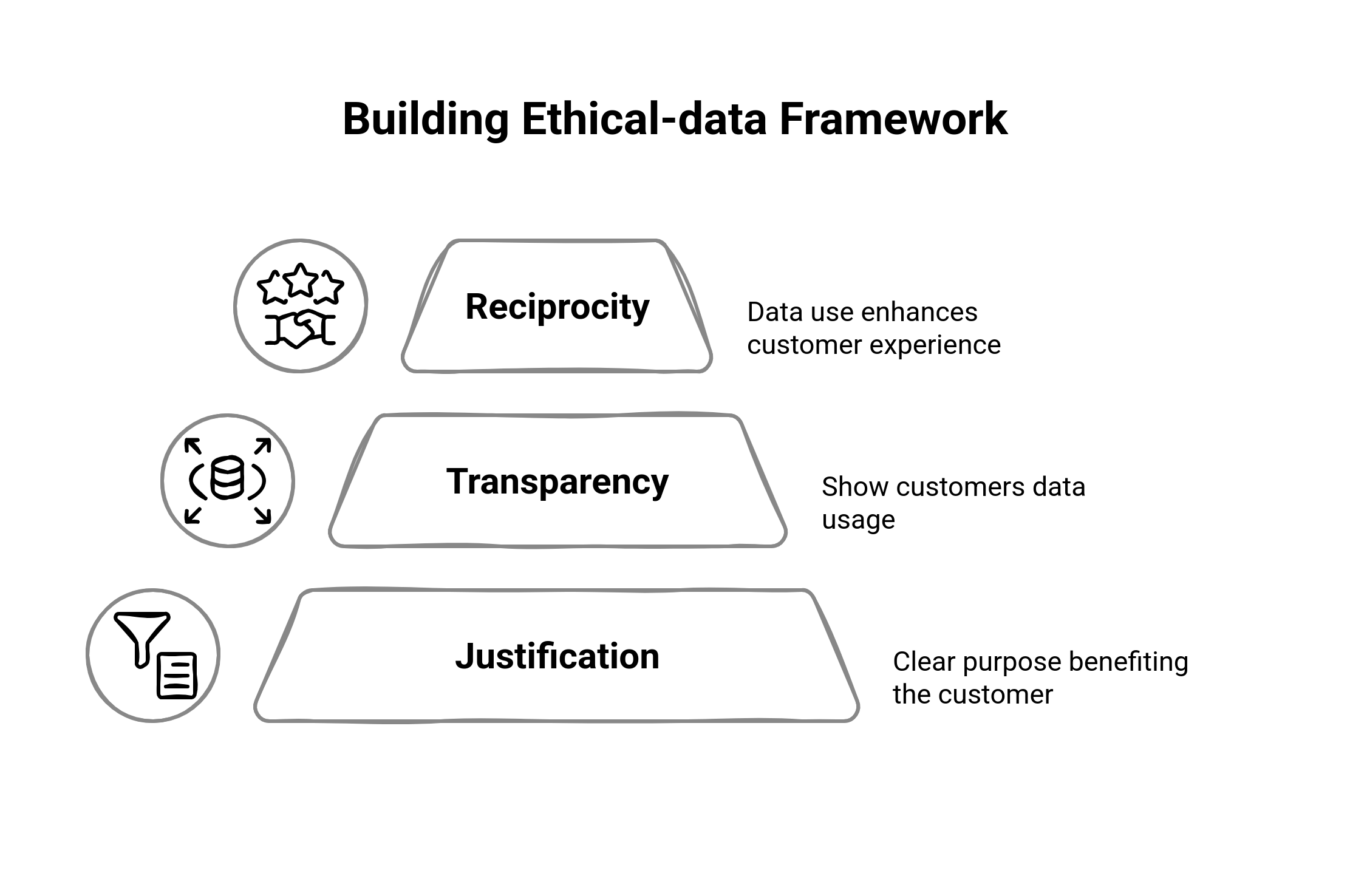
A profitable data strategy starts with restraint, clarity, and value creation. This section lays the groundwork for a practical application: one based on data ethics principles of justification, transparency, and reciprocity, cursorily enabling your personalization to be precise, compliant, and trustworthy. The ethics in marketing take a leap from an abstract notion to an operating system for growth.
Principle of Justification: Collect only that which creates value for the customer
Every data point you collect must have a clear, justifiable purpose that benefits the person behind it. This is the foundation of ethical marketing because it ties collection to outcome, not curiosity.
Implementation Details Steps:
Write a purpose statement for each field: For every attribute (industry, role, last active date), define (a) why it is needed, (b) how it improves the experience, and (c) what feature or decision it powers. If you cannot do all three, do not collect this attribute.
Decision Matrix for Data Mapping: Develop a data-to-decisions matrix that directly ties inputs to actions (e.g., Role → selects onboarding path; Plan tier → shows relevant limits). This reduces ambiguity, avoids data hoarding, and enables swifter actions.
Just Minimize and Expire: Apply the slightest scope (i.e., session-level vs. identity-level, if applicable) and set TTL (time-to-live) for sensitive fields. Stale data is both an ethical liability and an attack on negative personalization.
Just-in-time Capture: Get the data when it is needed (i.e., location requested only when showing nearby options). Doing so is in the customer’s workflow, thus increasing the quality of consent.
An example: A B2B SaaS wants to collect company size. Justification: "We use this to recommend the correct onboarding template and quota defaults." Without that association with a concrete benefit, this field is removed.
Why this drives profit: Less noise → better models → fewer irrelevant messages → higher conversion and lower CAC. You also cut storage and governance costs by not stockpiling unused data.
Principle of Transparency: Show what you know and how you use it
Transparency is a practice that applies to data ethics to make data visible; it makes sure data is understood, and even the things that the data does give control to the user. It shifts from just accepting a statement to engaging the leadership to make a proper decision to reach an established agreement.
How to implement:
A user-centric data dashboard. Here, a simple view of the individual's profile would have details on (1) data the system is storing, (2) where it came from, and (3) what it powers in clear (example: "We use your role to tailor onboarding") ways, and switches for editing or deleting data.
Layered explanations, starting from the most concise and plain and edging towards the complex, offer the option to learn more. Replace jargon (e.g., “processors,” “legitimate interest”) with task-level phrasing (“Helps us suggest the next best step”).
Contextual prompts. At the point of collection, explain the value: “Share your role to customize the setup in under 2 minutes.” Include duration (“kept for 12 months”) and scope (“only used for onboarding and support”).
Change logs & alerts. If data use expands (new feature, new destination), notify users and request re-consent where appropriate. A small banner—“We now use product usage to personalize tutorials”—builds credibility.
Preference centers that actually work. Granular toggles for channel (email, in-app), frequency, and content categories. Honor choices everywhere—no shadow retargeting.
Example dashboard copy: “Your data at a glance: role (you provided), plan
Why it is good for business: Lower opt-out rates and complaints bolster high-quality opt-ins and brand equity. When the customer understands the value of the exchange, he/she is more open to personalization and an upsell opportunity.
Principle of Reciprocity: Return clear value for the data you request
Reciprocity answers the fundamental question of data ethics regarding the customer today—"What Do I Get For The Data That I Share?" This cements the relevance of data ethics by attaching it to concrete benefits.
How do you apply it?
Value statements per attribute. Each requested field states the direct value it creates for the user: "Job role → you get role-based templates," "Tech stack → you get integration checklists," "Purchase history → you get refill reminders."
Immediate exchange. Instant utility is granted as a reward for sharing: the unlocking of a guided setup, pre-filled forms, or a related checklist on the same screen as the consent granted.
Progressive profiling. Start with the bare minimum; gain more over time by providing a continual flow of value. Each field gained should immediately translate into an observable increase in value (e.g., an advanced dashboard, smarter alerts).
Proportionate value exchange. The sensitive nature of the field requires a proportionately higher increase in value. Example: Share your revenue range to unlock premium benchmarks and ROI forecasting—not just generic tips.
Measure perceived value. Put a one-click "Was this helpful?" button after every personalized action. Review the value exchange again if thumbs-down increases, as the model might be optimizing for you and not for them.
Example: E-commerce asks you for style preferences and instantly creates a capsule wardrobe with mix-and-match recommendations, discounted bundles, and "buy the look" shortcuts—terrific value for minimal data.
Why this is profit-driving: When customers feel like they've profited, they stay opted in, deepen engagement, and convert quickly. Reciprocity turns ethical marketing into a growth enabler rather than a constraint.
Joining it all together: An easy cadence of operation
- Define: Make a list of what data you would like to collect. Write, for each, a justification, a transparency copy, and a reciprocity benefit.
- Design: Create the data-to-decision matrix and the user-facing data dashboard. Add contextual prompts at every capture point.
- Deliver: The launch should be done through progressive profiling and immediate payoff. Start with a single high-impact journey for which personalization adds the most value (say, onboarding or checkout).
- Govern: Set TTLs, access controls, and audit logs. Review data fields on a quarterly basis and delete those that do not pass the test of justification anymore.
- Validate: Measure value perception and outcome metrics; tweak whenever personalization drifts into the realm of intrusiveness.
Metrics linking ethics to revenue
- Consent quality rate: % of opt-ins retained after 30/60/90 days (signals informed, durable consent).
- Data minimization index: Ratio of used fields to stored fields (aim high).
- Personalization lift: Uplift in activation, CTR-to-conversion, or time-to-value for opted-in users vs. control.
- Trust indicators: Preference-center engagement, data dashboard visits, complaint rate per 1,000 users.
- Churn & LTV deltas: Compare cohorts with transparent, value-backed personalization vs. generic messaging.
How Marketing Algorithms Perpetuate Bias
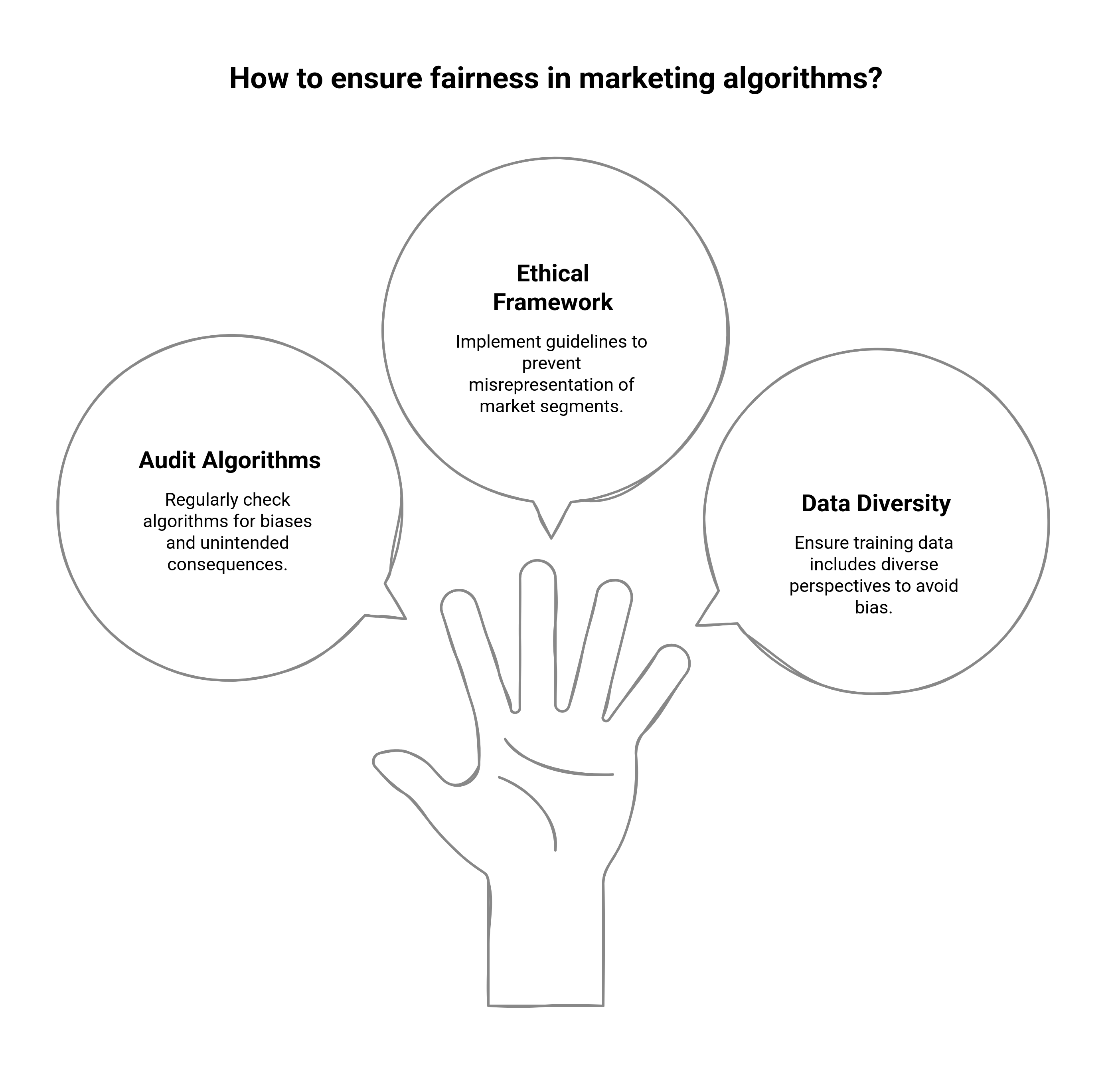
It is as good as saying that Algorithms are very much marketed to be objective data-driven solutions, but they generally mirror the bias found in the data from which they are trained and, on occasion, amplify it. This section deals with how historical data can reinforce societal inequalities, what ethical and business risks biased targeting poses, and the first steps for marketers to audit their algorithms for fairness and unintended effects. Principles of data ethics can thus empower brands to avoid having bias destroy trust and profitability.
The Bias Lap from Historical Data
Fair algorithms depend on the quality of data. No matter if the subject biases refer to gender, race, geography, or income, marketing algorithms trained with historical datasets invariably incorporate these biases. If their previous marketing campaigns targeted men more for leader-and-executive-oriented products, the algorithm would tend towards that skew, not showing relevant ads to qualified female audiences.
Such bias is not mainly intentional but embedded in the patterns identified by machine learning models. In the course of time, those patterns can solidify into systemic exclusion, where huge segments of the population are neglected or misrepresented. The first step in ethical marketing is identifying this risk; after all, personalization should not be understood as an unintended form of discrimination.
Targeting Biases and Their Ethical and Business Risks
On a data ethics premise, algorithms that favor a specific group render the brands that have adopted them unmoved in terms of fulfilling the expectations of a growing customer base in fairness and inclusivity. But beyond the mere fictitious pureness of morality, there are commercial consequences. When certain demographic targets are disenfranchised from the possibility or put in a position to be misrepresentation, there is a reduction in the avenues of income that are being cut off from reaching new potential customers, dilution of the brand image, and the risk of generating backlash to the public when the bias shows.
The risk is even more to the reputation. Imagine an article revealing your ad targeting excluded systematically low-income neighborhoods or certain ethnic groups. Even if this happened unintentionally, however, the public story would be focused more on the harm and not the intent. Such is why data ethics is important far beyond compliance: it is about long-term market safety.
In some industries, though, the stakes are even higher. A financial services firm would have its marketing algorithm employing biased creditworthiness data and thus reinforce economic inequalities. Healthcare brands would face a negative result of deprioritizing at-risk populations from receiving important wellness campaigns. What follows? Losses of trust, regulatory scrutiny, and properly realized growth opportunities.
First Steps for Auditing Marketing Algorithms for Fairness
Eliminating algorithmic bias isn’t a one-off task — it’s an ongoing process of review, testing, and adjustment. Here’s where to start:
- Diversity in Training Data – Examine the demographic breakdown of your historical datasets. Are certain groups underrepresented? If so, your algorithm’s predictions and targeting decisions will mirror that imbalance.
- Segment-Level Performance Analysis – Regularly measure campaign performance across demographic slices (e.g., by age, gender, income bracket, region). Large gaps can be early warning signs of bias.
- Bias Testing with Synthetic Data – Introduce controlled, balanced datasets to see if the algorithm’s targeting changes. If the results are skewed even with balanced inputs, the bias may be in the model itself.
- Human-in-the-Loop Oversight – Algorithms should not make critical marketing decisions in isolation. Human review of targeting logic, exclusion rules, and audience selection ensures alignment with ethics in marketing.
- Explainability Tools – Use AI explainability frameworks to understand why your algorithm makes certain predictions or targeting choices. Lack of transparency in decision-making can hide harmful patterns until it’s too late.
- Regular Ethical Audits – Make fairness audits part of your quarterly or bi-annual marketing reviews. Document findings, fixes, and improvements — not just for compliance, but for internal accountability.
By embedding these checks into your marketing operations, you move from a reactive stance to a proactive one — spotting bias before it turns into exclusion, PR crises, or missed revenue.
Conclusion
The future of marketing will not be defined by who collects the most data, but by who handles it with the most integrity. In a landscape where customers are more informed, regulations are more stringent, and competition is more intense, data ethics is no longer an abstract principle — it’s a tangible business advantage. Throughout this blog, we’ve seen that ethics in marketing isn’t about saying “no” to personalization or data-driven growth; it’s about saying “yes” to doing it responsibly. It’s about replacing the illusion of consent with transparent value exchanges, building frameworks that justify every data point collected, and ensuring algorithms serve inclusivity rather than exclusion. By embedding data ethics principles into the core of your strategy, you transform ethical marketing from a compliance checkbox into a brand-defining differentiator.
The data ethics definition is simple: responsible, transparent, and fair use of data. But the impact of living it is profound. It reduces churn by fostering trust, sharpens business intelligence by improving data quality, and positions your brand as one that customers choose not just for what you sell, but for how you operate. That’s why data ethics is important is not a question marketers can afford to overlook, because trust is now currency, and in the new economy of attention and loyalty, it’s the most valuable asset you can own.
The bottom line? The brands that thrive will be those that make data ethics inseparable from their growth strategy — balancing personalization with privacy, profit with responsibility, and short-term wins with long-term loyalty. In doing so, they’ll not only stay ahead of regulations but ahead of the market itself.