Introduction
Data is everywhere. It's this fuel for modern business decisions, this lifeblood for innovation, and, if we're honest, a source of many sleepless nights for privacy-conscious organizations. With global data volume exploding and privacy regulations tightening, one thing has become plain: data anonymization isn't simply nice to have; it's a non-negotiable bedrock of trust between any business and its customers. And the stakes are high; by the year 2024, 75% of the global population will have their personal data protected under privacy regulations. Just let that sink in. With a poor strategy for managing sensitive information, businesses risk not just failing to comply but also willfully eroding consumer trust: trust that is way more difficult to win back.
So, what is AI doing in this scheme of things? To put it point-blank, AI in data privacy is now changing how organizations face the problem of anonymization. Not only is it making anonymization faster and easier, but it is actually altering the very way we think about securing and responsibly leveraging data. This blog goes on to show how AI is aiding the data anonymization process and allowing companies to remain compliant without stifling innovative movements. Now, ready to take a look at how AI is converting this harrowing challenge into a strategic advantage? Let's get started.
What is Data Anonymization? Why It Matters in 2025
At its core, data anonymization refers to the process of irreversibly transforming data so that individuals can no longer be identified, either directly or indirectly. This involves techniques like removing or encrypting personal identifiers—names, phone numbers, or social security numbers—and obscuring patterns that could link back to a specific person. The goal? To ensure the data remains useful for analysis while safeguarding individual privacy.
Why Data Anonymization is Crucial in 2025
As we march further into the data-driven era, the importance of anonymization has grown exponentially. Here’s why:
- Data Security: With cyberattacks becoming more sophisticated, anonymization acts as a critical layer of protection. Even if bad actors manage to access anonymized datasets, the absence of identifiable information limits the potential damage. This safeguards both individuals and organizations from devastating breaches.
- Regulatory Compliance: Privacy regulations like GDPR, CCPA, and the recently emerging laws across the globe are non-negotiable. These frameworks demand stringent measures to protect personal data, and anonymization is often the gold standard for compliance. By anonymizing data, businesses can mitigate the risk of legal penalties while retaining the ability to analyze information for business insights.
- Consumer Trust: In an age where trust is as valuable as currency, companies that prioritize data privacy win the loyalty of their customers. Transparent efforts to anonymize data reassure consumers that their information isn’t being misused, fostering stronger relationships and brand reputation.
Why Now?
The rise of AI and big data has led to unprecedented opportunities—but also heightened privacy concerns. Organizations need to strike a delicate balance: leveraging data for innovation while protecting individual rights. In 2025, data anonymization isn’t just a compliance checkbox; it’s a cornerstone of ethical data practices that enables businesses to innovate responsibly.
Core Techniques of Data Anonymization
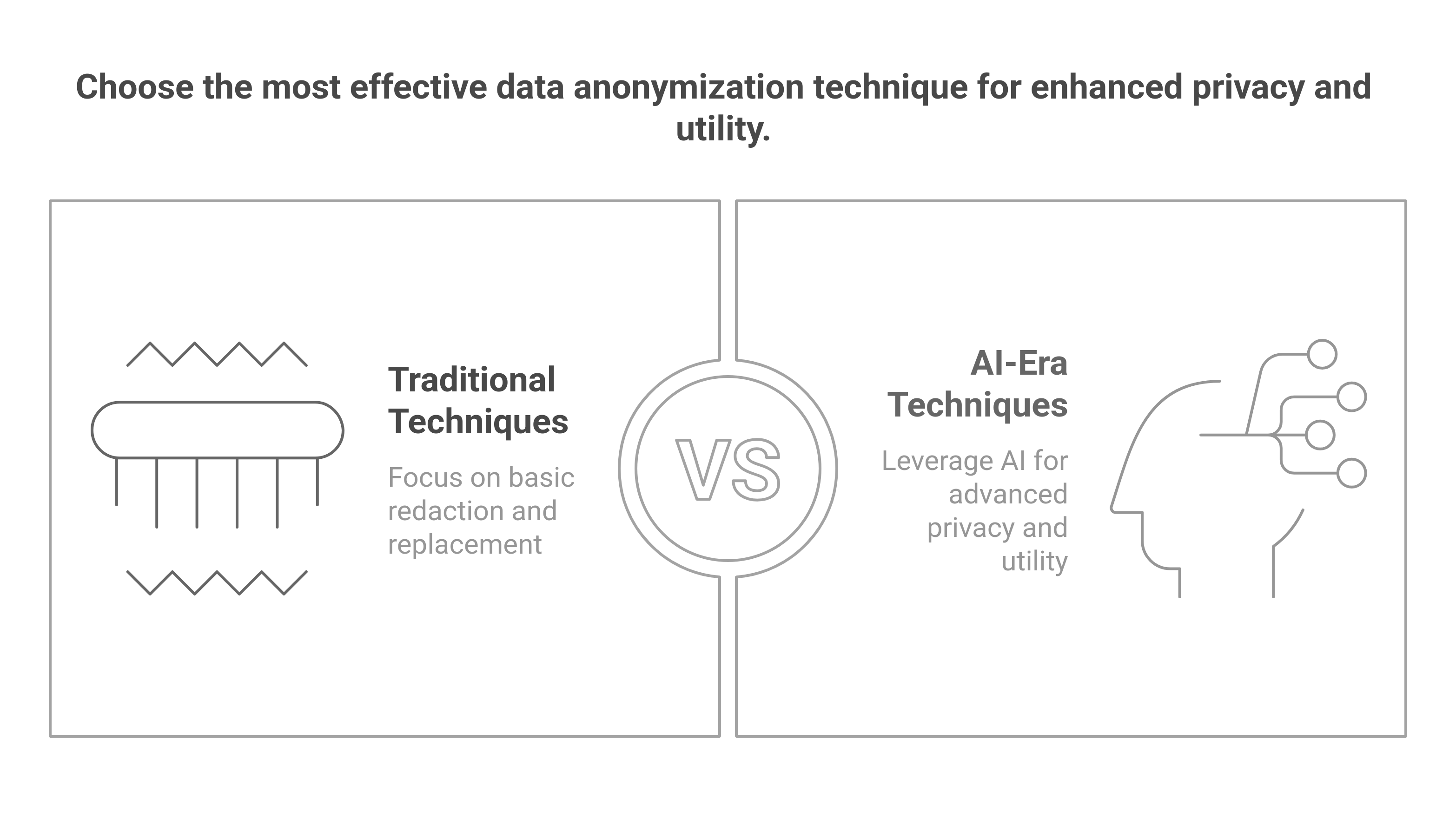
Over the years, data anonymization has moved and advanced as an art and science. Where the traditional methods laid solid foundations for protecting sensitive information, the AI era brought with it innovative but highly effective and adaptive approaches of their own to counter modern challenges. Let us examine them to know the inner workings of these techniques, while at the same time highlighting where AI makes a difference.
Traditional Techniques of Data Anonymization
Masking: Masking represents a more generic form of treatment for redacting or obscuring identifiable information, for example, a person's name might be replaced with asterisks or partial information (e.g., J*** S**** rather than John Smith). This is an obvious control, but very often requires other techniques to achieve complete anonymity.
Tokenization: This method replaces sensitive data with non-sensitive equivalents or "tokens." For example, a credit card number like 1234-5678-9012-3456 might be replaced with X1A2B3C4D5E6F7G8. The original data is stored securely and can be re-associated with the tokens when needed, which makes tokenization more about controlled access than irreversible anonymization.
Generalization: In generalization, the data's precision is reduced, making it less identifiable. For example, instead of showing a person’s exact age (e.g., 34), you might use an age range (e.g., 30–40). Sacrificing some granularity for privacy retains the analytical value of the data. Pseudonymization: It's changing personal identifiers into false ones, like substituting real names for randomly generated ones. In distinction to other techniques, it can be undone if the corresponding keys are available, which makes pseudonymization useful for cases in which occasional re-identification is needed (for example, in medical research).
Emerging AI Era Techniques of Data Anonymization
- Synthetic data Generation: Rather than anonymizing the real data, AI may generate an entirely new dataset that replicates the statistical properties of the original data. For example, a dataset containing customer purchase behavior patterns would reflect similar patterns but not expose real human individuals. This way, privacy is maintained while the data is rich enough for analysis.
- Differential Privacy: This method employs algorithms to introduce "noise" into the dataset, virtually rendering individual data points invisible but keeping overall tendencies. Slight random variation may be introduced in a dataset of survey responses so that no trace can be found of any particular response leading back to any one individual. This is a strong method that companies like Apple and Google use to find the sweet spot between utility and privacy.
- Dynamic Risk Scoring: AI systems are now capable of dynamically assessing the level of "re-identifiability" of a dataset prior to its sharing or processing. In other words, this dynamic risk evaluation is based on the context, sensitivity of the information, and adversaries considered. For example, analyzing a healthcare dataset may trigger the AI to apply anonymization measures immediately while minimizing the risks of resuming the identification process.
The Shift from Static to Dynamic
Although static rules may not hold in today's fast-paced, data-intensive environments, they form a great basis to start with. The application of artificial intelligence in data anonymization brings about this dynamic level-adaptive treatment technique customized for specific datasets and contexts, with privacy enhancement without sacrificing usability. It is this combination of the old and new that will ensure that anonymization keeps pace with the rising complexity of modern data ecosystems.
Limitations of Traditional Anonymization
Though older anonymous arrangements helped much in privacy assurances, today's world of big data and analytics finds them severely overstretched. With larger, unstructured datasets, traditional solutions still struggle to balance privacy and data utility at this instance. We might consider typical limitations that have rendered traditional anonymous techniques less valid in the year 2025.
Vulnerable to Re-Identification
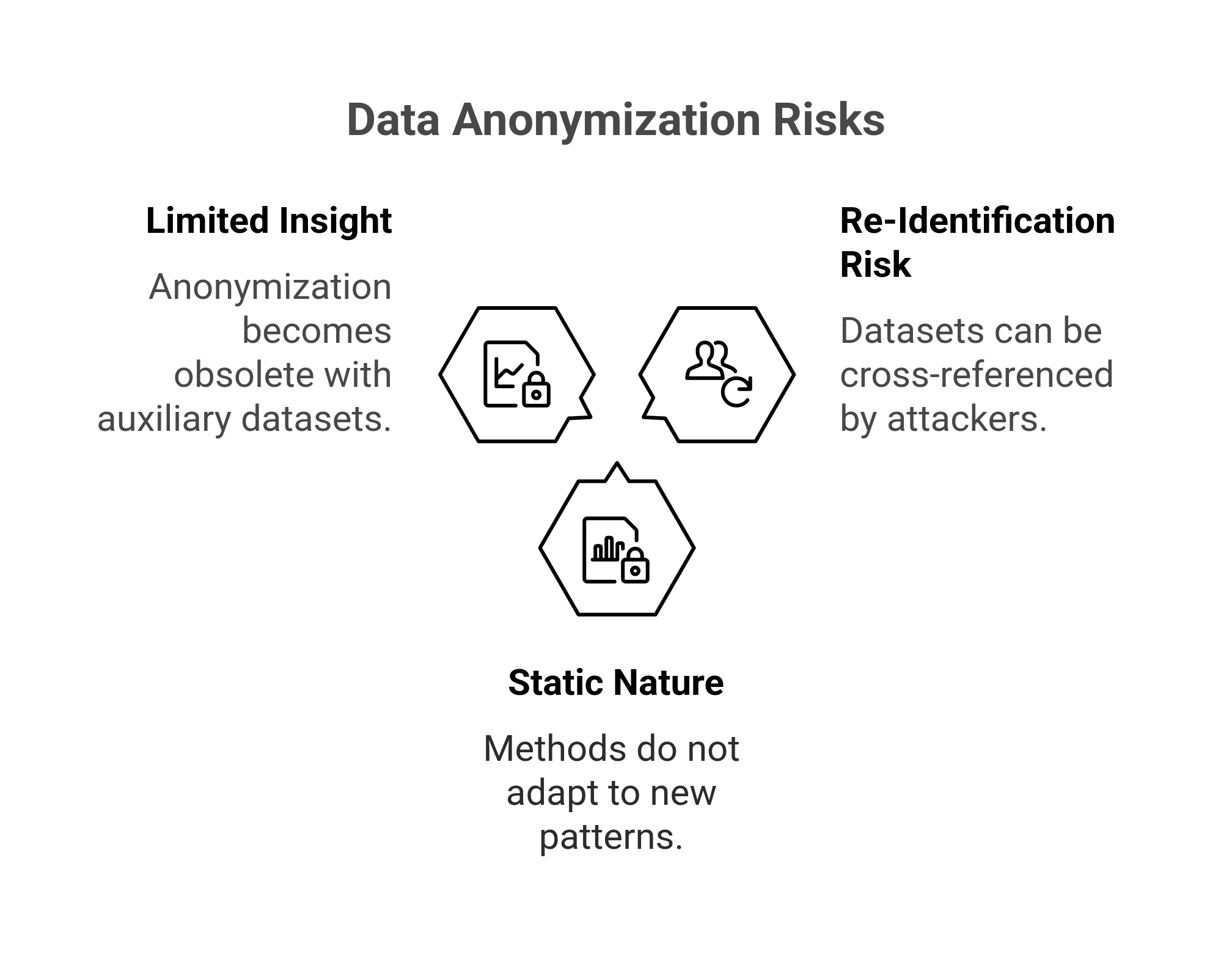
Being static, traditional methods of masking and generalization are relatively inflexible. They undertake a one-size-fits-all approach to all data. In this rigidity lies the vulnerability. When the techniques become advanced with higher computation power and auxiliary datasets, that is about the time when attackers expedite their assault by juxtaposing “anonymized” data with such external information. To illustrate: The generalized age range (e.g., 30–40) may be matched against location data to narrow down identities.
Trade-off with Data Utility
Anonymization incurs a cost to data fidelity. Generalization functions and pseudonymization work by downgrading the richness of the dataset, with serious repercussions for the dataset's value towards analysis. For instance, Masking or tokenization may protect identifiers; however, they can also obliterate insights by removing too much detail. In sensitive industries such as healthcare or marketing, the degree of detail is paramount, and consequently, tilting the balance between privacy and usability remains a huge impediment.
Inflexibility in a Dynamic Context
Concrete rules cannot handle dynamic risks and needs in real-world datasets. For example: A dataset might be masked for internal use, according to the usual standards; however, the potential for re-identification from an outside partner could theoretically be a new risk that could not be coped with by traditional means on-site. Only an updated method could have considered these variable risks.
When These Are Not Collective Data
The data thrown in these modern datasets generally includes some unstructured or semi-structured parts the likes as images, audio, or free-text entries. These tokenization and generalization-oriented traditional methods are actually meant for structured data and are thus not so comfortable with the complex type formats. For example, doing redaction on some text on a free-format survey could miss some subtle patterns or clues that still can lead to revelations of identities.
Contraindication to Advanced Analytics
As firms begin to embrace machine learning and AI, the quality of data assumes paramount significance. Traditional processes for anonymization can generate artefacts that create problems in the further use of these anonymized datasets for training AI models and validating the predictions. Examples: Noise injection or identifier masking could potentially help in some new ways to remove correlations or patterns that are essential for predictive analytics.
How AI Transforms Data Anonymization: An Overview
The arrival of AI in the domain of data privacy has transformed the way organizations carry out data anonymization. Instead of relying on static one-size-fits-all style methods, new AI-centric methods can intelligently utilize privacy-preserving techniques with greater utility for data. Let us see how AI is essentially acting as a disruptive force in the field of anonymization.
Pattern Discovery
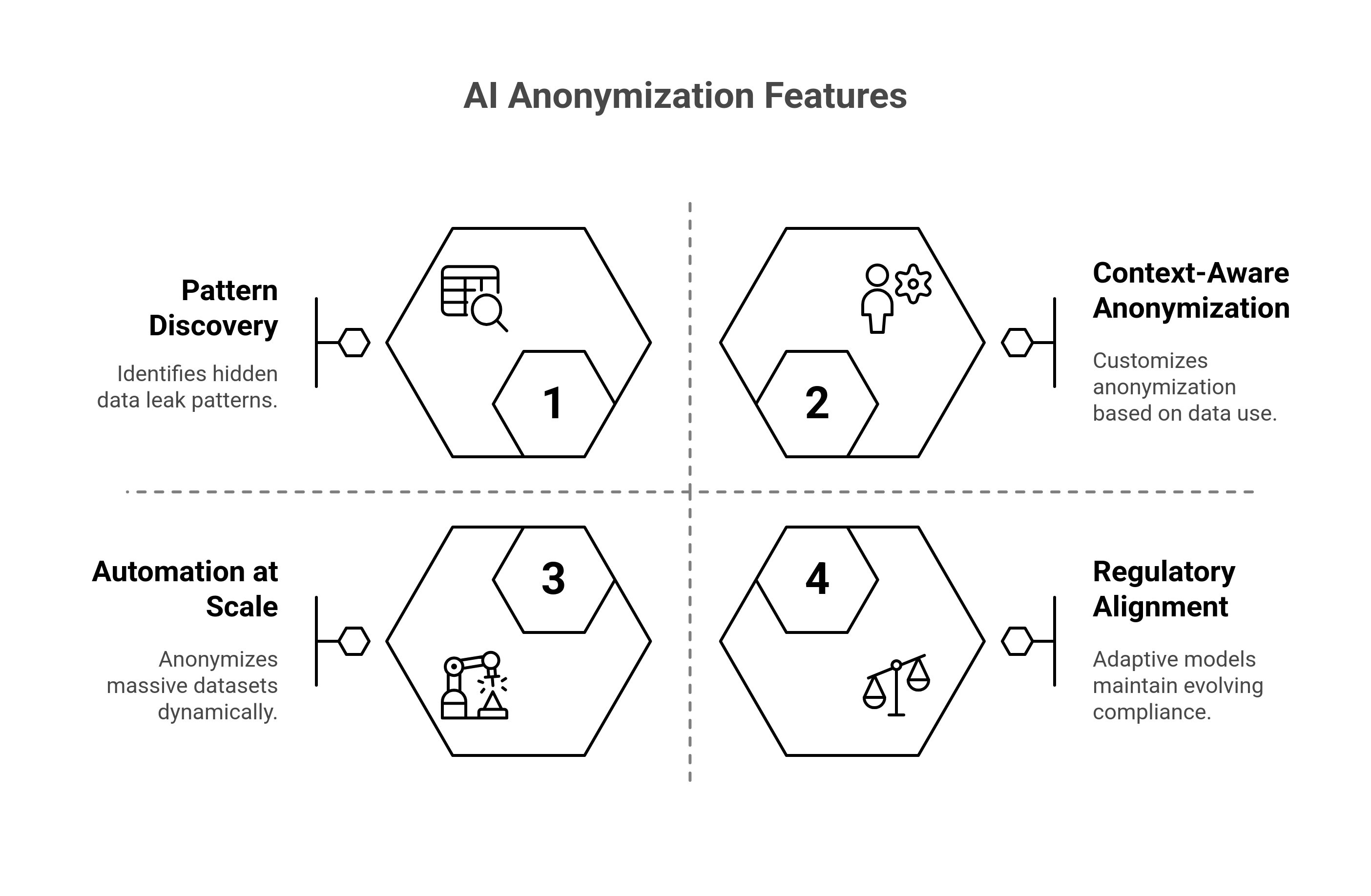
AI tracks down hidden patterns buried deep in the data set-anything that in any way may reveal a person's identity. For example, even once identifiers are scrubbed, AI may uncover minor correlations (like those with purchasing trends compared to zip codes) that could theoretically lead to re-identification. Such vulnerabilities would act against true anonymization, given that conventional approaches rarely consider them.
Context-aware Anonymous processing
One of AI's greatest strengths is its ability to customize anonymization approaches based on the intended use of the data. Static methods, on the other hand, consider elements like the following:
Who has access to the data?
What methods of analysis are employed?
What risks are involved?
For instance, a healthcare dataset for internal research might require some degree of anonymization to preserve accuracy when it is kept inside a company. The same dataset for external use would become much more stringent. These variables are adjusted dynamically by AI in every situation, balancing privacy versus usability.
Automation of the Scale
Anonymization of a large data set manually is tedious and tricky due to human error, especially within sectors with huge daily data creation, like finance or telecommunications. AI thus automates it and empowers the organization to:
Handle enormous datasets fluidly.
Ensure uniformity in the anonymization practice by applying techniques across the spectrum, be it structured databases or unstructured text, or images.
Even algorithms employed by AI can continuously evolve and adapt to fresh data and privacy threats automatically, without human intervention, allowing for scalability and accuracy.
Regulatory Alignment
Privacy rules such as the GDPR, CCPA, and other standards in the making require agility besides compliance. For instance, artificial intelligence-based anonymization may adjust itself in real-time other than if situations develop changes in the regulations or there are any new risks; it can do the following: AI models are designed to read and interpret the changes in privacy laws for necessary modifications to the anonymization techniques, thus ensuring that liability is still in compliance for businesses with the added benefit of not having to spend huge amounts on manual reconfigurations.
Data remain usable for insight whilst meeting strict global standards, which gives you a competitive advantage with respect to operating data privacy responsibly.
Key AI Technologies Powering Modern Data Anonymization
AI has brought a host of transformative technologies to the field of data anonymization, making privacy protections more robust, efficient, and innovative. Let’s explore the cutting-edge tools that are redefining how organizations protect sensitive information while maximizing its usability.
Machine Learning-Driven Risk Identification
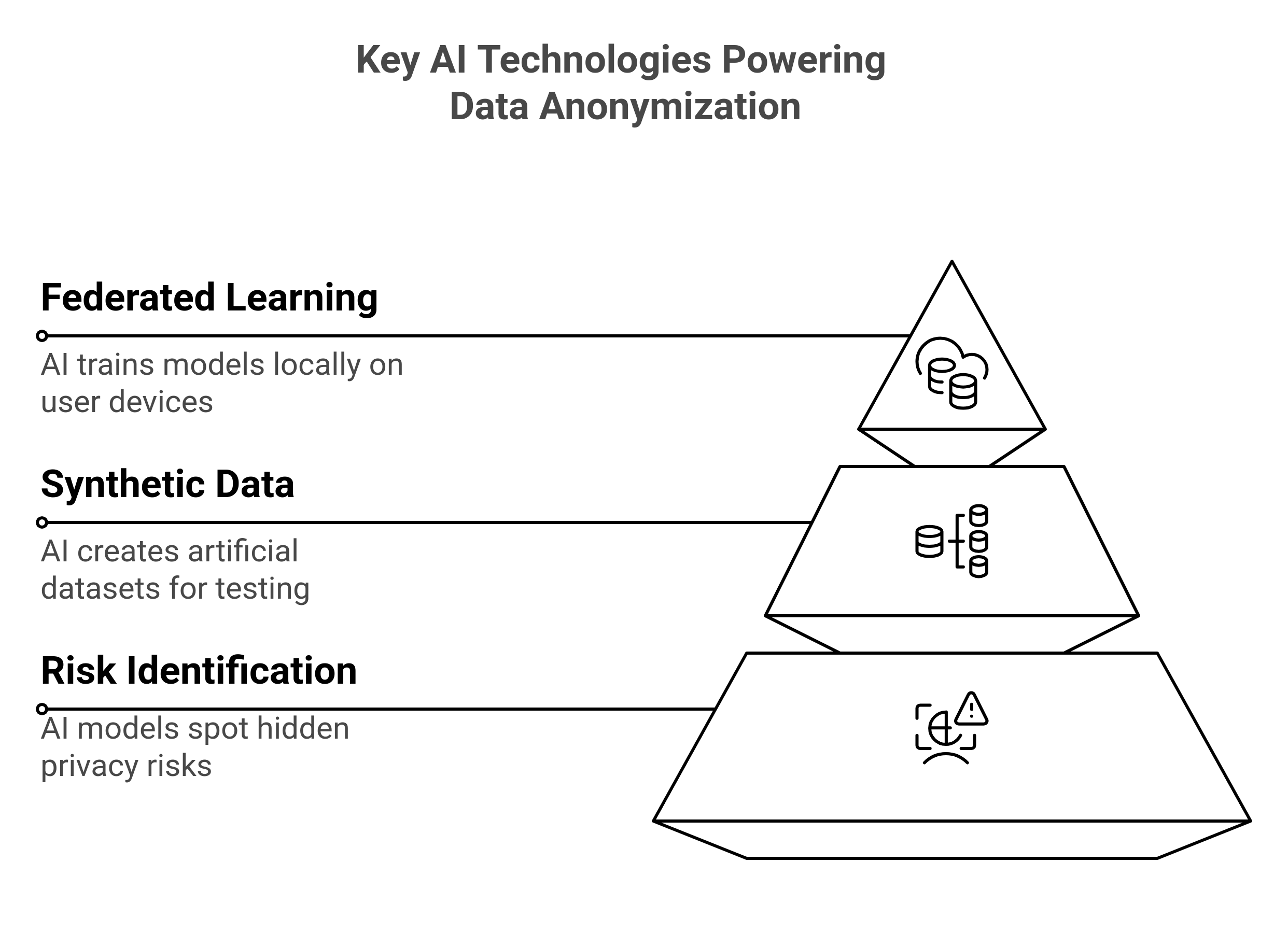
Machine learning (ML) enhances data anonymization by identifying risks that are often invisible to the human eye. AI models are adept at spotting both direct identifiers (e.g., names, emails) and indirect ones (e.g., unique combinations of demographic data) that could lead to re-identification.
How it Works: AI scans datasets to identify subtle patterns or correlations that could inadvertently expose individuals. It continuously learns from new datasets, improving its ability to detect risks over time.
Example in Action: Google Chrome’s Privacy Sandbox uses AI to prevent cross-site tracking by blocking identifiers that could link user activity across platforms. By identifying risky patterns dynamically, AI minimizes privacy leaks without compromising functionality.
Synthetic Data Generation Using Generative AI
Generative AI, powered by technologies like GANs (Generative Adversarial Networks), creates entirely artificial datasets that mimic the statistical properties of real data. This ensures data privacy while retaining its value for analytics, testing, or R&D.
What It Means:
Synthetic data generation eliminates the need to work with real, sensitive datasets.
AI generates data points that are statistically indistinguishable from actual records but contain no link to real individuals.
Federated Learning with Differential Privacy
Federated learning, combined with differential privacy, is a groundbreaking approach to model training. It allows AI models to learn from decentralized data (e.g., data stored on users’ devices) without ever transmitting raw data to a central server.
What It Means:
AI models are trained locally on users' devices, and only aggregated insights or model updates are shared.
Differential privacy techniques inject noise into these updates to prevent any individual data from being reconstructed.
Example in Action: Apple employs federated learning in Siri and keyboard suggestions, training AI on user behavior without ever collecting sensitive raw data. This ensures personalization without sacrificing data privacy.
Benefits of AI-Powered Data Anonymization
The integration of AI in data privacy has revolutionized how organizations manage and anonymize sensitive information. AI-powered anonymization not only addresses the shortcomings of traditional methods but also unlocks new capabilities that are critical in today’s fast-evolving data landscape. Here are the key benefits that make AI-driven approaches indispensable.
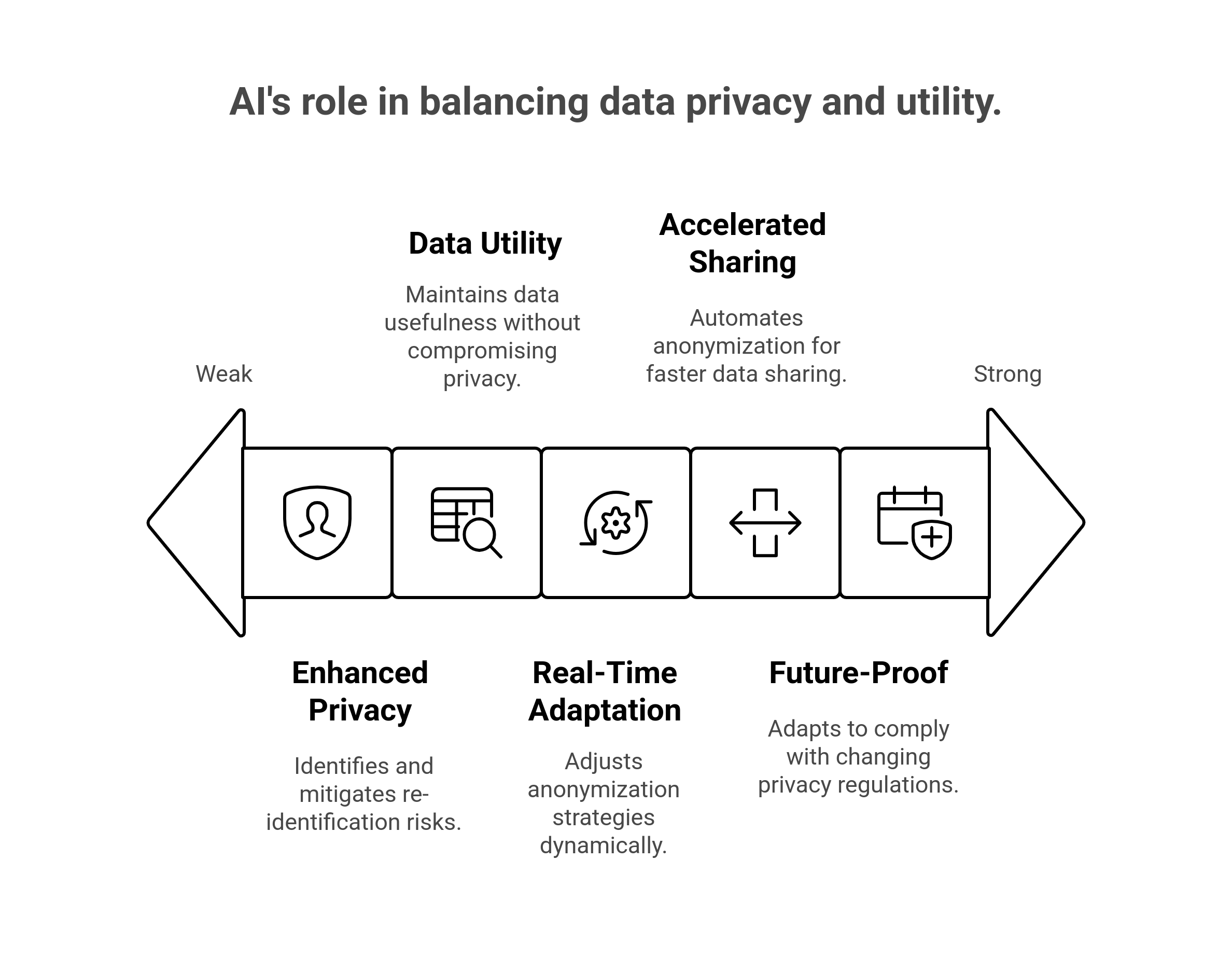
Stronger Privacy Protection
AI’s ability to identify and mitigate subtle re-identification risks significantly enhances data privacy. By analyzing patterns and correlations that might escape traditional methods, AI ensures that anonymized datasets are genuinely secure.
Example: AI can detect and obscure combinations of indirect identifiers (e.g., age, zip code, and occupation) that might uniquely pinpoint an individual in a dataset.
This ensures compliance with stringent privacy standards while maintaining user trust.
Real-Time Adaptability
One of AI’s standout features is its ability to adjust anonymization strategies dynamically. By analyzing the context, such as how the data will be used, the prevailing threat landscape, or recent regulatory changes, AI tailors protections on the fly.
Scenario: A healthcare provider sharing data for research can apply stricter anonymization for external partners while preserving granularity for internal use.
This adaptability minimizes privacy risks without hindering legitimate data usage.
Preserving Data Utility
Traditional methods often sacrifice data quality for privacy. AI-powered techniques, like differential privacy and synthetic data generation, strike a better balance by preserving the analytical value of datasets.
Benefit: Businesses can use anonymized data to train machine learning models, derive insights, or predict trends with minimal loss of accuracy.
This makes AI-anonymized data far more versatile for decision-making and innovation.
Accelerated Data Sharing
AI automates and scales anonymization processes, significantly reducing the time it takes to prepare datasets for sharing. This efficiency allows organizations to:
Collaborate faster with research partners.
Launch data-driven projects without lengthy compliance delays.
Impact: Faster data-sharing processes fuel innovation in fields like healthcare, finance, and marketing, enabling breakthroughs without compromising privacy.
Future-Readiness for Privacy Regulations
The regulatory landscape is constantly evolving, and compliance can be a moving target. AI-powered anonymization systems are inherently adaptable, capable of recalibrating as new laws emerge.
Example: AI can integrate updated GDPR or CCPA requirements into its anonymization protocols automatically, ensuring that organizations remain compliant without manual intervention.
This makes AI a sustainable solution for long-term data governance and regulatory alignment.
Conclusion
As the world grapples with the dual pressures of increasing data volumes and stricter privacy regulations, data anonymization has become more than just a compliance checkbox—it’s a cornerstone of digital trust. While traditional methods have served us well in the past, they fall short in the face of today’s complex datasets, sophisticated threats, and the relentless demand for innovation.
This is where AI steps in, transforming the landscape of data privacy with its ability to dynamically adapt, preserve data utility, and future-proof compliance efforts. By leveraging technologies like machine learning, synthetic data generation, and federated learning, businesses can achieve a level of privacy protection that was previously unimaginable—all while unlocking the full value of their data. In a data-driven world, embracing AI in data anonymization is no longer optional; it’s a strategic imperative. Organizations that adopt these advanced techniques will not only safeguard sensitive information but also empower themselves to innovate, collaborate, and thrive in a privacy-first era. The choice is clear: with AI, data anonymization evolves from a challenge into an opportunity—one that drives both trust and transformation.