Introduction
Data is no longer just useful instead, it is the very fuel. Web teams are flooded with metrics, dashboards, and behavioral charts, while brands chatter about transforming experiences into conversions. The question is, is this understanding of what happened enough? The most valuable thing today is a tryst with divination, predicting the future: predictive analytics as opposed to those trying to construct the past.
The good old traditional ones set the pace of how things turn out on the web. Say, how many did visit a page, what was clicked, and where they dropped off; those retro freaking historical crap for reporting would just be adequate learning about the past, and probably crap for prediction. Whereas predictive analytics, on the other hand, goes the extra mile. With machine learning in tow to historical patterns and behavioral signals, predictive analytics prophetically forecasts user actions, allowing real-time personalization and proactive decision-making. So, when differentiating between web analytics vs predictive analytics, it's not just data — it's the depth of insight and speed of action behind their application.
This blog breaks down the distinctions between traditional analytics and predictive analytics, when each of them really makes sense, how they can engage in a conversation, and why the leaning-conventional strategy of the day must be forward-thinking, towards personalization, and into automation. The guidelines will assist you in your work leading a web team, in the optimization of the marketing funnel, and really just help you understand the benefits of using predictive analytics. At the end of the day, this guide will further help you in making decisions that are even smarter, faster, and strategically correct.
What is Traditional Web Analytics?
Traditional web analytics refers to the process through which data is gathered, measured, and analyzed about the activity on a website to determine how users interact with such digital property. The main goal of traditional web analytics is to provide visibility into what happens on the website: visitor counts, content engagement, and conversion performance.

Traditional analytics is descriptive. It answers questions such as that kind for companies like:
- How many users visited our homepage last week?
- Where are most of our users coming from?
- Which blog post had the highest bounce rate?
- Did the recent campaign increase time on site?
The deductions from traditional analytic data tend to be retrospectively oriented. Such a data set becomes critical for reporting, performance reviews, benchmarking, and iterative improvements while not predicting behavior. Instead, traditional analytics have all the bases covered for an issue that just needs to be identified and diagnosed.
Common Tools Used in Traditional Analytics
These are widespread tools that made traditional analytics accessible to web teams of all sizes. The most popular are:
- Google Analytics (Universal and GA4): The tool par excellence for measuring things such as behaviors on the web, demographic data regarding audiences, where they come from, and where they should go in terms of conversion goals. GA4 will adopt an event-based model, but will still be used for the platform's retrospective analysis.
- Adobe Analytics: This is mostly deployed among enterprises as it is relatively deeper in segmentation and custom dashboards. Adobe is strong in its integrations and complex pathways into the user journey.
- Matomo (formerly Piwik): An open-source alternative that promises privacy-focused analytics, ideal for enterprises that are wary about complying with GDPR.
- Clicky, Mixpanel (for events), and Heap (auto-capture tools): These are more modern tools, but with most, tracking and summarizing of past behavior is still the main purpose of their use.
So, it's really just dashboards, report visualizations that tell teams how much they're winning and losing over time in terms of performance according to different user cohorts.
Standard Metrics Tracked in Traditional Analytics
Traditional analytics rely on the same key indicators and behavioral metrics that enable teams to conduct engagement research, drop-off diagnostics, and media effectiveness evaluations. Those key performance indicators often include the following:
- Pageviews: the total number of times a given page has been loaded.
- Sessions: An aggregation of interactions from a user within a selected time window.
- Bounce Rate: The percentage of visitors to the site who only view one page before leaving.
- Average Session Duration: The measure of time, within an individual session, spent by users on the site.
- Traffic Sources: The breakdown of where users come from (organic search, direct, referrals, paid ads)
- Goal Completions/Conversion Rate: Number of users who have completed desired actions such as signing up or making a purchase.
- Exit Pages: Pages that users most frequently exit their sessions on
Metrics that are useful in gaining a general understanding of certain types of audience behavior and in measuring success relative to target benchmarks or compared with years of its own historical results.
Common Use Cases of Traditional Analytics
Old-style analytics excel at assessing performance in the past, finding high-level trends, or conducting iterative improvements on user behavior. A few of these notable cases include:
- Post-Event Reporting: Analysis of the effectiveness of campaigns, content update launches, and website redesigns after they go live.
- Trends Analysis: Observing traffic growth and seasonal behavior, or the outcome of SEO/advertising strategies over long stretches of time
- Funnel Breakdown: Understanding user behavior walking through multi-step paths and, thus, where drop-offs occur.
- A/B Test Measurement: Comparing how different variations of content, layouts, or CTAs perform in order to see which version encourages higher engagement or conversion.
- KPI Dashboards for Stakeholders: Regular production of dashboards and reports for marketing, product, or leadership teams relevant to set business goals
Traditional analytics gives great visibility into what, but hardly scratches the surface in answering the why or what's next. Enter predictive analytics.
What is Predictive Analytics in Web Personalization?
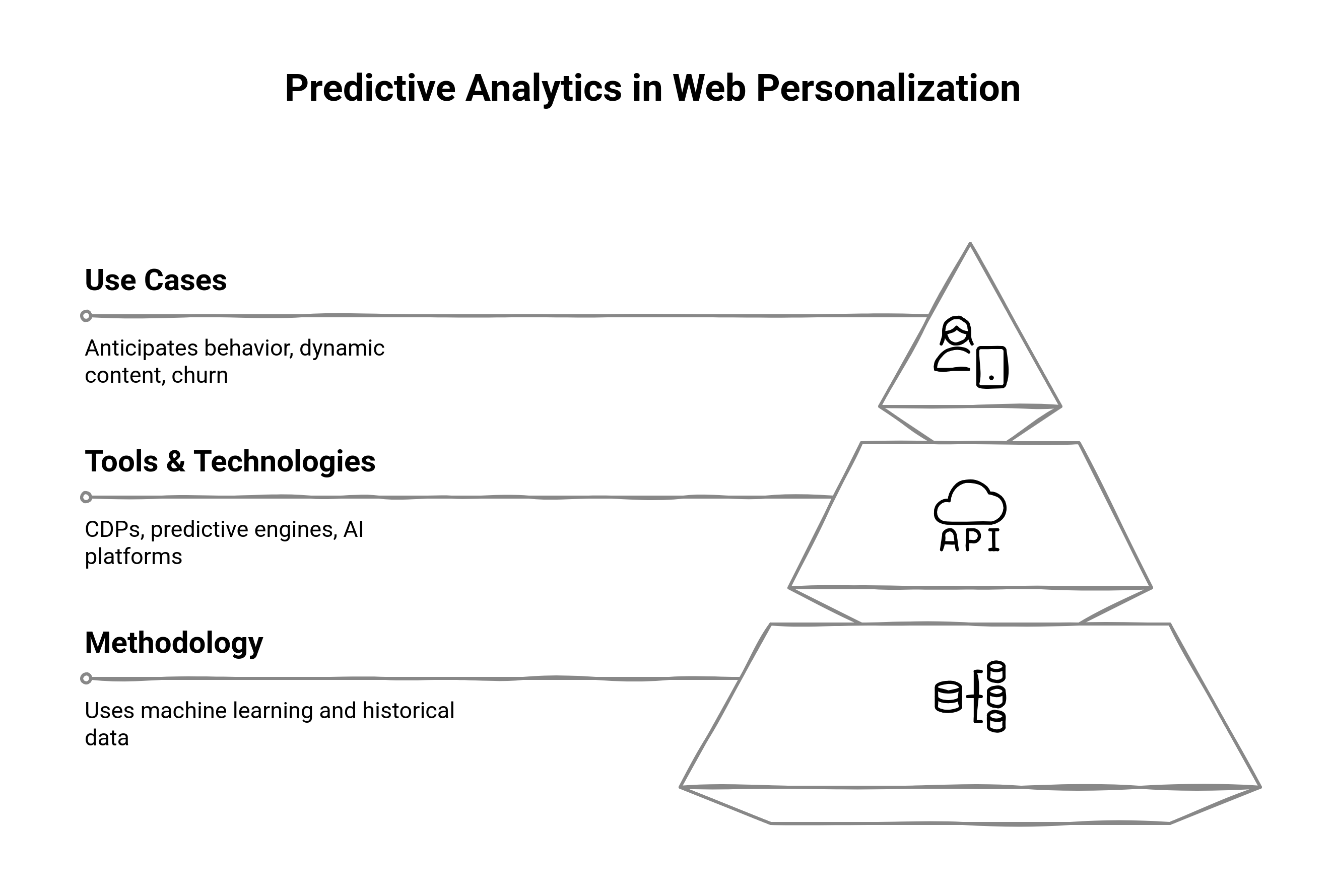
Predictive analytics in web personalization refers to the examination of historical and real-time user data to forecast future actions and adapt experiences in real-time. While descriptive statistics (the purview of traditional analytics) tell you what happened, predictive analytics deal with the tough question: what is liable to happen next?
In terms of digital experiences, this means foreseeing the needs of the individual user, whether it is suggesting the relevant product, surfacing personalized content, or giving specific nudges just before a visitor abandons their journey. Unlike traditional analytics, which is reactive, predictive analytics is proactive and often enables real-time personalization and smarter decision-making at scale. This is extremely significant for the personalization team, as it allows users to shift away from being solely segmented according to past behavior and instead start to deliver relevant next-best experiences based on intelligent prediction.
How Predictive Analytics Works
At the center of predictive analytics are machine learning algorithms trained to recognize patterns in countless examples of data and make statistically sound predictions about the outcome. Here is how it typically works in web personalization:
- Data Collection: It starts with behavioral data: clicks, views, time on page, past purchases, device type, referral source, etc. It can often be supplemented with contextual data events (location, time of day) and historical trends.
- Model Training: Using this historical data, machine learning models are trained to detect those patterns that relate to certain actions, like conversion or churn.
- Behavioral Scoring: Users receive predictive scores such as the likelihood to purchase, likelihood to bounce, or affinity to a certain product category.
- Real-Time Application: Now these predictions come into play to trigger real-time personalization activities such as changing banners, sending customized emails, or recommending specific content right before a user makes a decision.
This predictive layer converts websites from static user experiences into adaptive systems, intelligently shaping the customer journey from one moment to the next.
Common Tools and Technologies Powering Predictive Analytics
Implementing predictive analytics in web personalization typically requires more advanced infrastructure than traditional analytics. Here are some of the most common technologies involved:
- Customer Data Platforms: Mostly built-in predictive scoring capabilities in tools like Segment, mParticle, and Bloomreach.
- Predictive Engines & ML APIs: For example, Pecan, Salesforce Einstein, or AWS Forecast help teams build and deploy predictive models without needing to dive into deep data science.
- AI Personalization Platforms: Fragmatic, Adobe Target’s personalization modules create real-time content changes driven from predictive insights.
- Behavioral Intelligence Layers: These types of integrate into an existing analytics stack, applying predictive models on this behavioral data (Clearbit, LiftIgniter, or even standard GA4 with BigQuery ML extensions).
This leads marketing, product, and personalization teams to develop more intent forecasting and subsequently cause automatic web experience adaptation, unleashing the full benefits of predictive analytics.
Use Cases of Predictive Analytics in Web Personalization
Predictive analytics come into play where an assumption about user behavior would significantly benefit in improving engagement, retention, or conversion. Some of the key use cases are:
- Anticipating User Behavior: Determine which visitors can be converted, which will bounce, and which will churn — then take suitable actions based on that knowledge via targeted messaging or offers.
- Dynamic Content Delivery: Deliver personalized banners, CTAs, product recommendations, or content modules triggered by predicted interests or possible next best actions.
- Churn prediction: Score users based on the patterns of disengagement and intervene appropriately with an early re-engagement campaign or a loyalty offer.
- Lead Qualification: Assess lead conversion probability and direct leads for sales or to an automated nurture workflow.
- Smart Offer Optimizing: Present the best incentive or price point to the user based on their predicted value, discount sensitivity, or purchase intent.
Whenever they are executed properly, these use cases will not just enhance user experience but also have a direct impact on ROI, decrease expenditure on inefficient marketing, and elevate the brand’s ability to respond to user needs in real time.
Key Differences Between Predictive and Traditional Web Analytics
Distinguishing between predictive and traditional web analytics is not merely a technical detail; it runs deep into choosing the best approach to digital experience optimization. Though both approaches endeavor to draw value from data, they differ significantly in their focus, function, and business outcome. The five basic areas in which traditional analytics and predictive analytics have the most significant divide include:

Timeframe of Insights: Past vs Future
Traditional Analytics is backward-looking. It is concerned with what happened on your website: visitor behavior, session activity, conversions, and drop-offs. All of these can only be analyzed and reported years after their occurrence.
Predictive Analytics, as opposed to that, looks into the future. It extends what has happened and what occurs now to know what will likely occur next, such as which users will convert or abandon, or who will come back, so that decisions can be made proactively in the moment.
Why it matters: Conventional analytics would allow you to see a trend. Predictive analytics would help you change such trends.
Nature of Analysis: Descriptive or Prescriptive
Traditional Analysis is more descriptive. It tells past events and also enables a team to understand such KPIs as high bounce rates, underperforming campaigns, and the like, and also spot issues.
Predictive Analysis is rather prescriptive, if not proactive. It informs users who are likely to act in the future on what trends would suggest and what to do specifically or activate (discount or prioritize a lead) on the very basis of interpreted future behavior.
Why this matters: Descriptive insights help inform strategy; predictive insights help drive action.
Types of Data Dependency and Complexity
Traditional Analytics relies primarily on session-level and user-level event data—things like clicks, scrolls, and time on page. It tends to work well with relatively straightforward datasets.
Unlike Predictive Analytics, which needs infrastructure for real-time, historical, and contextual data, layered with machine learning models, and requires more complex readiness in case of failure.
Why it matters: Predictive models excel in richer data ecosystems and become better over time, as opposed to the relatively static traditional metrics.
Application Areas and Use Cases
Traditional analytics include reporting, trend analyses, and manual optimizations, i.e., making changes to CTAs based on bounce rates or testing landing pages.
Predictive analytics allows the personalization, marketing automation, customer segmentation, and risk mitigation, i.e., finding out which users are likely to churn and serving them real-time re-engagement campaigns.
Why it matters: Traditional analytics allow you to optimize what exists; predictive analytics allows you to shape and automate what is next.
Output Types and Business Actions
Traditional analytics has its own actions, like a report, or dashboard, or a performance summary, and does what it has to do. They are set for human judgment and making future plans.
Contrastingly, the main components of Predictive Analytics include real-time signals, dynamic content triggers, the next-best action recommendations, and behavioral scores, which directly inform what they see or experience on your site.
Why it matters: Traditional analytics performs a way for decision-making that acts on its own course; while predictive analytics empowers systems to take actions without a person's interference.
Benefits of Predictive Analytics as against Traditional Web Analytics
If traditional web analytics are still the cornerstone of performance monitoring and historical analysis, this very nature of being reactive limits how fast and how well teams can respond to user behaviors. Predictive analytics, in contrast, takes raw data and turns it into future-focused insight that propels more intelligent, rapid, and profitable decision-making, particularly in the context of personalization. Here are some key benefits that predictive analytics would impart to modern-day digital teams:
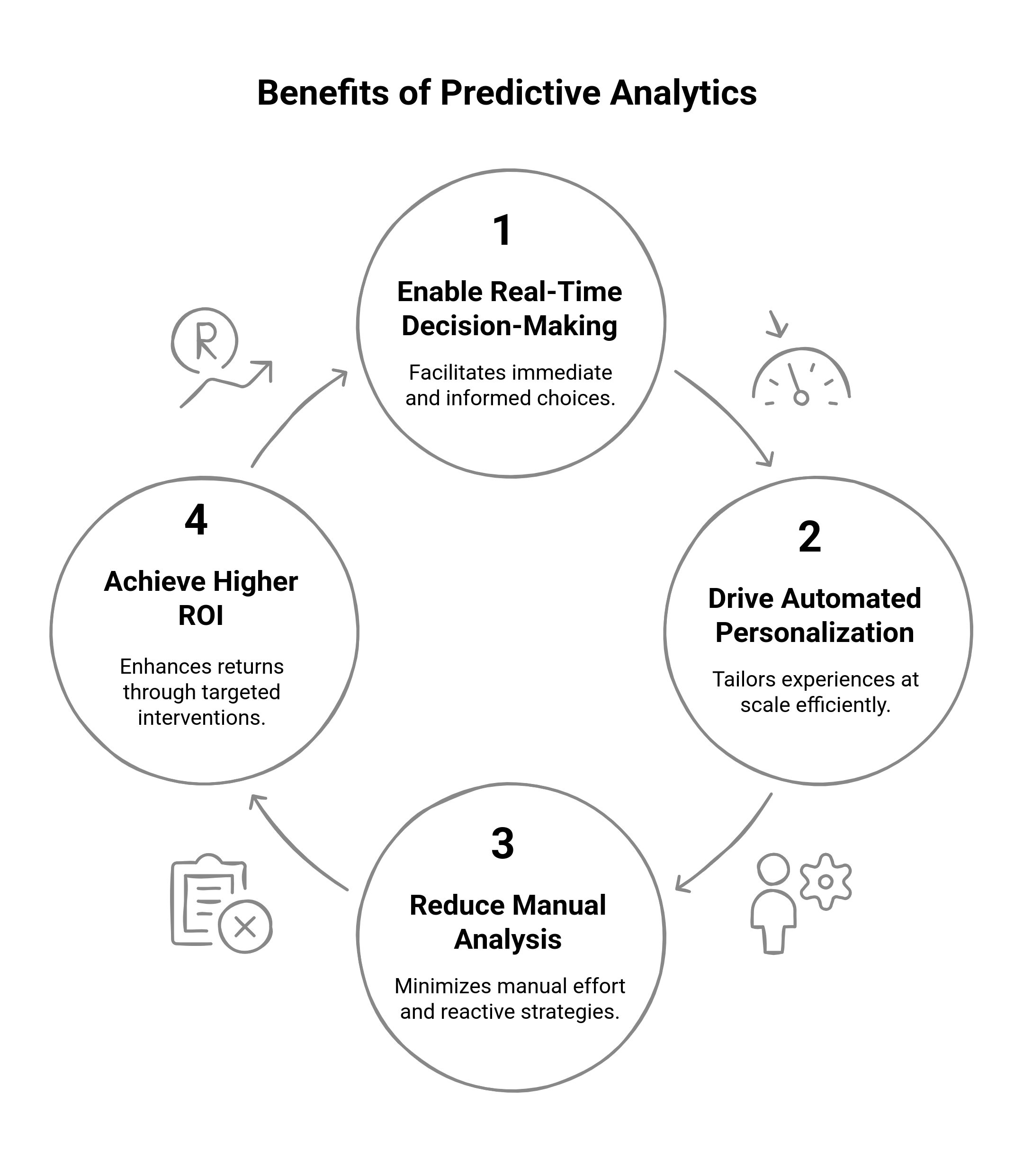
Enables Real-Time, Anticipatory Decision-Making
The most striking aspect of prediction analytics is the capability to pre-empt user actions. Rather than writing down observations after a bounce or failed conversion, predictive models will really identify how likely a user is to buy, the chances of exiting, or the risk of churn. This puts the web team in the position to act in the moment—who is waiting to show a retention offer, guide the customer toward the right product, or prod users down the funnel through hints in contextual messaging. Every user session becomes an opportunity to optimize outcomes before problems occur.
The Leading Driving Force in Automated Personalization
Predictive analytics swoops away needless guesswork from personalization. It does not end static audience segments based on past behaviors; rather, it scores a person's experience dynamically depending on predicted preferences and intent. This brings along perfect automation of personalization at scale-by presenting every visitor with a real-time experience of individualized content, CTAs, product recommendations, or offers without continuous manual intervention. Hence, more relevance, improved engagement, and loyalty bind consumers.
Reduces Manual Analysis and Reactive Strategies
Traditional analytics involved quite a bit of painstaking interpretation of dashboards, building reports, and debating with whom to act on any given report. Predictive analytics cut through all of this by automatically surfacing clear, actionable insights. Instead of reacting to lagging indicators like drop-off rates or form abandonments, teams can prioritize leads, trigger interventions, or refine content. All this can be done with predictive scoring models and AI-based recommendations guiding the way. This reduces operational friction, leaving the team more space to concentrate on strategy rather than just analysis.
Delivers Higher ROI With Precision Interventions
With predictive analytics, brands understand precisely who will convert, engage, or churn. Therefore, when brands have profound insights into the above-mentioned parameters, they can better distribute resources. Marketing spends could target high-intent users, sales may focus on hot leads, and re-engagement interventions could be narrowed down to those under real threat. Such pinpoint accuracy leads to undoubtedly higher returns, reduced wastage, and profitable customer journeys. On the contrary, traditional analytics are much broader in focus and are often involved with crafting one-size-fits-all strategies that lack precision and personalization.
Where Traditional Web Analytics Still Holds Value
In the rush to adopt AI-driven solutions, it is easy for anyone to forget that traditional analytics is still a part of the digital strategy. While predictive analytics can do so much, traditional web analytics is still valuable for critical functions, especially when it comes to clarifying and simplifying, plus ensuring compliance. Here's where traditional analytics still holds irreplaceable value:
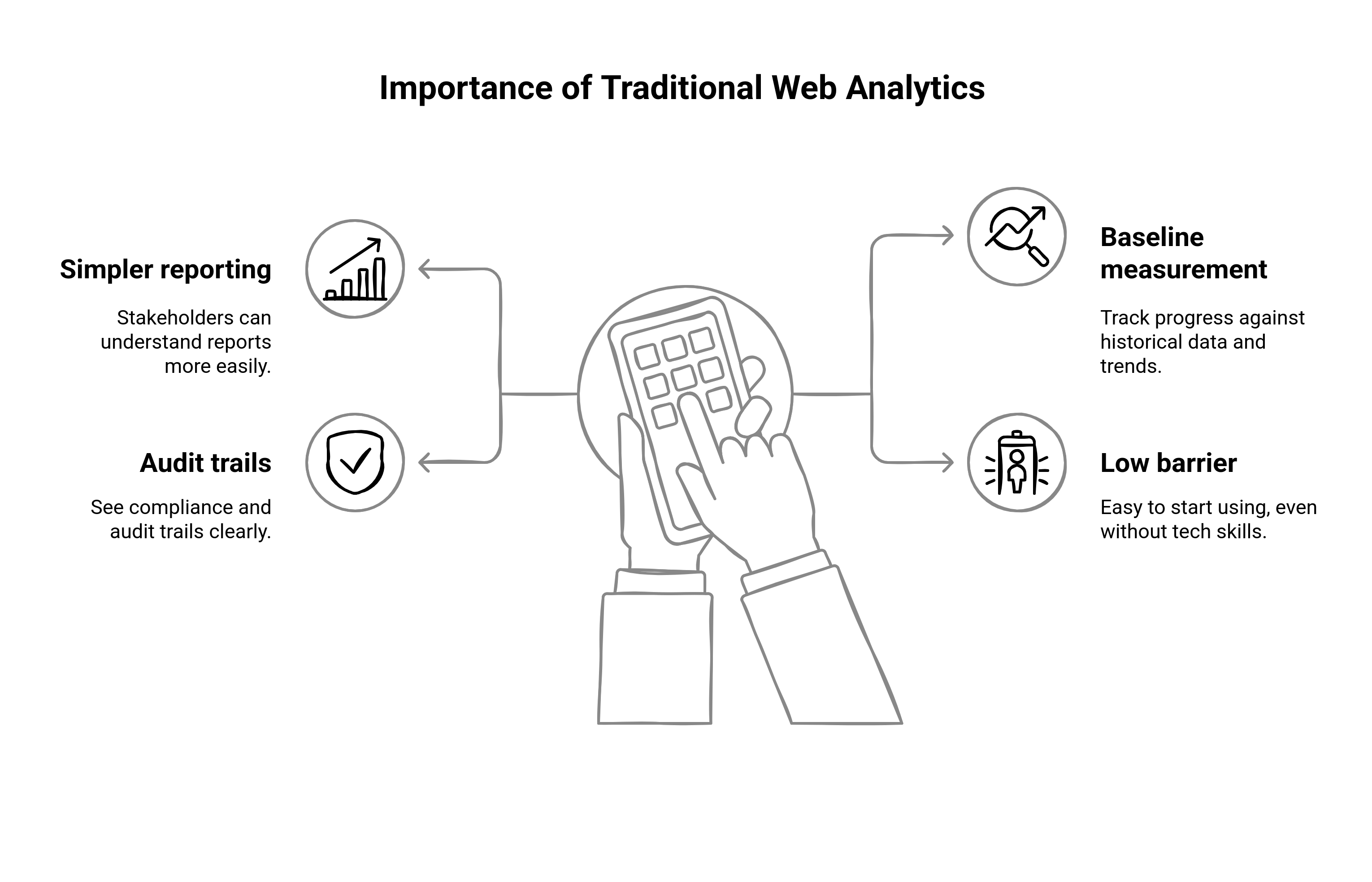
Easy Reporting for the Stakeholder
Traditional analytics tools like Google Analytics or Adobe Analytics provide quick, easy-to-digest dashboards and reports that non-technical stakeholders rely on. Whether it’s marketing managers tracking campaign performance or executives reviewing website KPIs, traditional analytics excels at summarizing results clearly. This simplicity is a sure thing when people have to communicate the performance and don't have to gather a bunch of citizens with a data-science model or algorithmic outputs.
The Baseline Measure and Historical Trend
In order to understand that you are indeed progressing, it is necessary to have a very reliable baseline. The traditional web analysis has always supplied longitudinal tracking of traffic, bounce rates, time on page, and conversions - that is, the key metrics to which teams use for monitoring performance from weeks to months, if not years. The ability to give trend analysis across the board or baselines that provide high-level benchmarking is absolutely critical to goal setting, comprehension of how successful an A/B test might have been, and looking at longer-term implications of SEO and marketing work in the composition.
Audit Trails and Compliance Visibility
Where regulations and compliance become critical in industries, auditability becomes another concern. Traditional analytics tools will usually have log-level details and data retention policies that make auditing, compliance reporting, and privacy management possible. Be it GDPR, CCPA, or internal policy reviews, traditional systems present a clear picture of what data is being collected when and how -- something that is not always so transparent with the complex tortuousness of ML-driven environments.
Low Technical Barrier to Entry
Low adoption barriers are among the reasons traditional analytics continues to thrive. Simple installations, user-friendly interfaces, and a wealth of documentation allow non-technical marketers and analysts to derive insights themselves without requiring support from data science or engineering. For small teams or early-stage companies, traditional analytics will serve a lot of value in short order and without a complete overhaul of the tech stack or sophisticated infrastructure.
How Predictive and Traditional Analytics Can Work Together
As tempting as it can be to pit predictive analytics against traditional analytics for comparisons, most importantly, these different methods should actually work together for maximum effectiveness. Predictive analytics does not replace traditional website analytics; rather, it extends and improves what has existed before. The end result of strategic integration will be an option for a hybrid analytics stack that is both reactive and proactive, both historical and inclined toward the future.

Here are some approaches wherein the two can work hand in hand to complete an overall well-rounded performance measurement capability for less than traditional, but far higher than mere digital analytics.
A Hybrid Analytics Stack: Descriptive Feeds Predictive
For traditional predictive models, the past is the basis for analytics. Pageviews, scroll depth, session duration, bounce rate, conversion funnels—these behavioral metrics are also used for reporting and are critical inputs for training machine learning algorithms. To put it another way, descriptive analytics do not simply tell you what happened. It feeds predictive analytics the raw material needed to model what is likely to happen. Just think of traditional analytics as the engine collecting patterns, and predictive analytics as the intelligence that converts those patterns into foresight.
Example: Cart abandonment rates could be analyzed with GA4. Then, that same dataset trains a predictive model that assigns scores to which users are most likely to abandon in the future, triggering personalized nudges in real time.
Unified Customer View: Merging GA4 and CDP Outputs
To reap the full benefits of predictive analytics, organizations must combine traditional data sources (such as GA4, Adobe Analytics) with orchestral tools such as Customer Data Platforms (CDP) or predictive engines.
GA4 presents a perfect channel for event-based tracking and behavioral trend outcomes. A CDP, on the other hand, does the heavy lifting of merging user identities, enriching profiles, and assigning predictive scores (likelihood to convert, churn, or reengage). When appropriately knitted together, they present a 360° customer view by merging what users have done with what they were predicted to do.
Outcomes: A whole new level of opportunities opened up with this kind of integration. Companies could now apply better segmentation, optimal timing for campaigns, and adaptive web experiences based not just on actual clicks but predicted intent.
Choosing the Right Approach for Your Business
While it sounds more fantastic than fiction with the whole ruckus about AI and predictive models, it has led people to conceive that every business is supposed to jump into advanced analytics. Quite the contrary. The proper analytics approach to choose depends on a variety of factors: how digitally mature your business is, what your business model is, your team's capabilities, and even your overall readiness. Here's how to decide about traditional vs predictive analytics, or the hybrid form.

When Traditional Analytics Proved Good Enough
For smaller websites or businesses that do not strive to achieve anything too complex digitally, traditional web analytics have traditionally served best.
Content-driven sites, blogs, and portfolios benefit from having user engagement, sources of traffic, and traffic trend monitoring without needing a complex analysis with forecasting.
Small teams with limited tech resources can rely on well-known tools, be it GA4 or Adobe Analytics, to substantiate manual decisions around performance and UX improvements.
On brochureware sites or simple lead-gen forms, where user experience is not the core value driver, predictive analytics is usually just nice to have.
The bottom line: If your objective is simply understanding what happens and reporting to stakeholders, then traditional analytics is far more than you need.
When Predictive Becomes Essential
On the other hand, predictive analytics truly becomes essential when personalization, real-time decisions, and lifetime value are in play.
E-commerce brands use predictive models to surface next-best products, optimize their promotions, and forecast customer churn or repeat purchases.
For a check into their prospective leads, personalizing onboarding tales, and identifying accounts that might face cancellation risks, SaaS companies heavily rely on predictive analytics.
B2B marketers benefit tremendously by predicting high-intent behavior across longer sales cycles and triggering well-timed nurture campaigns.
When your site requires complex journeys, real-time engagement, or monetization through returning users, it's clear that predictive analytics is not just helpful; it's also an enabler of growth.
Budget and Team Maturity Considerations
As with much in life, enthusiasm alone will not see predictive analytics through to successful implementation. It needs cross-functional alignment, budget allocation, and data maturity.
Hiring data scientists, machine learning experts, or having access to no-code predictive platforms will come in handy.
Marketing, product, and data teams must then work together to define their goals, score the models, and act on insights.
Investment in tools like customer data platforms (CDPs), AI personalization platforms, or marketing automation platforms with predictive functionality is often required.
If the team is just beginning with data-driven decisions, it might make sense to mature traditional analytics first before layering on predictive capabilities as readiness increases.
Tech Stack Readiness: What You Want in Place
To really unlock the advantages of predictive analytics, some baseline conditions must be met in the tech ecosystem:
Unified, clean data sources that, ideally, come from web, CRM, product usage, and campaign platforms
A place for a centralized data platform or CDP to gather and enrich profiles.
Access to machine learning models or predictive engines (either custom-made or third-party)
APIs and/or integrations for triggering actions based on predictive counts (e.g., personalized banners, targeted emails)
Without this backbone, even the best predictive engine won't deliver results, it needs the fuel of rich, reliable data and the operational ability to act on predictions.
Conclusion
The sweep from traditional web analytics to predictive analytics marks a distinctive shift in the present-day understanding of businesses and their engagement with audiences. But this is not the story of having one overtake the other, it is the tale of enhancement. Traditional analytics are the primary framework: it tells you what happened, how users came to you, how they behaved, and where they dropped off. It is essential to track performance and identify trends in measurement frameworks and unifying metrics. This is the daily dashboard for many sets of teams.
But competition and personalization have become the new baseline, meaning that predictive analytics will now move things forward when forecasting user behavior, automating real-time decisions, and scaling relevance across journeys. Predictive analytics will help people become proactive versus reactive, from insight working to action, from data processed to making an impact. The relevant conclusion for developing the most suitable analytical framework is not to discuss what to select between predictive analysis and traditional analytics. It must emphasize the hybridization of both analytics and their synergy. The future of web optimization belongs to the ones who can harness hindsight power and flip the coin to gaze into the future, blending credible measurements with smart prediction to craft digital experiences that convert, retain, and grow.