

Introduction
In today's hyper-personal digital world, businesses constantly balance the fine line of giving relevant experiences and respecting individual boundaries. With every click, scroll, and conversion tracked, users feel more aware and cautious regarding the use of their data. Thus, data privacy and privacy protection have moved from the legal department to the boardroom level. Companies that would want to gain trust, remain competitive, and avoid expensive mistakes need to reconsider the entire area of personalization from a PbD perspective.
With the evolution of privacy regulations (e.g., GDPR and CCPA), compliance is no longer an option. Regulators expect organizations to demonstrate data minimization, embed privacy as a default, and introduce privacy-enhancing technologies (PETs) that protect the user by design, not by accident. For personalization platforms, the pressure to deliver contextual relevance while ensuring security over consumer data has never been higher.
This blog will unpack what Privacy by Design really means in 2025, discussing its main PbD principles before walking you through implementing Privacy by Design in your product or marketing stack. From conducting a privacy impact assessment (PIA) to redesigning UX for better GDPR compliance, we provide actionable strategies that will allow for protection and performance. Because in a world where privacy is power, doing the right thing is not just the ethical choice; it is strategic.
What is Privacy by Design? A Modern Definition for 2025
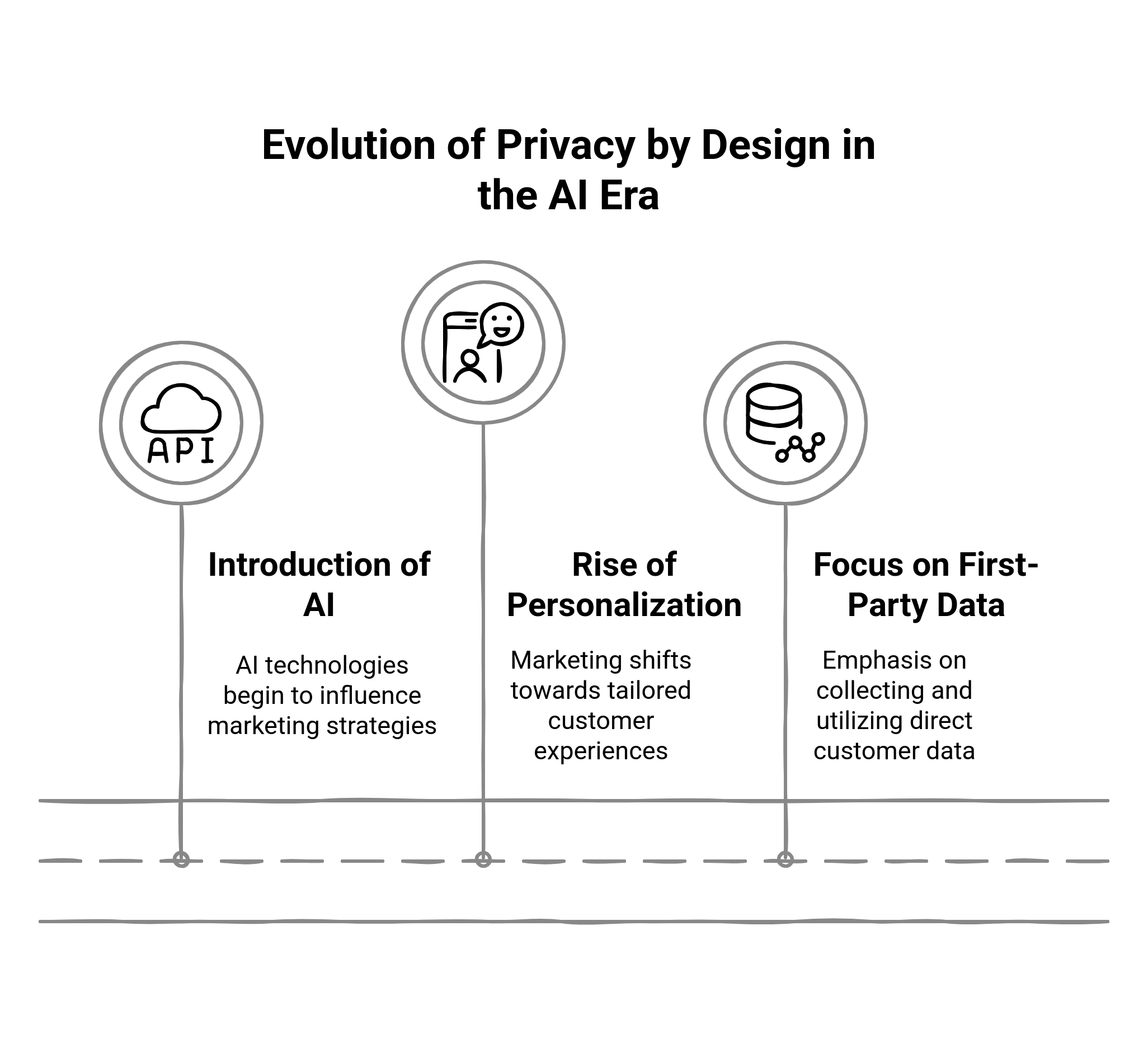
First introduced in the 1990s by Dr. Ann Cavoukian, the then Information and Privacy Commissioner of Ontario, Canada, Privacy by Design (PbD) was meant to be the ideology around which all privacy systems and technologies are structured, right from the emergence or conception stage onward.
It wasn't until 2018 that PbD found a legal footing under Article 25 of the GDPR. What has now turned a voluntary framework into a legal requirement for any organization processing personal data belonging to EU citizens is Article 25. This article requires companies to put into practice "data protection by design and by default," meaning that businesses shall proactively minimize data collection and access, unless that collection and access are strictly necessary for that purpose.
The Rise of AI, First-Party Data, and Hyper-Personalization
By the year 2025, the world will have changed tremendously. The increase in artificial intelligence personalization, predictive analytics, and first-party data strategies has made both data worth much more and more dangerous. Tools that track behavior intent, segment users in real-time, and orchestrate omnichannel experiences are already operating on streams of highly identifiable data.
This has turned PbD not only into a legal requirement but a strategic imperative. AI models can not only identify who the individual user is in a re-identified way using anonymized sets of data, but can also use spell factor ones. Hyper-personalized journeys can also lead to manipulation. The disappearance of third-party cookies has put the whole ethical personalization burden on first-party data-how the products are designed, governed, and maintained.
Redefining Privacy by Design for Today’s SaaS and Digital Products
What does the nuts and bolts of Privacy by Design look like, especially in the context of the digitally based stack, for today and the year 2025? In 2025, PbD is no longer a set of compliance-related checkboxes. It is architectural decision-making that prioritizes user trust:
- User-centric defaults: Consent means opting in-not hidden in legalese.
- Minimal data: You collect only what is necessary-not because of what you can, but because you should.
- Transparent flows: Each data point has a precise rationale and an overt reason for being.
- Cross-functional ownership: Privacy does not get stuck inside "legal." It is shared by product marketing, engineering, and compliance.
- Real-time data governance: Systems can respond to privacy preferences in real time-not only for static audit logs.
In short, by 2025, Privacy by Design will not just be an option or a theory anymore. Instead, it will be a design pattern to be considered by any company that wants to responsibly curate customized services, build enduring trust, and future-proof its data ecosystem.
Why Privacy by Design Matters in a Personalization-First World
This section investigates the clash between personalization and privacy, explains why scrutiny by regulators intensifies, and outlines how Privacy by Design could serve as a strategy advantage rather than just marking a compliance box.
The Personalization vs Privacy Paradox
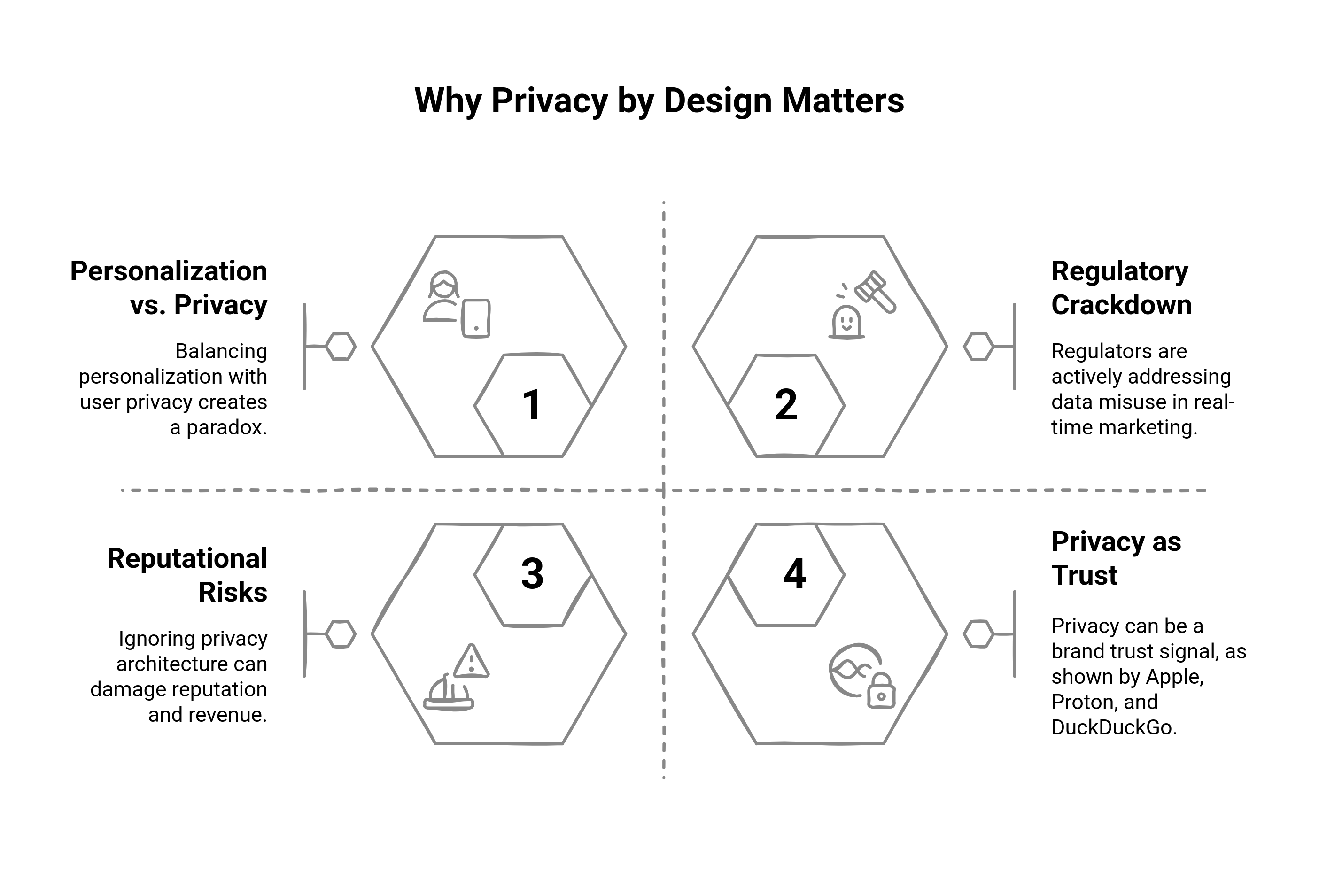
Data power personalization-the more you know about a user, the more relevant you can be; however, relevance can quickly slip into surveillance if users think they are over-tracked or manipulated. This paradox is central to modern marketing: how can one personalize experiences and yet leave autonomy and consent intact for users?
Most efforts in personalization often end up being covert forms of invasion-invasively tracking users without meaningful consent, profiled without clarity, or nudged to behaviors that cross ethical lines. The fact that Privacy by Design is intended to resolve the inherent tension allows for a contextualized experience within the borders set by the user.
Real-time Marketing Under Regulatory Fire
Real-time personalizing tools and behavioral targeting engines, another hype wave, and of late, regulators have been stepping into the fray to assess the environments within which businesses collect and process personal data. Judged from its recent judgments in the EU and the US, the ball is rolling in one direction; it is no longer excusable for personalization engines not to have built-in privacy controls.
For example, regulators investigate how these adtech stacks manage real-time bidding, identify resolution, and provide location-based content. Such offenses lead not only to penalties for the breaches, but also to systematic design flaws that create vulnerability for user misuse. Thus, companies that build evidence that privacy was not an afterthought, but rather built from day one, are clear. Privacy by Design helps avert the risk of later consequences.
Cost of Getting Privacy Wrong
Not attending to privacy architecture can cost far more than merely court fines. For a company, an affront to privacy means more than monetary loss; it means a full loss of trust, brand equity, and customer lifetime value.
Every public incident of a privacy breach can cause churn, negative publicity, and weak user confidence for a long time afterward. Unlike usability and performance bugs, privacy mistakes are viewed as integrity breaches. Users in the Software as a Service (SaaS) crowded arena bail out quickly when they experience opacity or insecurity.
Privacy as an Indicator of Brand Trust
Conversely, privacy-first brands stand to benefit. Apple, Proton, DuckDuckGo, etc., have made privacy an important part of their brand promise, and users have rewarded them with loyalty and advocacy. It is such companies that primarily set privacy as one of their product differentiators rather than as an impediment. Embedding privacy controls features-from mail-tracking blockers to anonymously browsing modes-into the product design gives these companies a strong dose of control and transparency: stronger brand stories, deeper customer relationships, fewer legal problems.
The 7 Core Principles of Privacy by Design
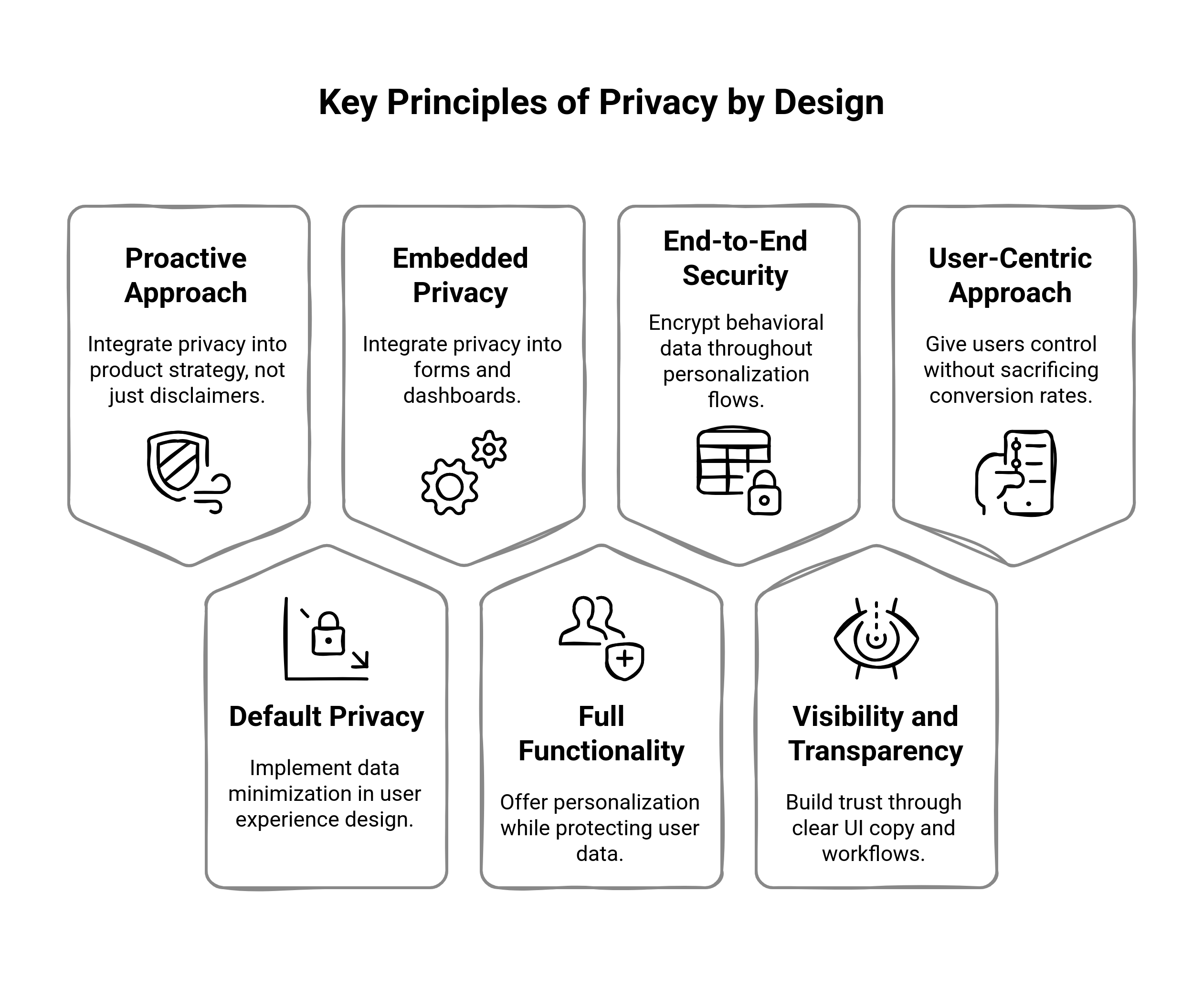
Privacy by Design is not an academic concept; rather, it is a set of practical principles that would inform your SaaS product's handling of users' data. Here, we analyze each of the seven core principles and break them down into frameworks of action for personalization-first merchants.
Proactive, Not Reactive: Bake Privacy Into Strategy, Not Just Policies
In most instances, companies respond to privacy matters after a data breach, some complaints, or the authorities forcing their hands to do so. Unfortunately, by that time, it is already too late. A proactive stance integrates privacy not only in legal documents but also in the product roadmap; for instance:
- During sprint planning, ask: Is this feature respecting least-privilege data use?
- Flag personalization experiments that collect sensitive behavioral signals without valid consent.
- Design safeguards before shipping, not after user backlash or regulatory fines.
This all-inclusive approach fosters resilience rather than just compliance.
Privacy as the Default Setting: Minimize Data by Design
The simplest explanation is: If a user does nothing, their privacy should still be granted. In personalization, this principle manifests itself in:
- Opt-in consent by default, not opt-out
- Progressive profiling: Collect only the data needed at each stage of the journey.
- Pre-filled form fields driven by session data—not stored personal info—unless explicitly consented.
You don't need to track everything to personalize effectively. Often, less data equals more trust and higher conversion.
Privacy Embedded Into Design: Build With It, Not Around It
Privacy shouldn’t be patched in as a legal disclaimer—it should be baked into the product architecture. SaaS examples:
- In dashboards: show what data is being collected and why (e.g., “We’re using this heatmap to improve page load performance”).
- In CDPs, allow marketers to build segments that exclude sensitive identifiers by default.
- In forms: use smart defaults and conditional logic to request only essential fields based on user behavior, not “just in case” data hoarding.
This turns privacy into a UX feature, not a burden
Full Functionality – Positive-Sum, Not Zero-Sum
There’s a common myth that you have to sacrifice personalization quality to achieve privacy. The truth? You can do both—if you design smartly. For example:
- Use real-time intent signals (e.g., clicks, time on page) instead of invasive identity graphs.Offer personalized recommendations based on session-level behavior without storing user identities.
- Give users control without crippling the experience—such as toggling off retargeting or audience tagging.
This principle challenges teams to pursue innovation, not compromise.
End-to-End Security
There is no privacy if you do not secure the data that sits behind it. In the case of those who handle personalization and SaaS:
- Since the behavioral tracking data is personal, you must end-to-end encrypt that data whenever it is used, likely across systems.
- For marketers, they must have role-based access controls (RBAC) to protect themselves from using any personal information.
- Keep logs of every single event of data access or export, with alerts set to trigger on anomalies.
Solid security is privacy. You are not just maintaining data; you are securing relationships.
Visibility and Transparency: Make Data Practices Understandable
Trust is built between users when they feel that they are being informed and have freedom rather than being placed in the dark.
- Visibility regarding privacy: Add phrases like "Why am I seeing this?" hovering alongside personalized areas or recommendations. Develop simple-language privacy pop-ups—basic modals or tooltip alerts that explain in brief what types of data are employed and not hidden in privacy policies.
Introduce user data settings directly into the product—now, please, no more support tickets. Transparency is the foremost value today in so much uncertainty, and where most companies still use legal notions and policies as a veil.
Respect for User Privacy: Keep Control With the Individual
Last but not least, allow the user to drive themselves. Examples :
- Let users customize their preferences for personalization (e.g., "Show me content by industry, not by my browsing history)
- Opt out easily from email tracking, heatmaps, or cross-device identification.
- Privacy is viewed not as a compliance tax but as a product experience.
It builds equity for your users, which in turn strengthens CLV in the longer term.
How to Implement Privacy by Design in Your Product or Website
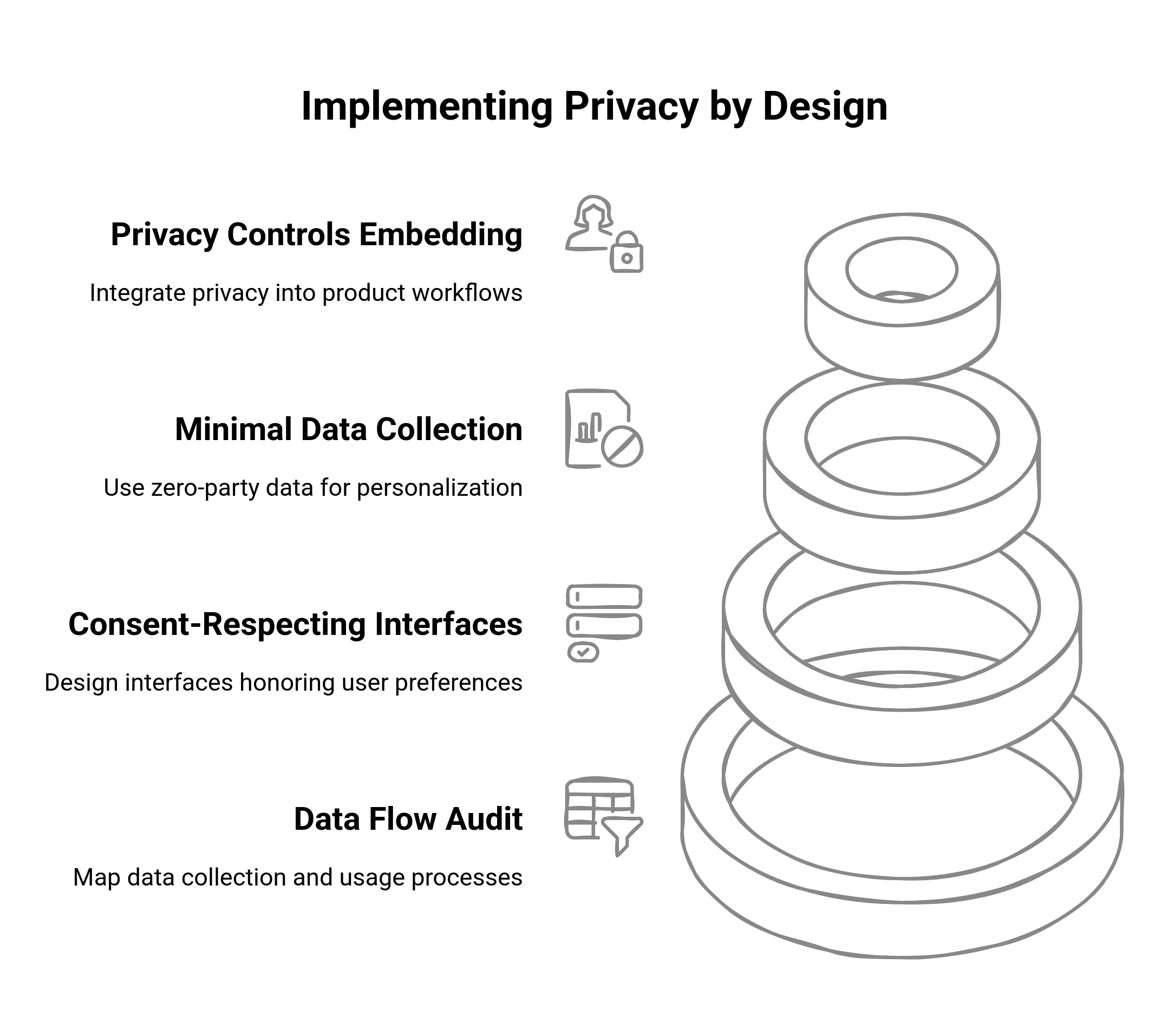
Privacy by Design isn’t just a theory—it’s a product discipline. In this section, you’ll learn how to apply PbD principles practically by auditing data flows, redesigning consent UX, minimizing data collection, and embedding privacy into product and admin workflows.
Audit Your Current Data Flows and Personalization Logic
Before you can improve privacy, you need to understand your data landscape. Most SaaS and marketing teams underestimate how complex their data pipelines have become. What to do:
- Map your entire data lifecycle:
- Where and how is data collected? (Web, forms, APIs, third-party tools)
- Where is it enriched or stitched together? (CDPs, CRMs, personalization engines)
- Where is it stored? (Databases, cloud platforms, spreadsheets)
Where is it used? (Dashboards, email tools, ads, recommendation engines)
Identify “hot zones”: These are parts of your system where PII (personally identifiable information) or behavioral fingerprints are combined or used to trigger personalized actions.Ask: Is this justified? Is it visible to the user?
- Classify your data:
- Essential: Required to deliver the core service (e.g., email for onboarding)
- Optional: Enhances user experience, but not mandatory (e.g., job title, industry)
- Intrusive: High-risk data that should be avoided unless explicitly needed (e.g., precise location, behavioral clusters, inferred intent)
Outcome: This exercise builds a foundation for redesigning how your personalization works—with privacy built in.
- Map your entire data lifecycle:
Design Interfaces That Respect Consent and Preferences
Consent is more than a pop-up—it’s a user experience. When implemented well, it can increase trust and reduce friction in the long run. What to do:
- Design for granular consent: Break down data usage into categories: performance tracking, marketing, personalization, and third-party tools. Let users toggle on/off each category rather than bundling them together.
- Make consent revocable, not permanent: Users should be able to change their preferences at any time, without emailing support. Add a visible, persistent preference center to your product or website.
- Improve consent UX across interfaces:
- Cookie banners: Use clear language (“We personalize based on your on-site activity. You can opt out.”), not dark patterns.
- Form fields: Mark the optional fields clearly. Don't default to unchecked consents.
- Preference centers: Include easy-to-understand labels (“I want content tailored to my role” vs. “Track my behavior”).
- Adaptive personalization based on consent level:
- If a user denies marketing cookies, switch to session-based or contextual personalization.
- Example: Serve “most viewed content in your industry” instead of user-specific suggestions.
Outcome: These changes give users real control, reduce legal risk, and reinforce your brand’s integrity.
Minimize Data Collection Without Sacrificing Experience
You don’t need to collect everything to deliver value. In fact, smart personalization can happen with less data—if you design it well. What to do:
- Use zero-party data strategically:
- Ask users for their preferences explicitly rather than inferring everything.
- Example: “What best describes your role?” in onboarding flows or welcome modals.
- Replace email gates with intent signals:
- Instead of gating content behind a form, track content engagement, scroll depth, or feature usage to personalize experiences.
- Example: If a user visits multiple product pages, show a tailored CTA like “See how this fits your tech stack.”
- Apply progressive profiling:
- Start with only the essential fields, then gradually collect more information over time as the relationship deepens.
- Tools like Clearbit or Fragmatic can personalize based on company firmographics without needing user PII upfront.
Outcome: You achieve relevance and personalization without collecting risky data, reducing both user fatigue and compliance burden.
- Use zero-party data strategically:
Embed Privacy Controls into Your Product and Admin Workflows
The final step is ensuring that your internal workflows support Privacy by Design, not undermine it behind the scenes. What to do:
- Role-based access control (RBAC):
- Not every team member needs access to raw user data.
- Limit who can see/export PII based on job function (e.g., marketing, sales, devs).
- Add opt-out mechanisms to the product:
- Let users disable behavioral tracking or personalized dashboards—without downgrading their experience.
- Opt-out CTAs should be visible, not hidden in footers or obscure settings.
- Adopt “default off” thinking:
- When building new features, start with least privilege access.
- Only enable personalization modules, tags, or integrations when explicitly needed and consented to.
- Implement audit trails:
- Track who accessed or modified data and when.
- This is not just for security—it also helps you prove compliance during audits.
- Outcome: Privacy becomes part of your product operations, not just a legal policy.
- Role-based access control (RBAC):
Privacy by Design in Action: Real-World Examples from SaaS and B2B
Good theory and execution. Examples from leading SaaS or enterprise companies provide evidence of how Privacy by Design can be implemented at scale across different business models and product maturity levels.
The Anatomy of Privacy Built Into Business DNA: Microsoft
Superimposing its Trustworthy Computing program on top of the already operational Privacy by Design culture, Microsoft has been leading in implementing Privacy by Design since 2002, years before most regulations required compliance. Their implementation serves as a model for how large enterprises can institutionalize privacy across teams and lifecycles.
Organizational Integration: Microsoft has more than 40 full-time privacy professionals and more than 400 staff members with privacy-related roles. This federated model ensures privacy is not siloed, but rather infused into engineering, marketing, product, and support.
Governance Through Privacy Reviews: Every product or service with privacy implications has a formal review. These aren't just check-box exercises; they're embedded checkpoints that gate launches until privacy risks are resolved.
Lifecycle-Level Controls: The Security Development Lifecycle mandates privacy and security controls from design to deployment, which entails continuous monitoring, threat modeling, vulnerability testing, and post-release remediation protocols.
Takeaway: Do not treat privacy like a department but a discipline extending into architecture, compliance, and user experience.
Salesforce: Innovation Driven by Privacy
Trust is elevated as the top value core to the Salesforce brand-and Privacy by Design has a huge role to play. The best practice has a trajectory for other B2B SaaS platforms grappling with complex enterprise use cases as well as compliance requirements.
Integrated-PDIAS makes use of high-risk processing activities to trigger effect during the development of a new product, not after, as with DPIA. Henceforth, privacy will not be an afterthought.
Customer-Controlled Compliance: This puts privacy settings right within reach of the Salesforce customers using built-in encryption, audit trails, and automated retention to comply by design or customize at scale.
Transparency through enablement: Salesforce does this both in relation to its product functionality and privacy documentation with the customer so that they understand not only what they can do, but why it matters.
Takeaway: The emphasis is that privacy in a B2B model is not just about the internals; rather, it concerns a customer's empowerment to fulfill their own requirements, too.
Google: Useful Privacy Without Losing Scales
Google has embodied Privacy by Design as the most effective means of achieving data-driven product development with substantial user controls and transparency. Their practices reflect a level of maturity concerning data minimization and healthy user agency.
Default Data Minimization: Auto-deletion settings are now enabled for new users by default for the purpose of periodically clearing activity data, thereby reflecting the principle of collecting things only for as long as one needs them and only those they actually need.
User Control Empowered: Users may review, download, port, or delete their data through a consolidated account dashboard. These tools live up to their promise: they are both intuitive and granular, making privacy controls accessible to non-technical users.
Radical Transparency: Google's clear statements on the types of data collected, how it uses such data, and the incessant iteration that it does not sell any personal information reinforce its privacy policy with interactive tools as a means to making abstract concepts easily understood.
Takeaway: Privacy needn't mean sacrifice for comfort. That would indeed make it viable for clear controls and default settings to reduce friction and build trust.
HubSpot: Privacy at Scale for the Mid-Market.
HubSpot describes how a mid-market SaaS platform can integrate Privacy by Design in an extensive yet user-friendly manner with regard to marketing and sales use cases that massively capitalize on behavioral data.
Built-in Privacy Controls: From cookie consent management to advanced automated privacy workflows, HubSpot provides privacy tools as part of the core product, rather than premium add-ons. The tools are meant for marketers and are not restricted to being used by IT personnel only.
Privacy-Driven Product Development: The privacy and security teams at HubSpot work directly with product teams to ensure that privacy requirements are considered as early as the feature initial planning stage, not just at the point of launch.
Compliance as Workflow: HubSpot has put this platform to work to tell GDPR storylines such as consent collection and fulfillment of data-subject rights. Turning privacy from a legal burden into a business-as-usual process.
Takeaway: Privacy can and should be self-serve. Build for usability, not just compliance.
Privacy by Design and Regulatory Compliance: GDPR, CCPA, HIPAA, and More
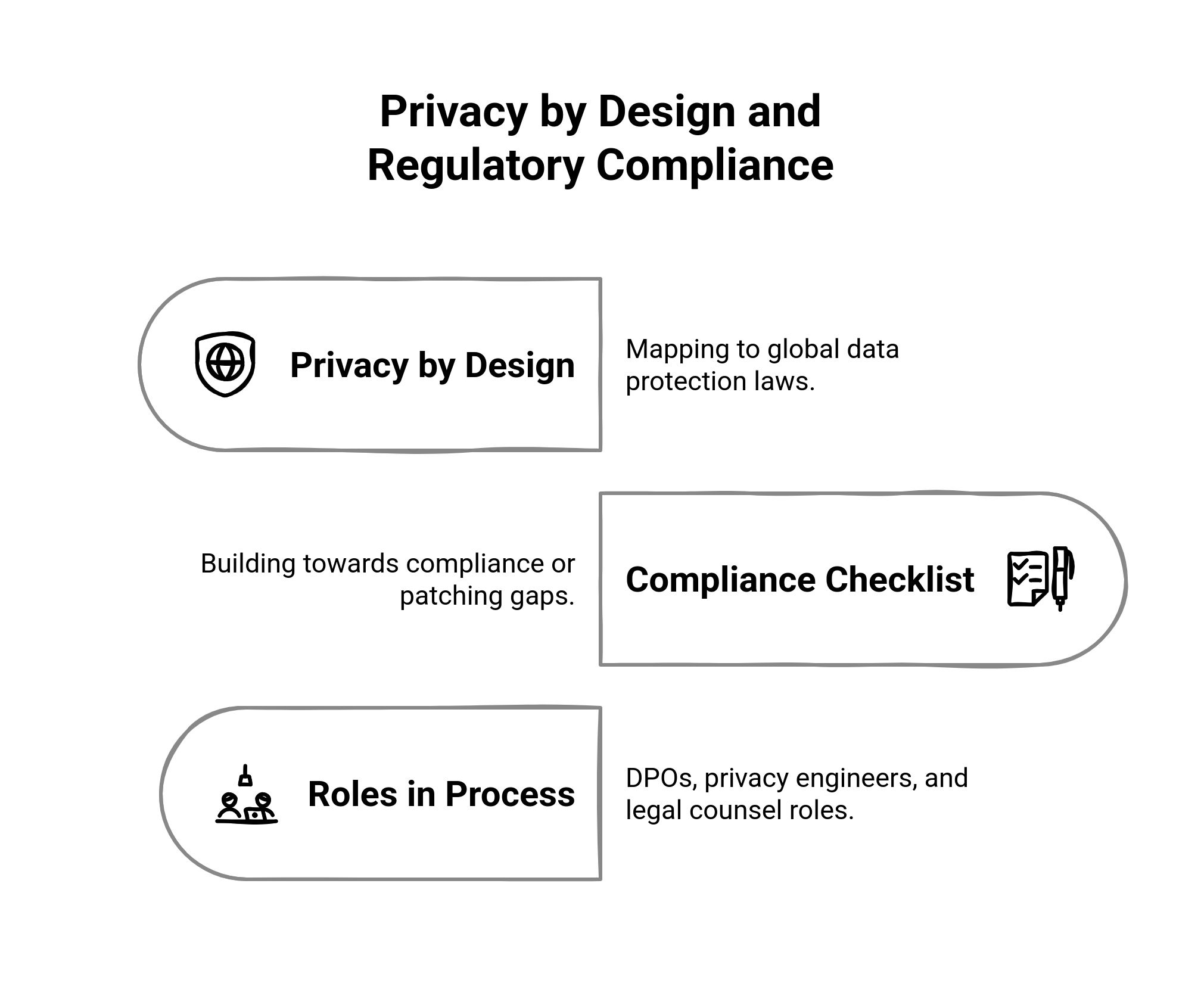
Privacy by Design is not only a nice-to-have but is increasingly becoming a legal requirement. In this section, we will take a deeper look at how Privacy by Design principles align with data protection frameworks around the world, as well as how compliance positions can be evaluated and who needs to be involved to make privacy operational.
How Privacy by Design Maps to Global Data Protection Laws
Privacy by Design is no longer optional for teams working with user data, especially in B2B SaaS, healthtech, and enterprise applications. Major regulations now require it by design and by default:
- GDPR (EU/UK): Article 25 explicitly requires controllers to implement data protection by design and by default. That means minimizing data collection, ensuring access controls, and enabling users to control their information, right from the start.
- CCPA / CPRA (California): While not using the same terminology, CCPA emphasizes transparency, purpose limitation, and user rights—principles that align directly with PbD. CPRA expands this with data minimization and risk assessments for sensitive personal data.
- HIPAA (USA - healthcare): HIPAA mandates administrative, physical, and technical safeguards to protect health data. While it’s not a “privacy by design” law per se, its requirements push organizations toward many of the same principles, especially end-to-end security and access control.
- LGPD (Brazil), PDPA (Singapore), PIPEDA (Canada): These and other modern laws also adopt GDPR-inspired principles, with similar expectations around data minimization, transparency, and user rights enforcement.
Bottom line: If you’re applying PbD, you’re future-proofing your product for a growing patchwork of global laws.
The Roles That Drive Compliance Through Privacy by Design
Building privacy into your product and workflows requires cross-functional collaboration. Here's who should own what:
- Data Protection Officer (DPO): Required under GDPR for many organizations, your DPO acts as the privacy conscience of the company, advising on risk, reviewing DPIAs, and ensuring alignment with local laws.
- Privacy Engineers: Increasingly common in SaaS and enterprise teams, privacy engineers build the systems that support PbD—from access control APIs to consent management layers and anonymization pipelines.
- Product & UX Teams: These teams own how privacy shows up for users in workflows, dashboards, forms, and default settings. Without their buy-in, legal requirements don’t translate into usable features.
- Legal Counsel: In-house or external legal teams provide the necessary interpretation of laws, draft privacy policies, and help define data processing boundaries. But they can’t make privacy actionable without support from product and engineering.
- Marketing & RevOps: These teams must ensure compliance in data activation, especially when using data in campaigns, enrichment, retargeting, and reporting.
Pro tip: Treat privacy like security—a shared responsibility model with clear ownership at every layer.
Common Pitfalls to Avoid When Implementing Privacy by Design
From unintentional over-collection of data to deceptive design, many reasons account for various missteps that even good-hearted teams will inadvertently make and derail their Privacy by Design initiatives. Here are the most common missteps, along with tips to help in the avoidance of responsibility.
Personalization Excessiveness with Third-Party Enrichments
Enrichment tools that append firmographics or behavioral data (Clearbit, ZoomInfo) are potent; however, when indiscriminately used, these violate the key PbD principles:
The Pitfall: Profile enrichment with no clear disclosure or consent readily occurs in a B2B environment. This scenario may involve the creation of crude firmographies for anonymous visitors to be targeted with extra-specific messaging.
Why It’s a Problem: By not having explicitly provided such data or opting in for that enrichment-monstrosity, they breach the very first principle of user-centric privacy, which might also attract any enforcement action under GDPR.
What to do instead: Disclose enrichment clearly and directly in your privacy policy and UI, with an easy opt-out option for inference-based personalization. For example, personalized tiers could be offered to users based on their declared preferences.
Causing Consent Fatigue with Overly Aggressive Opt-ins
You've seen it yourself—the modals, banners, and popups asking for permission for everything imaginable: tracking, cookies, emails, profiling, geolocation.
The Pitfall: Bombarding users with a myriad of checkboxes or nuancing a modal fatigue into existence just to have plausible consent on "file." This might serve legal risk-wise-but fritters away a lot of trust.
Why It is a Problem: Consent is not merely getting the consent out of a user. It must require free choice, every necessary piece of information, and the ability to withdraw consent. Contracting a bad consent experience leads to abandonment or unconditional acceptance.
What to Do: Ask for progressive permission. Ask for core permissions first, then ask for deeper permissions as users continue to engage. Making it easy for users to change their choices at any time is also a good idea.
Manipulative Data Sharing with Dark Patterns
Designing nudges that lead users to data sharing via manipulation, confusion, or guilt is a violation of user trust and PbD.
The Pitfall: Hide opt-outs in obscure places, pre-select checkboxes, use deceitful wording such as “Continue to have the maximized experience," or make refusal more difficult than consent.
Why it is a Problem: Not only is this unethical and immoral, but it is now illegal in many jurisdictions. Deceptive UX is under scrutiny from regulators under California's CPRA and the GDPR.
What to Do Instead: Conduct a dark pattern audit on your onboarding, cookie banners, and forms. If users can't say "no" with the same ease as "yes," you're out of compliance.
Failing to Update: Not Renewing Privacy Practices as Personalization Grows Changes
Products change. Data strategies evolve. But privacy policies and workflows often get left behind.
The Pitfall: Launching new features (e.g., AI recommendations, user journey mapping, predictive targeting) without updating DPIAs, privacy notices, or consent frameworks.
Why It is a Problem: Most of the time, newer data uses necessitate novel consent models, new impact assessments, or at least new documentation.
What to Do Instead: There should be a model privacy review loop that runs through the lifecycle of a product. It is every new personalization feature that should cause a re-evaluation of what data is being used, how it will be processed, and what the user sees.
Getting Started: A Privacy by Design Implementation Roadmap
Privacy by Design is not a one-off checklist but rather an organizational and cultural change. If you are ready to embrace privacy in your personalization engine and product workflows, then this five-step roadmap will provide a clear beginning.

Step 1: Appoint a privacy champion or task force
You cannot operationalize privacy without ownership. One must have privacy at the table when engaging with product, engineering, marketing, and legal. For implementing this, either one person (DPO), or a cross-functional group should be held accountable.
What to do:
- Nominate a privacy lead (even if unofficially) inside the product organization.
- Establish a privacy steering committee if you're mid-sized or larger.
- Set a schedule for quarterly reviews of privacy-impacting initiatives.
Pro tip: Empower the privacy owner with visibility, not just accountability.
Step 2: Perform a Privacy Audit of Data Touchpoints
Before building, figure out what you're collecting and how it flows. Many teams underestimate the number of touchpoints for collecting, storing, or inferring user data. If you do not know what is at play, you will not be able to design for privacy.
What to do:
- Map all data touchpoints. Include forms, tracking scripts, chatbots, personalization tools, CDPs, and CRMs.
- Know what data is collected (e.g., PII, behavioral, inferred) and why.
- Sort data among essential, optional, or unnecessary for your use case.
Pro tip: Create a "data flow diagram" that indicates the origin, processing, and residency of data.
Step 3: Updated Flows with Transparency and Control
Incorporate privacy considerations not only into the program and marketing flows but also into the privacy policy itself. Most violations of privacy occur not because the data is stolen, but because the users never knew about it or felt pressured to share.
What to Do:
- Major flows should be reframed—sign-up, form filling, content gating, cookie banners—and be set up to allow informed consent with revocability.
- Impose layered messaging—progressively disclose what is collected, and more importantly, for what.
- Adaptive personalization: Present generic CTAs if the user denies enrichment and tweak messages based on his/her consent levels.
Think like UX: Ask yourself, "How would this feel if I were the user?"
Step 4: Roll Out Changes with User Education and Comms
Privacy improvements are good only if they come with user awareness and understanding. There are cases of private update announcements being made quietly, and out of sheer compliance--transparency and trust come from conscious communication.
What to do:
- Big changes (a new privacy center, new consent tools, etc.) should be communicated on all user channels, like by email or through product modals.
- Make your write-ups clear and human-readable, avoiding any legalese.
- Explain how users can control their data and why those controls matter.
Pro Tip: Treat privacy updates just like any other feature release and promote their benefit for the user.
Step 5: Monitor, Review, and Iterate as Laws and Tech Change
Privacy isn’t static. It must evolve with your product and regulatory environment. A “set it and forget it” privacy policy is a liability. New regulations (like India’s DPDP Act, or upcoming U.S. state laws) and product features will constantly create new data scenarios.
What to do:
- Set recurring privacy reviews tied to your product roadmap.
- Stay informed on global privacy developments.
- Document DPIAs (Data Protection Impact Assessments) for major new data features.
Pro Tip: Make privacy a feature, not a footnote. The best teams treat user trust as a competitive advantage.
Conclusion
In a world where data powers every personalization engine, Privacy by Design is no longer a nice-to-have—it’s a product differentiator, a compliance necessity, and a trust accelerator. Whether you’re building dynamic website experiences, orchestrating multichannel journeys, or personalizing based on behavioral signals, privacy isn’t the tradeoff—it’s the foundation. Done right, it enables deeper personalization with user trust at the core, not in conflict with it. The organizations leading the way—Microsoft, HubSpot, Salesforce—aren’t perfect, but they’re proving that respecting user data builds brand equity, loyalty, and long-term growth.
If your company is serious about personalization, it must be serious about privacy. That means moving beyond checkbox compliance toward proactive design, transparent UX, and ethical data strategies that evolve with regulation and expectation. The next generation of marketing and product innovation will belong to those who make privacy feel like empowerment, not friction. The time to embed it is now.


