Introduction
AI has fundamentally changed how marketers engage with audiences, offering hyper-personalized experiences at scale. From predictive analytics to automated content recommendations, AI-powered tools can analyze vast amounts of data in real time, uncovering patterns that would take humans months to identify. This has led to a surge in AI-driven marketing campaigns that adapt dynamically to user behavior, promising relevance and efficiency like never before. However, despite its capabilities, AI is not immune to flaws—it can misinterpret context, reinforce biases, and sometimes create experiences that feel robotic rather than genuinely personalized.
This is where human oversight becomes indispensable. While AI can process data at an unmatched speed, it lacks the ability to truly understand emotions, cultural nuances, and ethical considerations. A well-trained AI can optimize engagement metrics, but it cannot determine whether its messaging aligns with brand values or resonates with human sentiment. Without human intervention, AI-driven campaigns risk falling into the trap of unintended biases, tone-deaf messaging, or even privacy concerns that can damage brand reputation. Marketers must serve as the guiding force, ensuring AI remains a tool for enhancement rather than an unchecked decision-maker.
In this blog, we’ll explore why AI, despite its capabilities, still requires human oversight to prevent biases, misinterpretations, and ethical risks. We’ll examine the limitations of AI, the critical role of marketers in guiding AI-driven strategies, and how businesses can build a framework for effective AI-human collaboration. By striking the right balance, brands can harness AI’s power while ensuring their marketing remains ethical, strategic, and authentically human.
The Rise of AI in Marketing: Benefits and Limitations
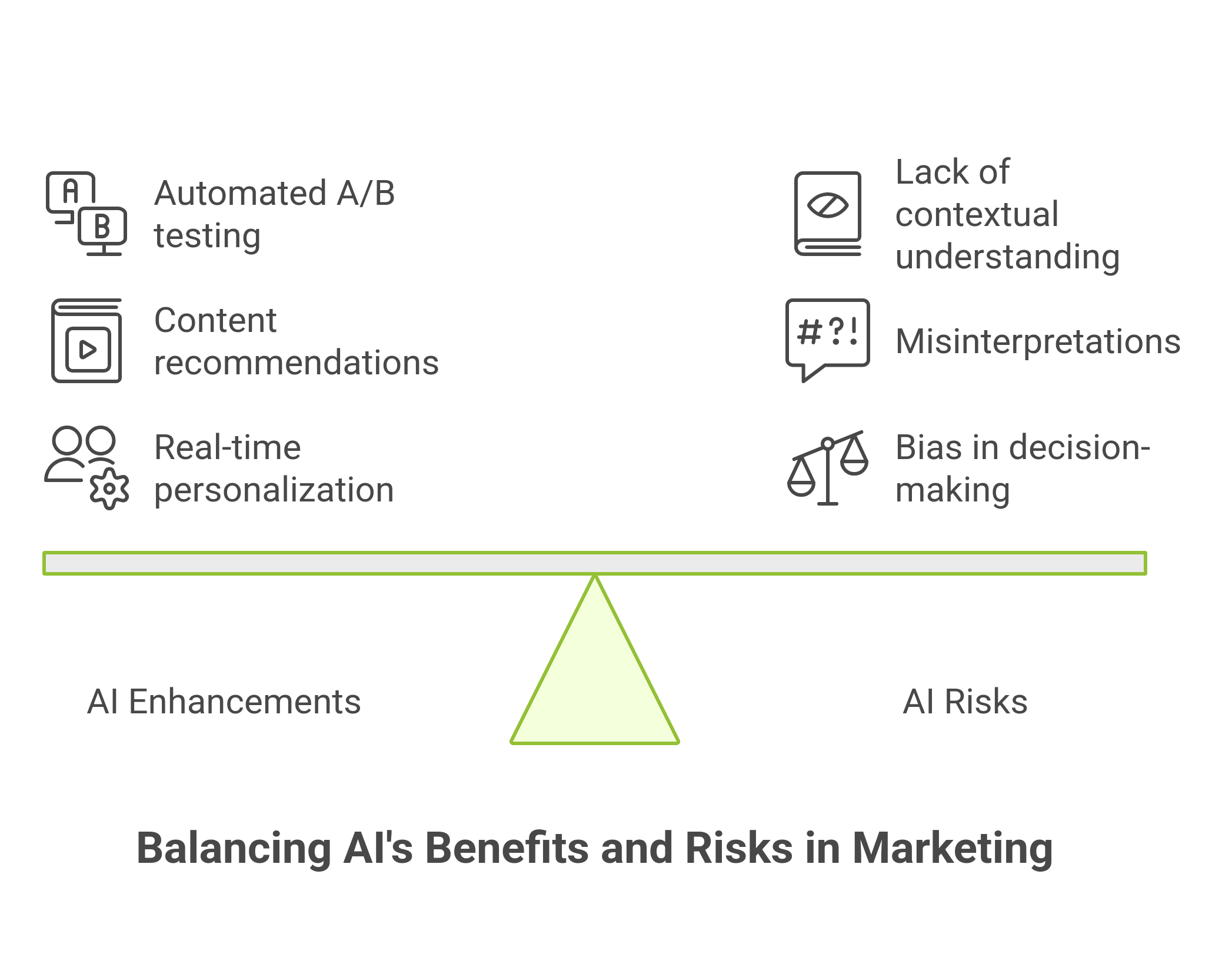
AI is reshaping marketing by enabling hyper-personalized experiences and data-driven decision-making. It automates processes, enhances customer engagement, and improves targeting accuracy. However, AI is not without its risks—biases, misinterpretations, and a lack of human intuition can lead to flawed outcomes. To maximize AI’s potential, marketers must strike the right balance between automation and human oversight.
How AI Enhances Marketing
AI has transformed marketing by enabling real-time personalization, predictive analytics, and automated decision-making. With AI-driven algorithms, brands can tailor content based on user behavior, serving the right message at the right time. AI-powered recommendation engines, like those used by Netflix and Amazon, analyze past interactions to suggest relevant content, increasing engagement and retention. Automated A/B testing allows marketers to test multiple variations of content simultaneously, accelerating optimization. Predictive segmentation further enhances targeting by identifying high-value prospects based on behavioral patterns, making marketing campaigns more precise and effective.
The Dangers of AI Without Human Oversight
Despite its advantages, AI is not infallible. It operates purely on data, which means any biases within the dataset can lead to skewed or even discriminatory outcomes. AI-driven ad targeting has, at times, excluded certain demographics due to flawed historical data, leading to ethical concerns. Moreover, AI struggles with contextual understanding—it may misinterpret sarcasm, emotions, or cultural nuances, resulting in tone-deaf messaging. Without human intervention, AI can also prioritize engagement metrics at the expense of user experience, serving clickbait-style content rather than meaningful, value-driven messaging.
The Balance Between Automation and Human Intuition
AI’s ability to process data and optimize marketing efforts is unmatched, but human intuition remains essential for strategic oversight. While AI identifies patterns, humans provide the ethical judgment, creative direction, and emotional intelligence needed to refine marketing strategies. AI should be seen as an assistant that enhances decision-making rather than replacing human expertise. By establishing clear guardrails, brands can leverage AI’s efficiency while ensuring their marketing remains authentic, ethical, and aligned with customer expectations.
Where AI Falls Short: Why Humans Are Still Needed
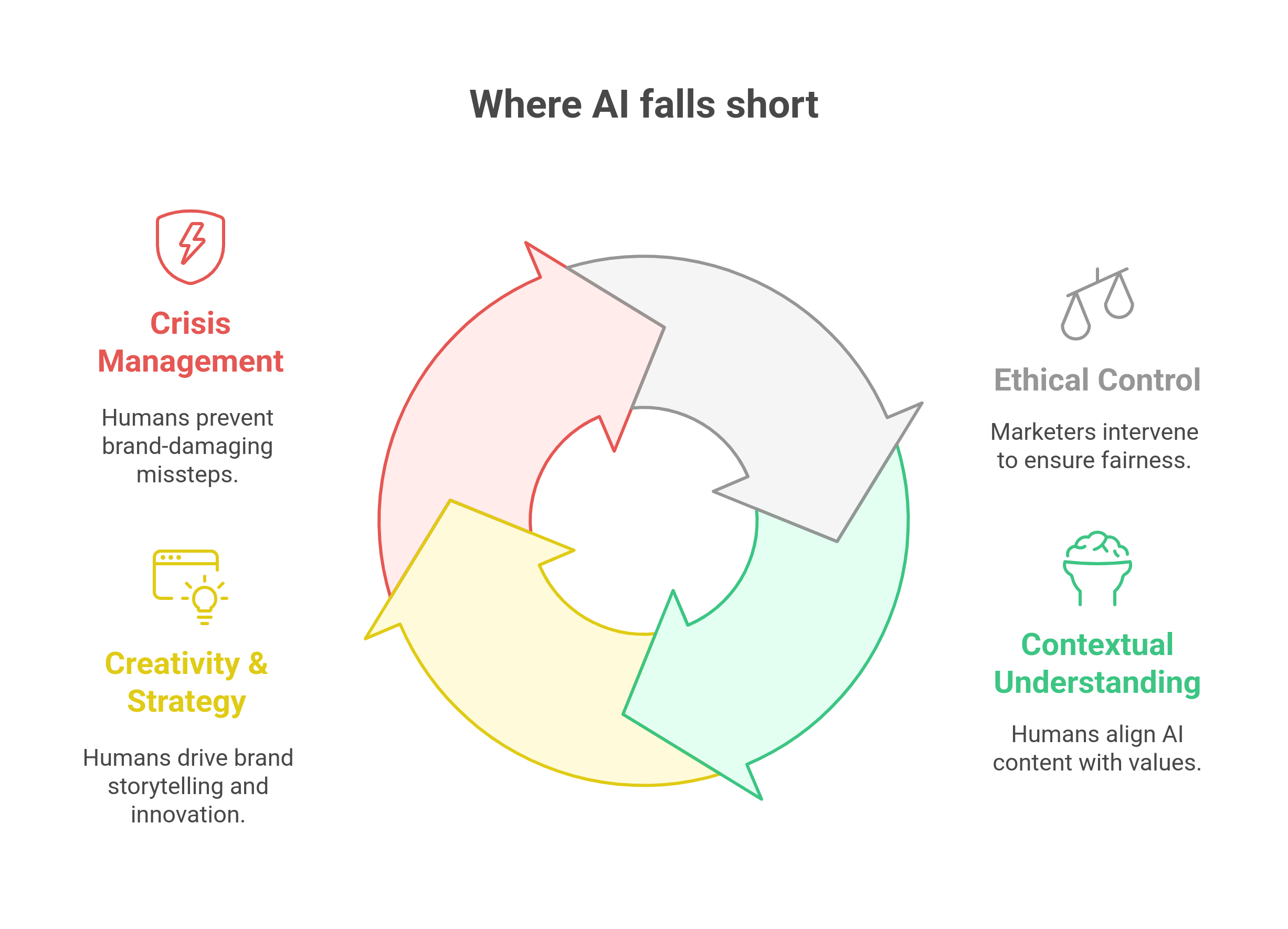
AI has undoubtedly transformed marketing by enabling hyper-personalization, automation, and data-driven decision-making. However, despite its many strengths, AI has inherent limitations that make human oversight essential. AI operates purely on patterns and data—while it can optimize campaigns and predict behaviors, it cannot understand emotions, context, or ethical considerations in the way that humans can. This gap creates risks, from reinforcing biases to delivering tone-deaf messaging that damages brand reputation. To ensure AI-driven marketing remains ethical, strategic, and brand-aligned, human expertise is necessary to provide oversight in key areas.
Ethical & Bias Control
AI’s decision-making process is only as good as the data it’s trained on. If that data contains biases, AI will perpetuate and even amplify them. There have been instances where AI-driven ad targeting has disproportionately excluded certain demographics or where AI-generated content has reflected stereotypes. For example, some hiring algorithms have inadvertently discriminated against women or minorities because they were trained on biased historical data. In marketing, this could translate into biased ad placements, unfair segmentation, or exclusionary messaging that alienates certain audiences.
Marketers play a crucial role in mitigating these risks by auditing AI outputs and applying ethical considerations that AI itself cannot grasp. This involves actively reviewing AI-generated content, adjusting algorithms to ensure fair representation, and setting guidelines for responsible AI use. Without human intervention, brands risk losing trust and facing backlash for allowing AI to operate without ethical guardrails. Ensuring that AI-driven marketing remains inclusive and socially responsible is a task that only humans can effectively oversee.
Contextual Understanding
While AI can analyze text, speech, and user behavior, it lacks true comprehension. It does not understand cultural nuances, sarcasm, humor, or emotional tone in the way humans do. This can lead to misinterpretations that impact how a brand communicates with its audience. For instance, AI chatbots or automated responses may misread customer sentiment, respond cheerfully to a complaint or fail to detect frustration in customer feedback. In global marketing, AI can struggle with local sensitivities, accidentally generating messaging that is inappropriate or offensive in certain regions.
Human oversight ensures that AI-generated content aligns with brand values, audience expectations, and cultural contexts. Marketers act as the final filter, reviewing AI-driven messaging before it reaches the public. They refine content to ensure that it conveys the intended tone and meaning, preventing potential missteps that could harm a brand’s reputation. While AI can assist in scaling content production, human intuition remains irreplaceable in crafting messaging that is truly relatable and contextually appropriate.
Creativity & Strategy
AI is excellent at optimizing existing strategies, but it cannot replace human creativity or visionary thinking. AI can suggest which subject lines have the highest open rates or which ad creatives drive the most conversions, but it cannot originate a compelling brand story, create a disruptive marketing campaign, or develop a long-term brand strategy. AI lacks imagination—it works within the parameters set by historical data and predefined algorithms, meaning it cannot think outside the box or introduce new creative concepts in the way humans can.
Marketers are responsible for defining the big picture—shaping brand narratives, positioning products in competitive landscapes, and crafting experiences that resonate emotionally with customers. AI can assist by providing insights, but it cannot determine how a brand should evolve, how it should communicate its unique value, or how it should build customer relationships over time. The most impactful marketing campaigns are built on human creativity, with AI serving as a supporting tool rather than the driving force.
Crisis Management
One of AI’s biggest weaknesses is its inability to anticipate and respond to crises appropriately. AI-driven automation operates based on historical data, making it incapable of predicting unprecedented events or rapidly adjusting to evolving situations. This can be particularly dangerous in public relations or brand reputation management. If a company faces a crisis—such as a product recall, a major social issue, or a PR scandal—AI may continue running ads, sending pre-scheduled emails, or recommending content that feels out of touch with the situation.
Human marketers are essential in these moments, as they can quickly assess the situation, halt campaigns, and craft sensitive, real-time responses. AI lacks the ability to read social and emotional cues that define crisis communication. Without human intervention, brands risk appearing tone-deaf, insensitive, or opportunistic in the face of global events. Crisis management requires empathy, adaptability, and strategic decision-making—qualities that only human oversight can provide.
The Human-AI Partnership
While AI has revolutionized marketing, it is not a replacement for human expertise—it is a tool that enhances human capabilities. The most effective marketing strategies are those that combine AI’s data-driven precision with human creativity, ethical reasoning, and strategic oversight. AI can automate tasks, analyze vast amounts of data, and generate insights, but humans must remain in control to guide its outputs, refine messaging, and ensure that AI-driven marketing aligns with brand values.
The Framework for Human-AI Collaboration in Marketing
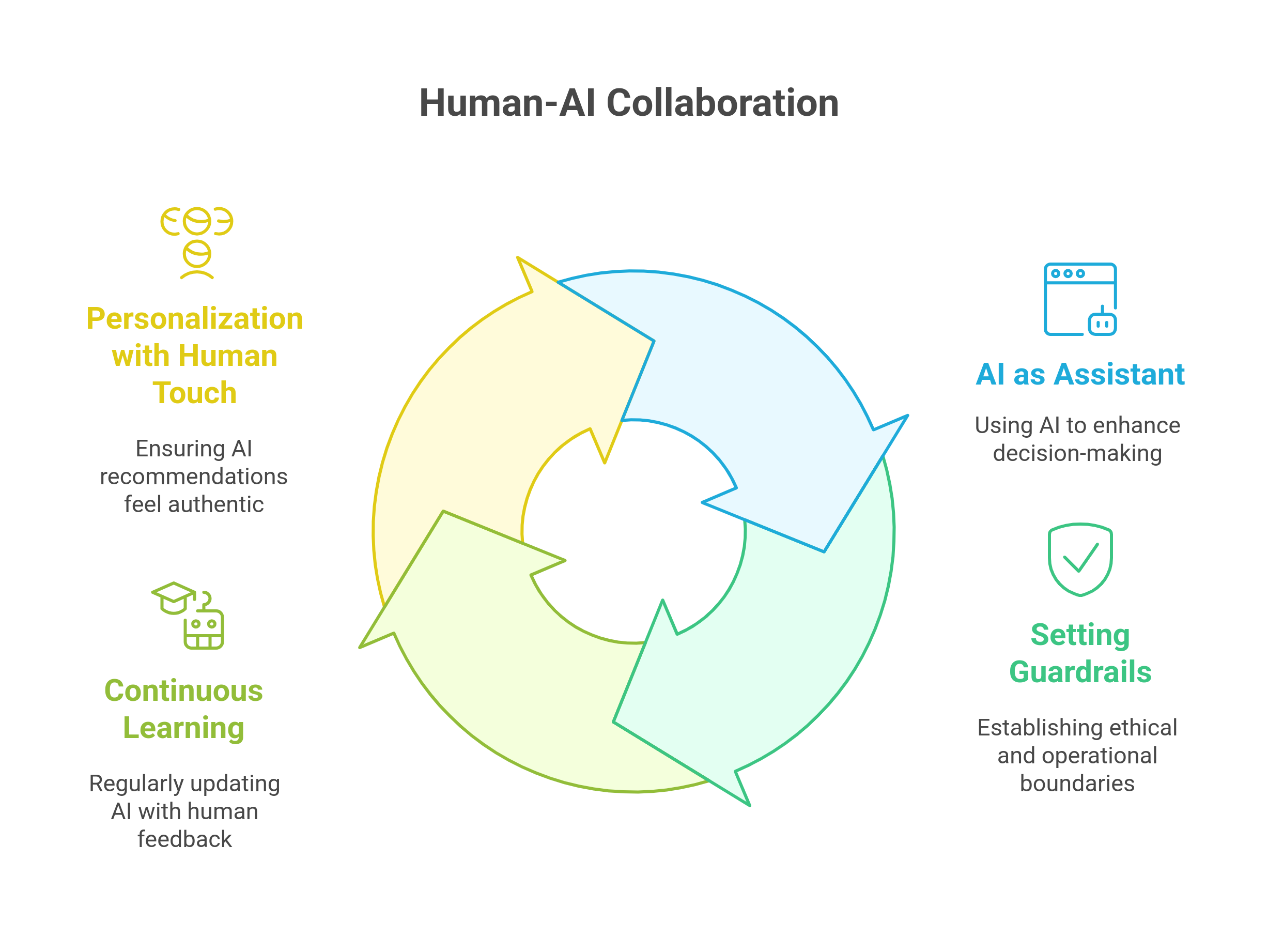
As AI becomes more deeply integrated into marketing workflows, the key to success lies in striking the right balance between automation and human oversight. AI should not be viewed as a replacement for marketers but rather as an assistant that enhances efficiency, provides insights, and scales personalization efforts. However, without the right framework, AI-driven marketing can become impersonal, biased, or misaligned with brand values. To ensure AI remains a powerful yet responsible tool, businesses must establish clear strategies for collaboration, including ethical guardrails, continuous learning, and human-guided personalization.
AI as an Assistant, Not a Replacement
AI excels at processing large volumes of data, identifying patterns, and automating repetitive tasks—but it cannot replace human creativity, intuition, and strategic thinking. Marketers should leverage AI to enhance their decision-making rather than delegating critical business choices entirely to algorithms. For example, AI can analyze customer behavior to suggest the best-performing email subject lines, but it should be a marketer who decides which aligns best with the brand’s voice and campaign objectives. Similarly, AI can recommend content variations for different audience segments, but marketers should fine-tune messaging to ensure it resonates on an emotional level.
By treating AI as a co-pilot rather than an autonomous decision-maker, brands can harness its strengths while maintaining control over their messaging and positioning. AI should provide marketers with insights and recommendations, but final approvals, creative direction, and strategic pivots should always remain in human hands. This approach ensures that AI enhances rather than diminishes the human element in marketing.
Setting Guardrails
To prevent AI from making misguided decisions, businesses must establish clear ethical guardrails and workflows that ensure human oversight at key touchpoints. These include:
Ethical Guidelines: Defining company policies on responsible AI use, including how data is collected, processed, and applied to marketing strategies. This helps prevent privacy violations, biased targeting, or intrusive personalization.
Diversity Audits: AI models should be regularly audited for potential biases in messaging, audience segmentation, and ad placements. This ensures that AI-driven campaigns are inclusive and do not unintentionally exclude or stereotype certain demographics.
Content Approval Workflows: Instead of letting AI autonomously publish content, businesses should implement human approval checkpoints. AI-generated copy, recommendations, or automated customer interactions should be reviewed by marketers before going live to ensure they align with brand values and campaign goals.
Without these safeguards, AI-powered marketing can drift into ethically questionable territory, risking brand reputation and customer trust. Establishing structured workflows ensures that AI remains an asset rather than a liability.
Continuous Learning
AI models are only as good as the data they are trained on, which means they require continuous monitoring and fine-tuning to remain effective. Unlike humans, AI does not "learn" in a way that allows it to adapt contextually without explicit reprogramming. To maintain relevance and accuracy, AI-driven marketing tools should be continuously updated with human feedback.
This involves:
Regular Performance Reviews: Marketers should analyze AI-generated outputs to determine whether they align with business objectives, making adjustments when necessary.
Feedback Loops: AI systems should allow marketers to provide direct feedback, refining recommendations over time. If an AI-generated campaign underperforms or produces irrelevant suggestions, human intervention is necessary to correct the course.
Updating Training Data: Consumer behavior, language trends, and cultural contexts evolve—AI should not be operating on outdated information. Regularly updating datasets ensures that AI-driven personalization remains relevant and effective.
By integrating human feedback into AI workflows, businesses can prevent stagnation and ensure that AI adapts to the ever-changing landscape of marketing.
Personalization with a Human Touch
One of the greatest risks of AI-driven marketing is the potential for personalization to feel robotic or overly mechanical. While AI can segment audiences and tailor content based on data-driven insights, it lacks the emotional intelligence to craft experiences that feel truly human. Personalization should go beyond algorithmic recommendations—it should create meaningful connections with customers. Marketers play a crucial role in ensuring that AI-powered personalization feels authentic by:
Adding Emotional Intelligence: AI can suggest personalized product recommendations, but marketers should infuse messaging with human warmth, empathy, and creativity.
Customizing AI Outputs: Instead of relying on AI-generated content as-is, marketers should refine language, tone, and formatting to ensure it aligns with the brand’s personality.
Blending AI with Human-Led Engagement: Automated recommendations should complement—not replace—genuine human interactions. For example, chatbots can handle routine customer queries, but complex or sensitive issues should be escalated to a human representative.
The Future of AI in Marketing
AI in marketing is advancing at an unprecedented pace, with increasingly sophisticated algorithms capable of personalizing content, predicting customer behavior, and automating entire campaigns. Yet, as AI grows more powerful, the need for human oversight is becoming more—not less—critical. While AI can process vast amounts of data and make split-second optimizations, it lacks the judgment, ethics, and creativity that define truly effective marketing. The future of AI-powered marketing will not be about replacing humans but about evolving the role of marketers to work alongside AI in more strategic ways.
As AI technology advances, we are witnessing the rise of AI copilots—intelligent systems designed to assist marketers rather than replace them. These AI-powered assistants can provide recommendations, automate workflows, and generate insights, but they still require human intervention to ensure relevance and accuracy. Additionally, the emergence of explainable AI—AI models that provide transparency into how decisions are made—will allow marketers to better understand and refine AI-driven strategies. Ethical AI frameworks will also become a necessity, ensuring that AI-powered marketing remains compliant, inclusive, and aligned with brand values. Companies that fail to establish these frameworks risk alienating customers with impersonal, biased, or intrusive marketing efforts.
For marketers, the key to thriving in an AI-dominated landscape lies in future-proofing their skills. Instead of fearing automation, marketing professionals should focus on areas where human intelligence is irreplaceable: strategic thinking, creative storytelling, brand positioning, and ethical decision-making. AI can generate insights, but it takes a marketer to translate those insights into compelling narratives. AI can automate testing, but it requires human intuition to interpret the results and iterate effectively. By embracing AI as a tool rather than a threat, marketers can elevate their roles from execution to strategic, leading innovation rather than reacting to automation.
Conclusion
AI is transforming marketing, making it more data-driven, efficient, and scalable than ever before. However, AI is not autonomous—it requires human oversight to be truly effective. Without human intervention, AI can lead to biased messaging, tone-deaf personalization, or automation errors that damage brand trust. The best marketing strategies are those that harness AI’s speed and precision while preserving human creativity, ethics, and intuition.
In the future, AI and human marketers will work in collaboration, not competition. AI will handle data-heavy tasks and provide recommendations, while marketers will focus on the strategic, creative, and ethical dimensions of marketing. Companies that successfully integrate AI while maintaining human oversight will not only optimize efficiency but also build stronger, more authentic customer relationships. The future of marketing is not just AI-powered—it’s AI-augmented, with humans firmly in the driver’s seat.