Introduction
Martech Stack no longer remains a tactical toolbox; rather, it has become the nerve of modern marketing strategy. Where, at the outset, a collection of isolated tools for email, analytics, and social media endeavors came together and then morphed into a highly integrated ecosystem that successfully augments personalization and performance. For CMOs, growth leaders, and marketing teams, the pressure is mounting. The existing systems cannot cope with real-time personalization, data-driven engagement, or the right equilibrium in the customer journey. There is an obligatory need to run faster to adopt intelligent Marketing Automation, a composable tech stack, and AI-driven platforms, not just an option now, but a mandatory line of difference between leading the market and trailing behind. Be it scaling up or optimization of the work of established tools, building a Martech Stack that is truly agile, linked, and future-driven has become the rightful burden.
In this blog, we will dive deep into the Martech Landscape as of 2025, delineating the potential challenges that might make marketers more vulnerable in their quest to achieve success. You will also learn how best to integrate Martech, do an audit that is more effective than all others, and most importantly, save them from making mistakes that cost them good money. Iconoclasts will show you how to organize or optimize your Martech Stack to ensure it lasts through eternity.
What is a Martech Stack and Why It Matters in 2025
Short for Marketing Technology Stack, a Martech stack is basically a set of tools, platforms, and technologies that marketers use to plan, execute, analyze, and optimize marketing campaigns within a specific channel or across all channels. By 2025, the Martech stack will no longer be a collection of disparate software tools. It instead constitutes a unified data-driven environment in which customers experience seamless journeys and measurable business growth. Integrated at the core of a Martech stack are Customer Data Platforms (CDPs), Marketing Automation, Campaign Analytics, Content Management Systems, and Personalization Engines. These are the technologies for collecting and automating workflows, personalizing interactions, and reporting performance across every channel and anywhere, from email through social media and web experiences.
How Martech Has Evolved
This has also been the case until now, where most companies treat Martech as a shiny object. These companies acquire point solutions to deal with a single isolated marketing problem. In 2025, however, the conversation has changed. Today's Martech stacks think in ecosystem terms. They have become composable, built with modular tools that could be connected, adapted as per requirements, and scaled according to business needs.
Changes like these reflect an even bigger change, namely, that marketing strategy has now shifted. Siloed tools create disjointed customer experiences. Today's winning brands focus on interoperability from marketing to sales to customer success, where data, workflows, and insights can all flow fluidly across departments.
Martech vs. Adtech vs. RevOps: Understanding the Convergence in 2025
In 2025, the boundaries between Martech, Adtech, and Revenue Operations (RevOps) are increasingly blurred. Understanding how they intersect is key to building a high-performance, scalable stack.
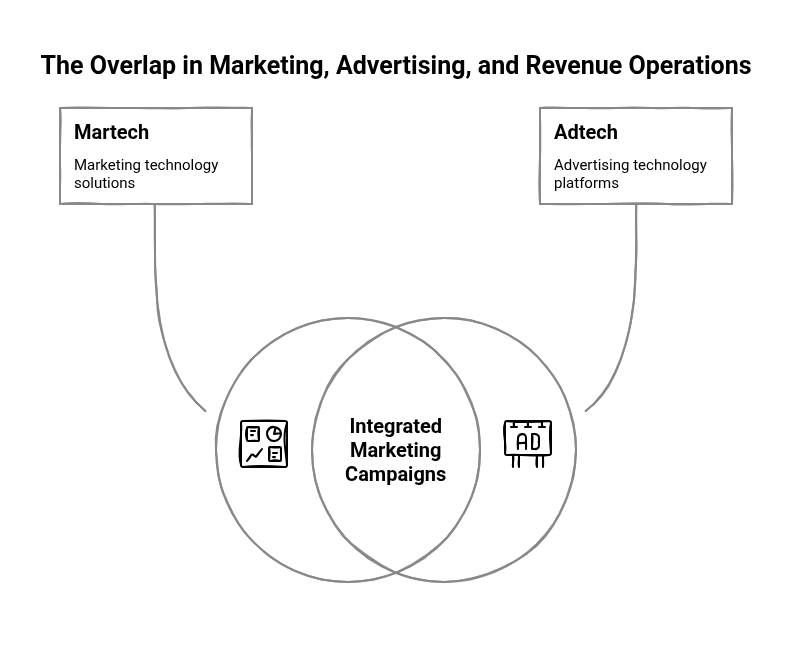
- Martech focuses on and will manage owned and earned media tools for customer relationship management, email campaigns, SEO, personalization, and a few analytics tools. These are basically powering the experience you fully control.
- Adtech makes money from paid media, the demand, ad server, retargeting, and programmatic advertising systems. Most times, that's where customer acquisition starts.
On the contrary, RevOps is the operational backbone across marketing, sales, and customer success. It seems that all those go-to-market systems are aligned around shared data, metrics, and processes, as well as those systems that belong to Martech and Adtech. Therefore, on a very basic level, your Martech stack will have to be capable of meeting its marketing objectives and integrating seamlessly with sales enablement, ad delivery, and customer service engagement. To put it very rudely, by 2025, your Martech strategy will be your revenue strategy.
Key MarTech Trends Reshaping the Landscape in 2025
Foundational change is underway within the Martech arena of 2025. Greater expectations of consumers and the transformation of data ecosystems compel marketers to rethink their processes of building, integrating, and activating technology. Below are considered to be the five most significant Martech trends influencing brand engagement, personalization, and growth in the present landscape.

AI-Native Martech Tools: Copilot to Fully Autonomous Campaigns
In 2025, this would mark the tipping point in the acceptance of AI-native Martechs. These are not legacy systems with AI features strapped on; they were built from the ground up with machine learning, generative AI, and real-time decision-making engines as their core. The marketing teams today rely on AI for everything from predictive segmentation and content generation to autonomous campaign execution. Forget AI-generated subject lines; today, systems serve as marketing companions and, in some cases, fully autonomous orchestration of campaigns across channels while continuously optimizing in real-time, based on performance data and customer behavior.
Composability and Modularity in Martech
Those days of "one-size-fits-all" monolithic marketing platforms are on their way out by 2025, where brands would embrace composable Martech stacks built from interoperable, best-in-class tools that can be flexibly integrated and swapped out as changes in needs arise. This modularism is such that it allows greater agility, cost-effectiveness, and innovation. Besides being trapped in a vendor's roadmap, marketers have the freedom to compose their own stack from microservices, APIs, and headless architectures that could fit surprisingly well into their go-to-market model. It's quite a change from rigid to resilient.
Architecture Driven by Privacy: How to Make Sense of Post-Cookie and Compliance Challenges
As third-party cookies continue to be erased and global data privacy laws become tighter, privacy first does not just apply to Martech but becomes mandatory. In 2025, marketers will have to embed consent management, strong data governance, and privacy-preserving analytics in their stacks. Server-side tagging, clean rooms, and differential privacy are becoming the standards. It is now competitive to trust, and number ethics are primary to the Martech strategy.
CX, Sales, and Marketing Convergence
The once distinct silos of marketing, sales, and customer experience (CX) tech stacks are being demolished as the marketplace converges into a unified platform stretching across the customer lifecycle-allowing for closer departmental, interdepartmental alignment. By 2025, the pioneering organizations of the future will be building an integrated system, potentially including CRM, CDPs, support tools, and engagement platforms on a single platform. Such convergence will create real-time visibility, paving the way to true omni-channel orchestration, where marketing does not stop at developing a lead but, as an example, encourages loyalty, growth, and advocacy.
Zero And First Party Data: Fueling Personalized Marketing Next Generation
With third-party data rapidly declining, zero-party and first-party data are becoming the backbone of personalized marketing. In 2025, prominent brands will intensify their endeavors in collecting declared data from customers directly (zero-party) and behaviorally observed data from the owned channel (first-party). Modern Martech stacks are now meant to ingest, activate, and personalize that data-rich and granted. From preference centers to interactive experiences like quizzes and product finders, marketers are building trust while gaining deeper insights to power hyper-personalization at scale.
Core Martech Stack Components that Every Marketing Team Needs in 2025
Marketers will have to create a 21st-century, not just a robust but also agile and interconnected, marketing technology stack if they want to be competitive in 2025. A well-designed martech stack includes core components that drive marketing at a new level of personalization, data-based, and scalable experience. Here is a list of every MarTech tool an organization needs to develop customer experiences that matter and can be measured in ROI.
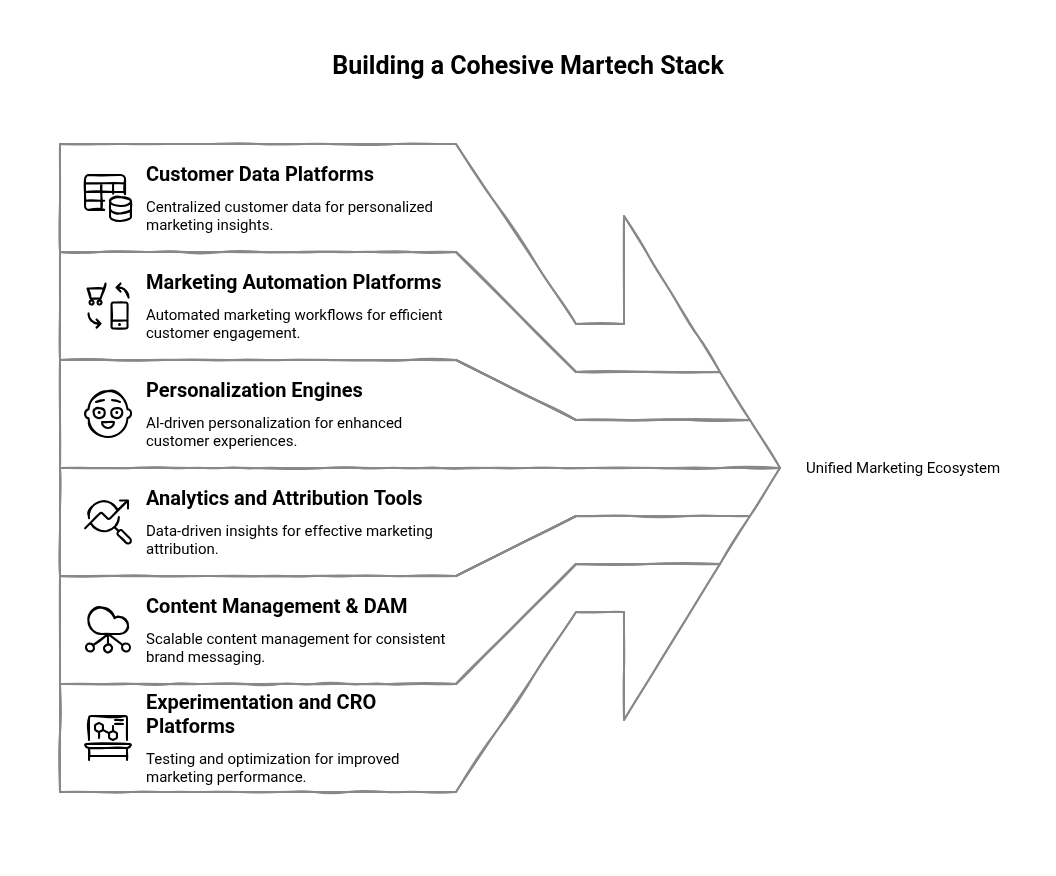
Customer Data Platforms (CDPs): The single source of customer truth
As we know it, a Customer Data Platform (CDP) has become the skeleton of the modern Martech stack. It aggregates customer data from all sources, including CRM, website, email, support, and transactions, into a single, accessible profile. By 2025, CDPs will be mostly AI-enabled solutions that provide real-time segmentation, identity resolution, and predictive insight. These solutions enable marketers to confidently activate personalized campaigns across channels, with privacy regulations in mind, maximizing data transparency across teams.
Marketing Automation Platforms: Orchestrating Customer Journeys
Marketing automation tools are just that-they allow marketers to send the right message at the right time via triggered campaigns, drip sequences, and multi-channel orchestration. Come 2025, and automation means something much bigger than email—it's SMS, in-app messages, push notifications, chats, and even direct mail. The next-gen platform provides AI-driven recommendations, journey mapping, and dynamic audience management, enabling marketers to build adaptive customer experiences that respond to real-time behavior and preferences.
Personalization Engines: Delivering Real-Time, AI-Powered Experiences
In 2025, real-time personalization is no longer a matter of choice—it's expected. Thus, personalization engines in 2025 utilize machine learning to customize content, offers, and product recommendations dynamically across websites, emails, and mobile applications. They use first-party data and zero-party data to synthesize 1:1 experiences based on user intent, lifecycle stage, and historical behavior. Built-in decision-making logic for predictive scoring, along with continuous optimization, is expected to foster both engagement and conversion.
Analytics and Attribution Tools: Marketing Proofs
The use of marketing analytics and attribution tools becomes crucial in an era of tight budgets and increased skepticism. In the year 2025, the tools will not only be able to provide these vanity metrics but also allow for incremental attribution and include the ability to apply predictive analytics. Externalities take into account all major platforms: the major players integrate with CDPs, CRM, and ad platforms, which will provide a true 360-degree view of the actual customer lifecycle and closed-loop reporting. Furthermore, with AI, marketers can not only forecast trends but also simulate campaigns and optimize in real time, linking marketing performance to revenue directly.
Holistic Operations in Content Management Systems (CMS), Digital Asset Management (DAM): Scalable Content Operations
Content is still king, although in 2025, it must also be possible to do the creation, management, and distribution of it at scale. Modern CMS and Digital Asset Management (DAM) tools provide for this. They allow marketing teams to centralize assets, along with enabling version control and repurposing content across channels and formats. Headless CMS options provide flexibility for omnichannel delivery, whereas DAM systems ensure brand consistency and faster go-to-market execution-all never before possible.
Experimentation and CRO Platforms: Data-Driven Testing at Scale
Entering Continuous testing is the major secret of highly efficient marketing teams. These are conversion rate optimization (CRO) and experimentation platforms, with which marketers run A/B tests, multivariate tests, and, eventually, real-time feature flag testing. Such tools are expected in 2025 to integrate very thoroughly with analytics techniques and create the very complex possibilities for non-technically oriented users to validate hypotheses, enhance their UX, and scale successful programs without depending entirely on development teams.
Integration and iPaaS Tools: Uniting Martech Stack
No martech stack would perform well in isolation; connection tissues between tools are integration platform as a service (iPaaS), ensuring that data flows evenly from one point to another, from CDP to CRM, automation to analytics, CMS, all the way to personalization engines. Indeed, these tools greatly assist with customer data synchronizations, workflow automations, and API management without custom code writing. By 2025, low-code and no-code interfaces may prove to be rather commonplace, allowing marketers to gain more stack ownership without IT barricades.
How to Audit and Optimize Your Existing Martech Stack for 2025
As Martech budgets get ever more scrutinized and customer expectations seemingly become more difficult to meet, merely having tools is no longer sufficient. Starting from 2025, marketing leaders will have to proactively go about auditing and optimizing their Martech stack to ensure alignment with business objectives, integration across teams, and intelligence for scaling. In a sense, be it is inheriting a legacy system or fine-tuning a mature stack, the following framework will guide you in identifying gaps, getting rid of waste, and maximizing your ROI.

Signs Your Stack is Underperforming or Outdated
Before auditing your stack, your most rudimentary step is to recognize the signs of damage. Here are some examples of red flags that may signal it might be time for your stack to be overhauled:
- Tools duplicating each other: Multiple platforms to run the same functions (e.g., two CRMs, two email tools) with minimal use.
- Siloed data: Customer insight that is dispersed across channels or platforms shall not be connected together.
- Weak adoption: Major tools are unattended by marketing, sales, or ops teams due to complexity or lack of training.
- Slow campaign velocity: New campaigns would take a long time and much effort to launch due to the multiple integrative processes, even developer time.
- ROI not clear: Difficulties linking revenue items to tool usage or outputs or retention, or performance metrics.
- Limited personalization: Difficulties in providing contextual, dynamic experiences across the customer journey.
If any of these issues are prevalent, it is definitely costing more than contributing to the stack and thus it is worth the time to reevaluate.
Conducting a Martech Gap Analysis: Matching Tools to Goals
A Martech gap analysis is a method of assessing what tools you have and what tools will be required to achieve your marketing and business goals as they currently stand. Here are the steps in doing this:
- List your marketing goals for the year 2025 (e.g., increase CLTV, reduce CAC, improve lead velocity, expand into new channels).
- Inventory by category the tools you already have in place: CDP, CMS, CRM, automation, analytics, personalization, etc.
- Map every tool to a goal: Ask yourself, "How does this tool contribute to that outcome?" Be honest. Identify gaps and overlaps: Do you lack capabilities (for example, testing tools, AI personalization)? Are multiple platforms either underused or do they duplicate functionality?
This process helps to shift the Martech conversation away from tools and toward outcomes, ensuring that each piece in your stack has an articulated purpose.
Frameworks for Martech Stack Audits: TEAM vs. RACE
We'll be using these two proven frameworks for your Martech audit and optimization process:
TEAM Framework (Technology, Execution, Adoption, Measurement)
- Technology: Do your current tools fit your strategy and scale? Are they secure, modern, and integrable?
- Execution: Can your current team efficiently execute campaigns and journeys using this stack?
- Adoption: Are the tools well adopted and understood from marketing, sales, and CX perspectives?
- Measurement: Can you really track, attribute, and optimally perform through the stack?
This framework makes for great internal health checks and strategic alignment across departments.
RACE Framework: Reach, Act, Convert, Engage
- Reach: Do you have tools to draw new audiences (SEO, paid media, influencer platforms)?
- Act: Can you engage and capture leads effectively (landing pages, lead scoring, chatbots)?
- Convert: Are there tools in place to nurture and convert leads (CRM, automation, personalization)?
- Engage: Do you support post-sale engagement and loyalty (email, community, CX platforms)?
The RACE model is the best fit for aligning your Martech with the customer journey at weak spots where tech may be failing to deliver at a stage.
Aligning Martech with Business Goals and GTM Strategies
Ignoring most aspects of the optimization of Martech is strategic alignment. A tool may be great when used alone, but if it does not directly support GTm, it will be seen as a distraction and not a differentiator. You can ask yourself:
- Does our Martech stack support our business models, for example, PLG, Sales-Led, ABM, or eCommerce?
- Do tools get configured to the customer lifecycle stages or are they still kept in departmental silos?
- Are we using tech for cross-functional efficiency between marketing, sales, and success?
- Is our stack flexible enough to support future priorities, for example, global expansion, new verticals, AI-driven workflows, etc.?
Once the stack reflects actual business outcomes, customer acquisition, retention, and revenue, it will be possible to streamline operations while gaining clarity in executive buy-in and budget support.
Criteria and Questions to Consider When Selecting the Right Martech Tools for 2025
Deciding on Martech in 2025 will be more than just trying to catch up with the latest technology trend; it is all about the strategic scaling of platforms that interact with each other and support the long-term vision of the company. It doesn't matter which tool it is: a CDP, a personalization engine, or even an analytics tool; getting it wrong can mean months of delay in implementing the wrong decision, revenue loss, and frustration for you and your team members. The following is an overview of the main criteria and key questions every marketing director should consider before acquiring or replacing a tool in their Martech stack.
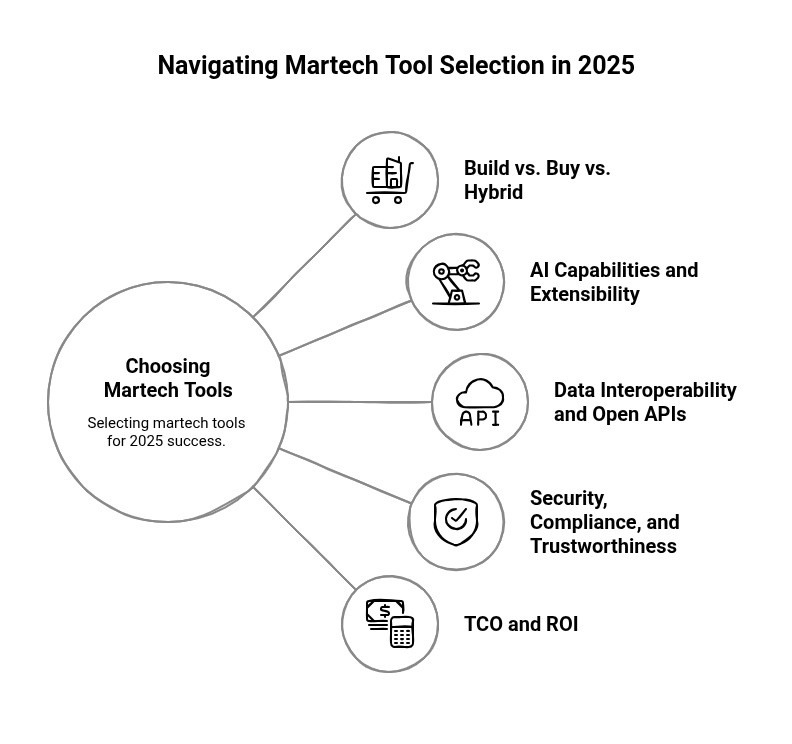
Build vs buy vs hybrid: Which strategy suits your organization best?
By 2025, businesses will have three main approaches when it comes to their implementation of Martech:
Buy: Off-the-shelf SaaS platforms need short timeframes to deploy and come with built-in support, security, and feature sets. Overall, they are the solution for companies focused on speed and scale.
Build: For companies with deep engineering talent or very specific needs, flexibility, and full control can be achieved by building custom Martech method solutions.
Hybrid: Core platforms increasingly seem to be bought (CDP, CMS), with proprietary layers built on top (decision engines, customer scoring models).
Also, the question: Do we have the technical resources to build and maintain a solution? Or should we integrate and speed-to-value with a vendor?
Evaluating AI Capabilities and Extensibility
Today, just about every Martech vendor is claiming to offer AI features. In 2025, you will have to distinguish between the following:
AI-enhanced tools (those that simply add automation or recommendations for specific features)
AI-native platforms (which are built on machine learning and real-time decision-making).
Other than that, you'd ask about extension: Can your data science team customize models? Can you bring your own data into the system for training or scoring?
Above things, it is important to know if: "Does this platform give us control over how AI is used, or is it a black box?"
Data Interoperability Open APIs
Customer data comes from many sources, so integration is a must. Insist on open APIs, prebuilt connectors, and support for the new generation constructs such as reverse ETL, server-side tagging, and event-driven architecture. You want tools that play well with others, not walled gardens.
Key question: Can this tool ingest and activate data from systems we currently have (CRM, CDP, cloud warehouse, etc.)? -And in real-time?
Security, Compliance, and Vendor Trustworthiness
In the time of GDPR, CCPA, and increasing AI regulation, the first thing you need to check from your Martech vendors is security. It means the following:
SOC 2 Type II and ISO 27001 certifications
Role-based access control (RBAC)
Data residency support
Clear data usage policies and retention policy
Continuous compliance with global and industry-specific regulations
Apart from technology, check the vendor reputation, their product roadmap transparency, and support model.
Key Question: Is this vendor a long-time partner I can trust with very sensitive customer data?
Total Cost of Ownership and Return on Investment: Beyond the License Fee
Looking at the total cost of ownership of a Martech tool, it is way beyond the subscription fee alone. Consider this:
Implementation and onboarding time.
Internal resources needed (IT, ops, design).
Training and change management.
Cost of integrations, connectors, and maintenance.
Opportunity cost if campaigns are delayed or data is siloed.
On the other hand, account measure of ROI potential: does this platform improve conversion rates or retention or campaign velocity, or depth of personalization? Does it reduce manual work or data silos? The question to be asked: Will this tool produce a measurable business impact within 6 to 12 months, and scale with us over 3+ years?
Common Martech Stack Mistakes to Avoid in 2025
Even the most state-of-the-art technologies fall flat on their faces if they aren't used well with respect to strategy, alignment, and proper adoption. In the year 2025, Martech offerings would become too complex and cross-functional; hence, the error that you could avoid is choosing the right options from the offers, but not the key blunders. This is the most common mistake marketers make, with tips for avoiding each to protect your investment and performance.
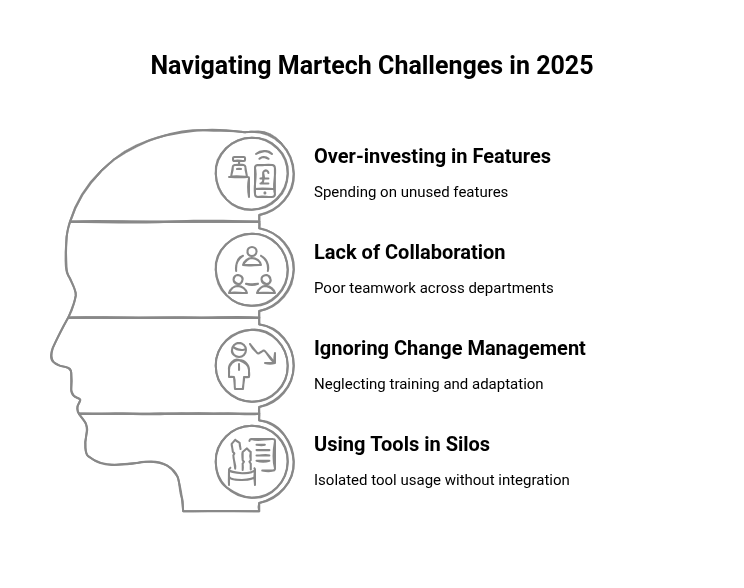
Over-Investment in Features Without Driving Adoption
One of the priciest mistakes in Martech is over-purchasing capabilities based on the fact that no one in your team has learned how to use what you bought. Of course, it's tempting to go crazy with AI personalization, predictive modeling, or omnichannel orchestration, but most marketing teams are using less than 50 percent of what their platforms offer. Here's what happens in most underused platforms:
Campaigns become stagnant or overly simple;
ROI evaporates;
Morale in the teams declines because of tool fatigue.
Avoid that by: Realigning to real business use cases at the time of buying tool features; structured onboarding, enablement, and internal champions investment.
Ignoring the Considerations of Change Management and Internal Training
Frustration is likely to be the result when a new tool is rolled out without any consideration for adoption, training, and change management. No Martech platform is plug-and-play. Even the most user-friendly product will require:
Alignment of workflows and use cases
Training for various roles (marketers vs. analysts vs. execs)
Time to provide input, iterate on, and optimize the training materials.
There is no support for the changes being introduced; therefore, teams resist adopting them and revert to old habits, leaving the new tools to collect dust.
Avoid this by implementing the Martech launch as a product roll-out. Create onboarding playbooks so that everyone is prepared to take full advantage of the tool. Develop internal champions for the tool. Consider tool usage metrics side-by-side with marketing KPIs.
Lack of Collaboration Between Marketing, Sales, IT, and Operational Functions
A Martech stack only for marketing will eventually crash. In 2025, successful stacks will require working closely together with Sales, Customer Success, IT, Data, and Ops. Why is this so?
To validate compliance and integration feasibility with IT and security.
To properly configure and align workflows with Ops and data teams.
To align messaging and visibility across the customer lifecycle with Sales and CX teams
Stacks fall apart, workflows break, and no one knows who is responsible for what without shared ownership.
Avoid this by involving stakeholders from each department in the evaluation, implementation, and optimization process. Maintain a long-term cross-functional governance model for managing the stack.
Integrative Functions of Diversified Tools
A powerful tool used solo is only a quarter as effective when compared to its weight in the greater ecosystem. Yet many still use:
A personalization engine disconnects from the CRM
An automation platform that cannot ingest behavioral data in real-time
Analytics tools that do not relay insights to campaign builders
Come 2025, Integration becomes not just an option but a mission. Customer journeys are nonlinear; disconnected tools mean disconnected experiences.
Here is how to avert that: Audit your stack for integration gaps. Prioritize tools with open APIs, native connectors, and read/write compatibility from your central data layer (e.g., CDP, data warehouse).
Conclusion
Let us rethink the martech strategy for the conclusions of 2025 and beyond. The Martech stack of 2025 will not just encapsulate a set of tools; it will be a dynamic, intelligent ecosystem determining how brands connect, convert, and retain customers. Down the line, sustainability will only be defined through strategy alignment, cross-functional collaboration, and constant evolution. Marketers are supposed to become architects of experience and data stewards. They are not just platform operators. So, whether you're simply auditing your current stack, bringing in new vendors, or gearing up for that AI future, make sure: Build a foundation that is robust today and flexible for tomorrow in your Martech platform.
The Next Step: Is Your Martech Stack Ready for the Future?
Take a proactive approach. Run your Martech audit. Align with revenue and CX teams. Re-evaluate your technology roadmap. Because, in 2025—and beyond—the brands that will win will not be those with the biggest stack but those with the smartest, leanest, and most connected one.