

Introduction
With the shortening of attention spans and the raising of expectations for personalization, marketers move toward the use of microsites for focused engagement. Unlike any traditional website, which can be way too broad and content-heavy, or a single landing page that feels unduly simplistic, the microsite has found the sweet spot. It allows for a stand-alone and content-rich experience designed for a specific campaign, audience segment, or product initiative. The structural and strategic difference is why brands choose to go with microsites to cut through digital noise.
Talking about the migration to microsites, the trend seems to not just be anecdotal; there are results to show for it. Marketers are prioritizing more immersive and focused digital experiences as compared to obviously less engaging content hubs. By 2025, the purpose of a microsite has become apparent: whether to assist a product launch, educate a niche audience, or host an interactive campaign, the merits of a microsite are agility, relevance, and cohesion of purpose. In this blog, we will review microsite strategic applications, showcase some great microsite examples, and argue about how this format is changing the landscape of digital engagement for the modern marketer.
What is a Microsite?
A microsite is a standalone web property on either its own domain or a branded subdomain that uses a domain different from the company's main website. Differentiated from the broader digital platforms, microsites are narrow and laser-focused, generally serving a particular campaign, product, initiative, or audience segment. They may have their own navigation, design language, and content strategy targeting a specific user experience rather than multiple business objectives. Where the main site functions as a digital headquarters for all comprehensive purposes, a microsite acts rather like a focused satellite, purposefully designed to provide clarity, engagement, and depth around one single message.
Core Differences: Microsites vs. Websites vs. Landing Pages
To understand the benefits of a microsite, it’s essential to contrast it with the two most common digital formats: the main website and the landing page.
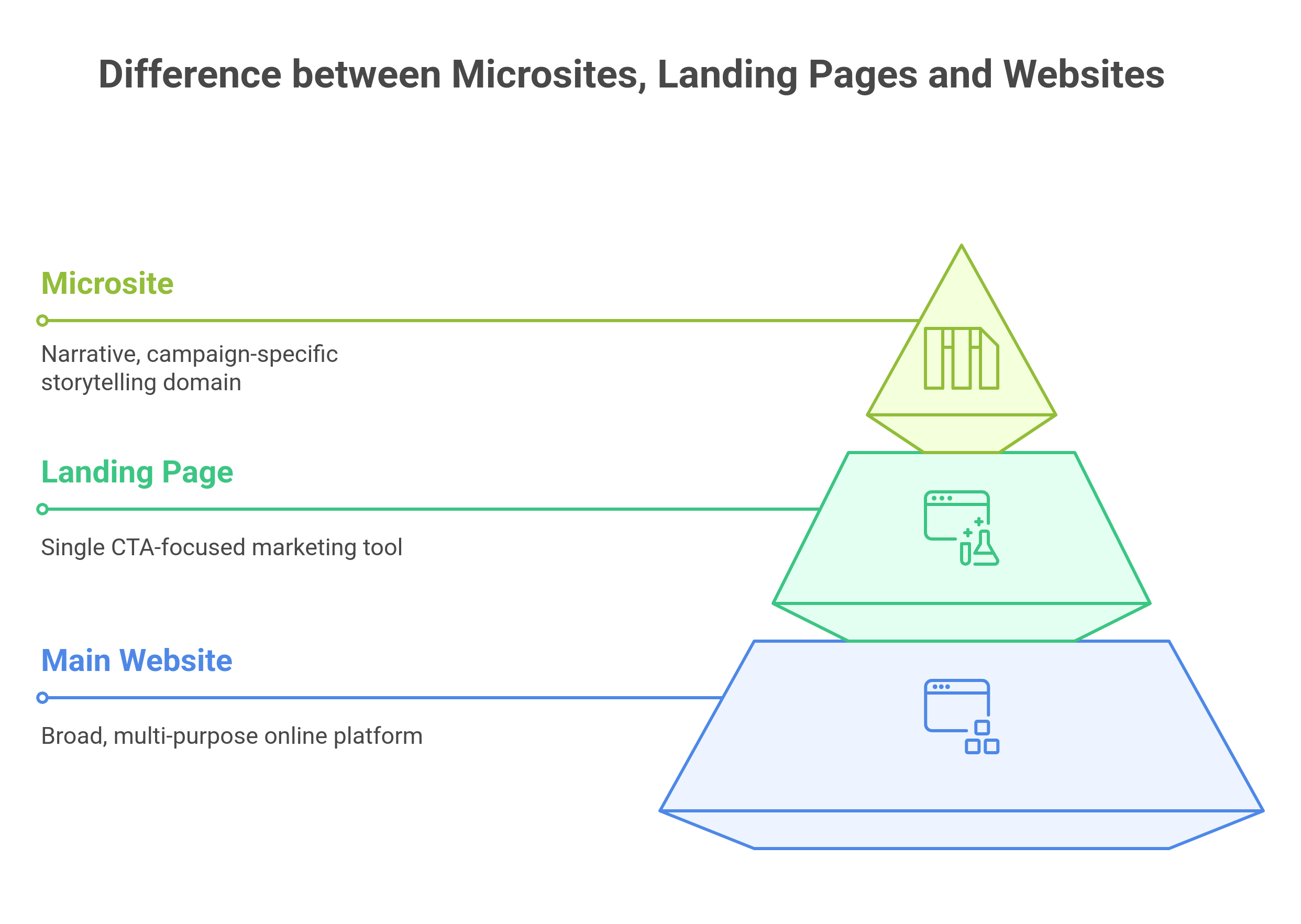
- Main Websites: Corporate websites serve as the digital backbone of a brand. They’re built to house a vast array of information: product catalogs, investor relations, company news, careers, legal disclaimers, customer support, and more. Their design is optimized for scale, discoverability, and broad audience engagement. This versatility is both a strength and a constraint—main websites often require extensive internal alignment and are less agile when it comes to fast-moving campaigns or creative experimentation.
- Landing Pages: Landing pages are designed for direct response. They typically serve a single marketing objective (e.g., lead generation, registration, purchase) and are tied closely to paid media efforts or specific CTAs. Their content is minimal, their navigation is limited (or absent), and their success is measured almost exclusively by conversion rates. While effective for short-term, transactional goals, landing pages lack the depth or storytelling capacity needed for brand building or complex narratives.
- Microsites: Microsites occupy the middle ground. They are content-rich, campaign-specific platforms that allow marketers to build immersive experiences around a focused theme. Unlike landing pages, microsites can support multiple forms of engagement—video, long-form content, interactive tools—without requiring users to leave the environment. Unlike main websites, they’re agile, self-contained, and often faster to launch and iterate. Common microsite examples include product launch hubs, event-specific sites, interactive educational platforms, and branded storytelling environments.
Strategic Purpose of a Microsite
The purpose of a microsite stretches far beyond just simple promotion. It is created to make a digital space with optimization for depth, control, and targeted engagement. Some of specifying strategic reasons for this deployment of microsites by marketers are:
- Isolation of a Campaign Message: Microsites allow teams to de-link a campaign or message from the restraints of the primary site’s structure, SEO guidelines, or brand compliance requirements. This means one is free to take creative risks with accompanying thematic consistency.
- Targeting of Niche Audiences: Whether vertical-specific, a regional, or content variations tailored to a specific persona, microsites can talk to segments that might get lost on the main site.
- Speed and Flexibility: A microsite can be set up quickly and iterated without affecting other digital properties. Particularly useful during time-sensitive activities such as events, product launches, or reactive storytelling.
- Telling Your Brand Story and Educating: Microsites provide real space and flexibility to educate users in immersive and interactive formats. Unlike landing pages, they are limited to transactional objectives and can elevate brand perceptions and long-term value delivery.
Basically, a well-executed microsite becomes a strategic digital asset - it can complement a broader web infrastructure while specializing its impact over a particular subject.
The Key Benefits Associated With Microsites
With marketing evolving towards a more personalized, campaign-oriented, and content-centric approach, microsites have become the tools for the pioneering brands. Their worth comes not from substituting the main website but rather aiding it with an array of agile and impactful digital experiences aimed at some specific goals. The following are the most compelling advantages of a microsite in the modern-day marketing ecosystem:
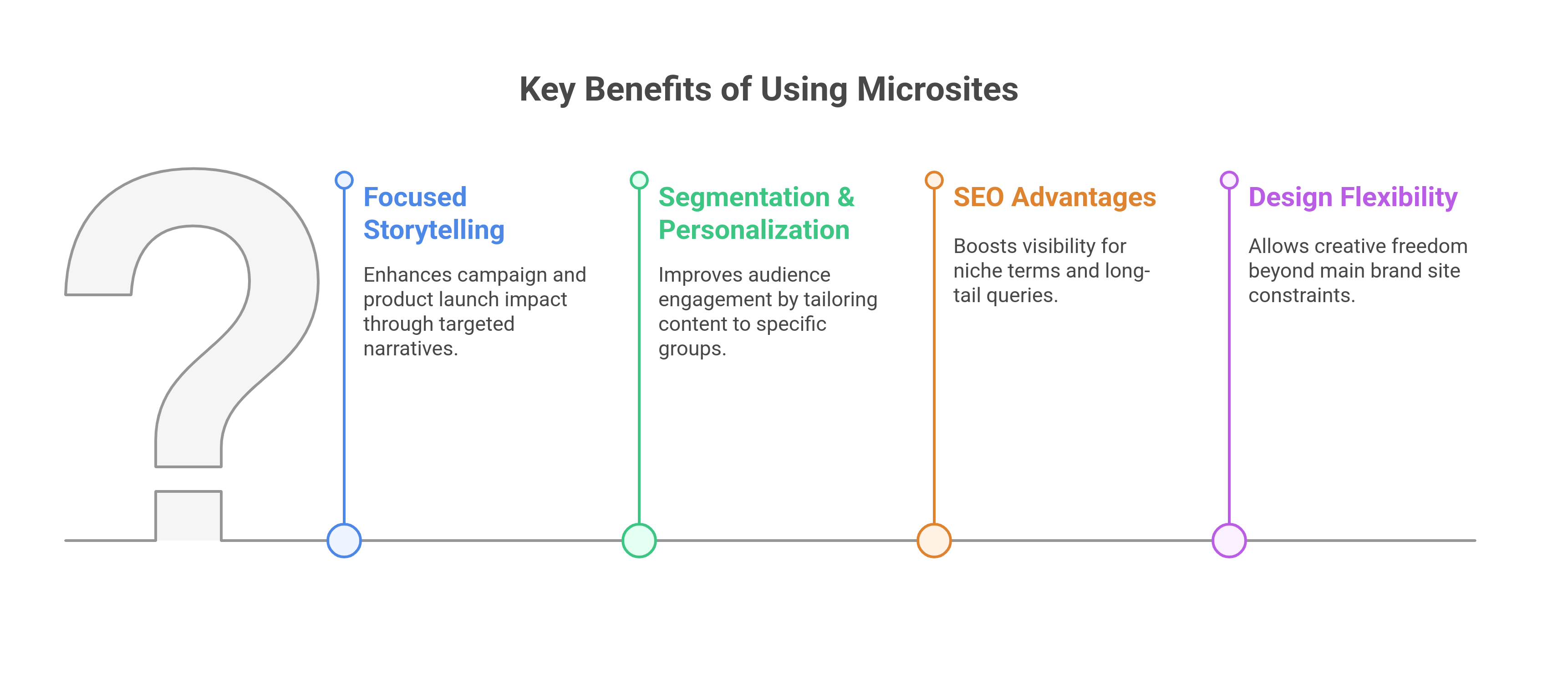
Facilitate Focused Storytelling for Campaigns and Product Launches
Microsites shine in creating immersive zones around a single storyline—be it the introduction of a product, the withdrawal of a brand initiative, or the rollout of a thought leadership campaign. Contrary to typical websites, which need to straddle multiple audiences and objectives, microsites provide a blank canvas on which marketers get to build a cohesive story without distraction. This focused storytelling promotes engagement through content presented in an orderly and deliberate manner—from product demos or interactive way-finding to in-depth videos or testimonial content. One of the more popular microsite applications finds the launch of a product, whereby attention to every detail, narrative control, and thematic consistency could make the difference between being noticed and being ignored.
Enhanced Opportunities for Segmentation and Personalization
Microsites let marketers create experiences for specific customers, verticals, or stages of the buying process in the age of relevance. A B2B company, for example, could utilize several microsites to target various industries with specific messaging, case studies, and solutions. Due to the self-contained nature of microsites, they can be more closely related to an account-based marketing (ABM) strategy, email campaigns, or retargeting initiatives. This personalization produces a journey with users that drives high engagement and conversion rates. This type of segmentation is next to impossible in a company's main website, where generalization must dominate all messages to serve a wider audience and stakeholders. Microsites give marketers the leeway to narrow their scope and directly address the needs and pain points of one audience.
SEO Benefits for Niche Terms and Long-Tail Search Phrases
Microsites can be great for customers, not just that, but they can also give strategic SEO advantages. When writing on a very narrowly defined channel or product, such that a microsite covers this, then a microsite would be optimized for specific niche searches and long-tail keywords that do not really fit anywhere naturally on the main site. Search engines reward websites that go deep instead of wide and value relevance. If a microsite is built on clear-cut keyword clusters, establishing itself as authoritative content, it would beat the larger websites in specific queries. This is all the more interesting for highly competitive segments, where either owning a subject niche or positioning yourself as an authoritative voice could yield high-quality organic traffic. Plus, microsites can also be used as SEO playgrounds whereby marketers are testing new content formats, new link structures, and some tech optimizations without really jeopardizing the SEO performance of the main domain.
Greater Design Flexibility Outside Main Brand Site Constraints
One of the often-underestimated advantages of a microsite is the freedom it gives with respect to visual design and user experience. Primarily, main websites are encumbered by brand guidelines, CMS constraints, and multi-stakeholder governance. Microsites can escape most, if not all, of these strictures. Marketers and designers can build creative, daring, and campaign-specific digital experiences with this leeway—be it rich media, interactive elements, or unconventional layouts. There is more room for creative designs when one is free of corporate website constraints. Branding can also be altered for different audiences and themes for a given microsite. For example, a youth-oriented microsite for a consumer brand could be designed in a much more fun style than would fit within the corporate identity of the parent brand.
Use Cases for Microsites
Microsites have emerged into a potent instrument of the B2B marketer, not because of dimension and dexterity, but for their unique by targeted, and high-impact experiences across the buyer journey. Discrete-purpose microsites make it easier for B2B brands to build digital touchpoints that are aligned tightly with marketing and sales goals, diversifying the purposes they serve in traditional websites. Below are the four high-value microsite uses being employed by leading brands.
Product or Services Launches
Microsites are excellent for moving through new product or service launches. Instead of having to clutter a corporate homepage with all sorts of launch content-or only make do with a single landing page-brands now create their own microsites dedicated to immersing users in the product narrative. Here, on the microsites, interactive product walkthroughs, video demos, specifications, FAQs, and customer reviews may all exist together under one digital roof. By keeping the launch contained to a separate property, brands control the user journey, specifically ensuring that every touch point on that journey reinforces the value proposition of the product. This method works best for complex B2B offerings needing detailed explanation and sufficient trust-building before conversions.
Example: Adobe's "Creative Types" Microsite
Adobe introduced the "Creative Types" microsite to engage users in discovering their creative personalities through an interactive quiz. This initiative not only promoted Adobe's suite of creative tools but also provided a personalized experience that resonated with their target audience.
Event promotions or virtual conference hubs.
A very common case for microsites is to be represented as the digital headquarters for events, whether for onsite or virtual ones. Annual conferences, webinars, or partner summits have microsites as a place for attendees to register, review session agendas, read speaker bios, and engage with content before and after an event. These microsites can be rapidly spun up, and fast shut down quickly after the event, making them an ideal solution for temporary experiences. For instance, digitally leading B2B tech companies build branded virtual event hubs that not only manage logistics but also provide on-demand content, networking, and sponsor solutions.
Example: BetterUp's "Uplift" Summit Microsite
BetterUp developed the "Uplift" microsite as a central hub for their two-day summit focused on courageous leadership. The microsite featured event details, speaker information, and registration options, creating an immersive experience that built anticipation and streamlined attendee engagement.
ABM-Specific Experiences for High-Value Accounts
Account-Based Marketing (ABM) needs personalized experiences behind the scenes, especially for those priority personas, and microsites were just made for that. As an increasing number of B2B brands include dedicated microsites for individual accounts or industry verticals-topped up with customizable messaging, case studies pertinent to the target company, and even personalized video content-forging closer ties to the sales teams and improving the total collaborative effectiveness. These microsites empower sales teams by offering a valuable tool for outreach and follow-up. At good high-value accounts, an effective microsite can signal the brand's commitment as well as differentiate the brand itself from others pursuing a more generic approach.
Example: Snowflake's Personalized Microsites for Targeted Accounts
Snowflake implemented a personalized microsite strategy as part of its Account-Based Marketing (ABM) efforts. By creating dedicated microsites tailored to individual high-value accounts, Snowflake was able to deliver customized content and messaging, resulting in increased engagement and conversion rates.
Thought Leadership Hubs and Resource Libraries
Microsites serve as thought leadership platforms in industries heavily reliant on educated and informed decision-making in purchases. Curated libraries of content, such as whitepapers, research reports, explainer videos, blogs, and insights into the industry, now exist within microsites organized for particular audiences or themes. Given this, these microsites can allow brands to completely dissociate themselves from the main website in name and structure, giving them more authority in their specialized domains using a more editorial tone. For example, a cybersecurity firm could have a microsite that addresses the CISO-level content, while a SaaS provider could have one focused on trends in digital transformation for enterprise IT leaders.
Example: GE's "Txchnologist" Microsite
General Electric launched the "Txchnologist" microsite to showcase their commitment to innovation and technology. This platform served as a content hub featuring articles, videos, and insights, positioning GE as a thought leader in the tech industry.
How to Build a Microsite: Step-by-Step Guide
Microsites can be extremely effective in generating engagement; however, much depends on the careful implementation of the surface. From architecture and design through implementation and content strategy to the "high-performing" microsite requires more than asking, at the developer points his website browser to a series of pages. This section is a step-by-step framework followed by the best marketing teams to launch microsites ready for campaigns and optimized for conversions.
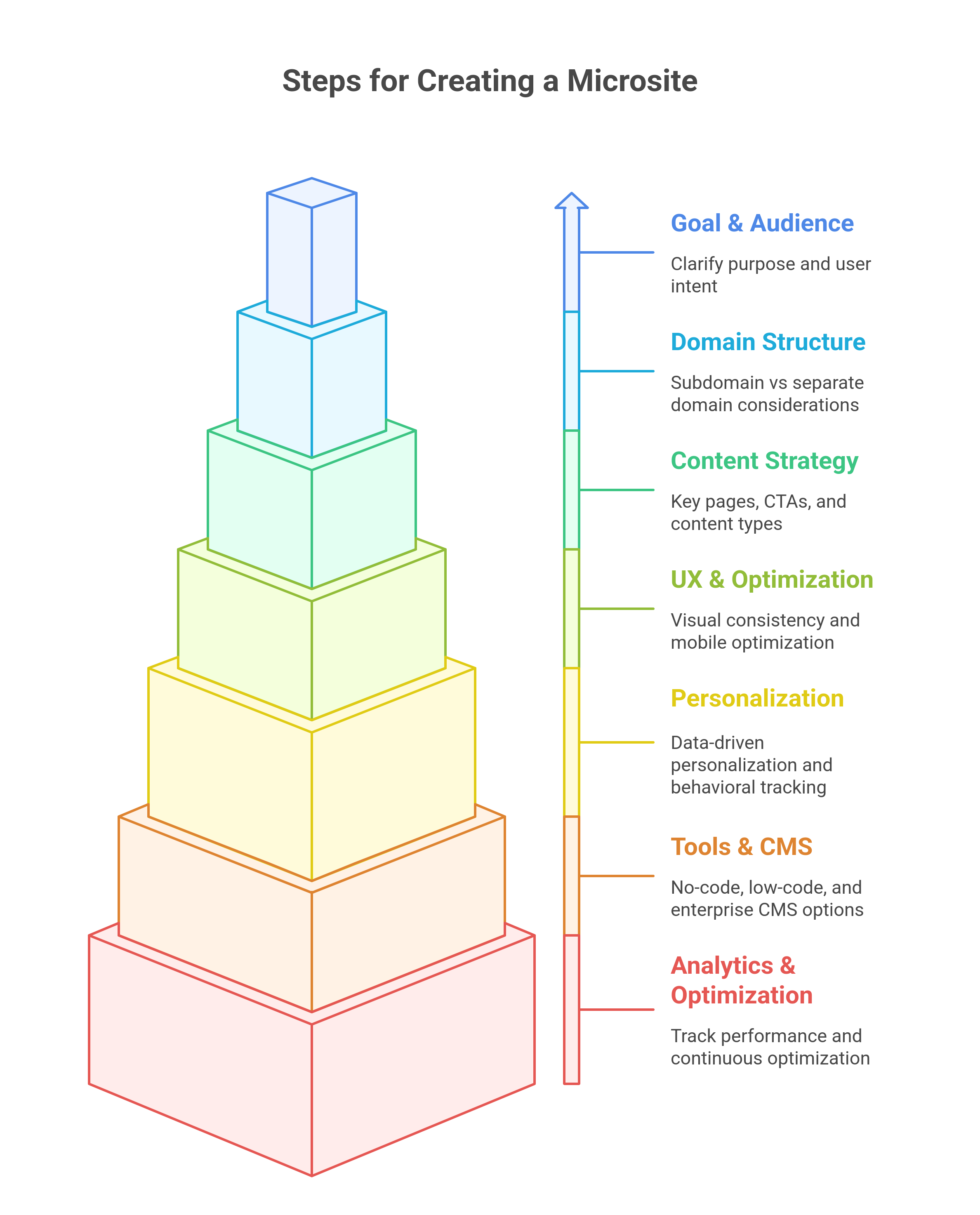
Define Campaign Goals and Target Audience
Before anything else, the first thing to be clarified is why the microsite exists. Each design decision, content choice, and metric should flow from this foundational first step. Purpose and User Intention Clarification: Are you launching a new product, nurturing leads, pushing event registrations, or educating a niche segment? Setting these parameters early will ensure broadening of the scope of your microsite is avoided. Consider funnel stage and persona alignment: Identify whether this microsite will be socialized at an early stage in the marketing funnel or further down: awareness, consideration, or decision. Create personas based on pain points, objections, and content formats.
Tip: An upper-funnel microsite aimed at educating will look vastly different from one intended for account-based marketing at the bottom. Get this right.
Choose the Right Domain or Subdomain Structure
The structure of your microsite plays a strategic role in discoverability, branding, and SEO.
Separate Domain
Pros: Maximizes creative freedom; provides great separation from the firm brand; cultivates an independent SEO authority.
Cons: Requires building domain authority from scratch; risk of fragmenting web presence.
Subdomain
Pros: More interim for temporary purposes; this is somewhat inheriting its SEO equity from the main domain (and it keeps that connection alive).
Cons: This will still be seen as a separate site by Google, so you are likely to have to do some SEO for it, anyhow.
SEO considerations: Generally, Google sees subdomains as independent properties, so the content developed for a microsite may not always help ranking for the primary domain. However, such well-optimized microsites can rank themselves for niche-long tail queries and can transfer quality traffic to your core site.
Best Practice: If branding and SEO consistency are a priority, use a subdomain. For experimental, campaign-specific projects, a separate domain may offer more freedom.
Devise the Content Strategy and Information Architecture
A successful microsite will most probably depend on the clarity and navigational structure of the actual content.
Define Core Pages: Plan somewhere between 3 and 7 core pages as required according to scope. Examples: Homepage, Product Overview; Testimonials; Resources; Pricing; CTA Page.
Content Types: Combine formats such as explainer videos, use cases, calculators, whitepapers, and webinars that entertain users are entertained.
Clear Navigation & Structure: Users spent 35% more of their time on their microsites if they had a clear hierarchy and structure, says Nielsen Norman Group. Prioritize CTAs that are clearly visible and consistent in repeating those pages.
Avoid Extension: Avoid the temptation of excess building. You are not developing your corporate website microsite is a focused asset. Every page should earn its keep.
Creating a Design for UX, Speed, and Mobile Optimizing
Your design needs to look beyond being aesthetic; it should perform well across devices and load in no time under pressure.
Brand consistency: Add visuals (colors, fonts, tone) to match the campaign or brand at large, unless it is intentionally outside the strategy.
Mobile-First Design: Microsites typically record high mobile traffic, particularly when promoted through email, paid ads, or social campaigns. Ensure that all CTAs, forms, and visuals cleanly scale.
Speed on Pages: Shrink images, compress scripts, and eliminate bloated plugins. Speed is a core ranking factor and directly affects the bounce rate.
Accessibility: Use proper contrast, alt text, and semantic HTML to make a microsite usable by all audiences.
Tip: Check Google Lighthouse for the audit of your microsite pre-launch regarding performance and accessibility.
Integrate Personalization and Behavioral Tracking
Modern microsites aren't static; they respond and adapt to real-time user behavior and context.
Data Connections: Link your microsite with Customer Data Platforms (CDPs), CRM systems, and behavioral tracking tools.
Dynamic Content: Personalize headlines, calls-to-action, or modules based on categories such as visitor industry, visitor location, or source of the campaign (LinkedIn vs. email).
ABM Targeting: Build logic that serves industry-specific case studies, testimonials, or offers to different segments by high-value accounts.
Quick Win: Start small with some geo-targeting or UTM-triggered content variations to test the ROI of your personalization before going into full behavioral modeling.
Selecting the Right Tools and CMS Platforms
Your choice of platform influences agility, performance, and team freedom.
No/Low-Code Options:
Webflow: Best for designers and marketers; a lot of visual control; quick loading.
Unbounce: Best for landing page-style microsites; great for A/B testing.
Traditional CMS Platforms
WordPress: Flexible and widely supported, but can be bloated without optimizations.
Adobe Experience Manager (AEM): Enterprise level; works well with complicated martech stacks but requires higher development effort.
Key Considerations:
Integrate with existing systems (Salesforce, HubSpot, Segment, etc.)
To allow custom tracking pixels, quick deployment, and SEO best practices
Ability to scale if the microsite is transitioned to a long-term content asset
Pro Tip: Choose a CMS that your team can manage with minimal IT dependency since the real strength of a microsite lies in its agility.
Set Up Analytics and Optimization Frameworks
The lifecycle of a microsite does not end when it is launched, but begins with launching.
Analytics Setup: Connect to GA4, Hotjar, Microsoft Clarity, or your preferred analytics stack. Set up event tracking for CTA clicks, scroll depth, video views, and form fills.
A/B Testing: Test key variables—headlines, button copy, hero images—to optimize for conversion. Tools like Fragmatic can integrate with most CMS platforms.
Optimization Loop: Use heatmaps and session recordings to diagnose drop-offs, tweak UI/UX, and iterate quickly.
Metrics to Track: Bounce rate, time on site, conversion rate, scroll depth, traffic sources, and returning visitors.
SEO and Personalization Capabilities of a Microsite
A considerable advantage of microsites, besides design flexibility or the ability to focus on campaigns, is their ability to become highly precision-targeted digital environments. Microsites aren't merely stripped-down corporate websites; they are agile, purpose-built entities that are optimized for higher SEO and deeper personalization, so they are worth their weight in gold for brands that want to double generic reach while directing experience to very specific user intents and behaviors. Let us consider how microsites support better targeting in contemporary marketing today.
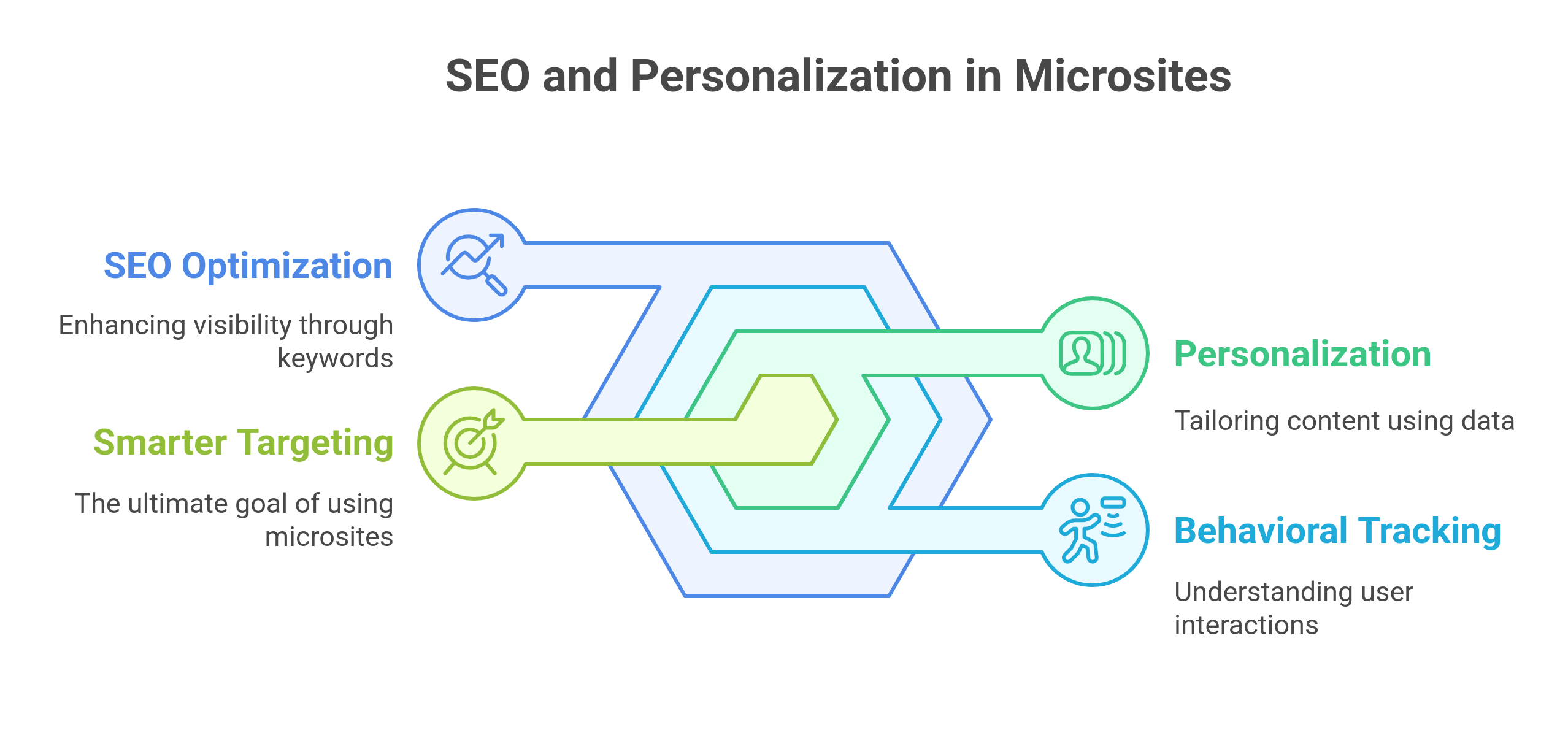
Focused Keyword Targeting and SEO Schema Opportunities
Traditional websites often struggle to rank for niche, long-tail search queries due to their broad architecture. Microsites, however, can be structured entirely around highly-specific themes, allowing for SEO precision that’s difficult to achieve on a bloated domain.
- Tight Keyword Clustering: A microsite focused on a single product, event, or audience allows for naturally concentrated use of core and long-tail keywords. This improves relevance and topical authority in the eyes of search engines.
- Dedicated Meta Structures: Because you’re not constrained by global SEO settings, microsites give you freedom to write hyper-targeted meta titles, descriptions, and H1s—one of the most underrated microsite uses.
- Schema Markup for Rich Snippets: You can implement specific schema types (e.g., FAQ, HowTo, Product) to improve visibility in search results. For example, a microsite for an upcoming webinar can use Event schema to generate rich search listings.
SEO Advantage: Microsites have a higher chance of ranking for specific terms that might be too buried or diluted on a broader site, making them a strategic asset for content targeting.
Enhanced A/B testing and Behavioral Tracking
A microsite can be built around a crystal-clear, testable purpose-say, form filling, demo requests, or content usage-making it easier to run controlled experiments than on a full-on website that caters to varied audiences and competing goals.
- AB Testing without the Collateral Damage: You can confidently test any variations of your CTAs, messaging, page layouts, and navigation schemes without interfering with your main domain or broader traffic.
- Granular Event Tracking: An integration with analytics platforms like GA4, Microsoft Clarity, or Hotjar provides the ability to track specific behaviors; scrolling depth, hover intent, abandonment rates-and use that data to fine-tune the user journey.
Segmentation through Audience: With micro-sites, you can isolate data from a specific campaign or persona and thus acquire cleaner, actionable insights.
Real-Time Personalization Utilizing CDPs and Behavioral Data
Adaptive microsites are at their best when combined with more recent techniques for personalization and proper data infrastructure.
- CDP Integration: If linked to a Customer Data Platform (for example, Segment, Fragmatic, or Adobe Real-Time CDP) microsites can dynamically adapt based on a user’s behavior, intent, or account attributes.
- Persona-Based Personalization: Provide different headlines, images, or offers to different visitor segments, such as industry verticals or roles (e.g., CMO vs. IT Director).
- Behavioral Triggers: Present specific CTAs or content modules based on previous session behavior, referral source of the session, time spent on the page, or activity scrolling down.
- ABM personalization: For account-based campaigns, dynamically modify use cases, customer logos, and proposition messages according to the firmographic data pulled via tools like Clearbit or 6sense.
Conclusion
Microsites are, in 2025, a strategic necessity. To put it differently, microsites have long stopped being simplistic adjuncts, and today they carry the potential of delighting modern marketers in presenting relevance within a fragmented world of digital existence. Non-linearity in the buyer's journey thus emerges with increasingly higher expectations from the audience, rendering the initiation of focused, fast, and personalized experiences no longer a nice-to-have feature but a competitive mandate. With vague architecture and SEO inaccuracy, they could easily deflect the noise within marketing teams, as they would be structured to address very specific segments with bespoke content. They are nimble enough for experimentation, and powerful enough to cater to the long-term strategic objectives-from product launches and ABM initiative delivery. A good microsite is much more than a piece of digital real estate. It is a pointer that says your brand is sensitive, agile, and serious about delivering value precisely where and when it matters.


