Introduction
B2B buyers pride themselves on their capabilities as rational decision-makers. After all, this is high-stakes, multi-million dollar budgeting decisions, where vendors are evaluated against a very high series of requirements. Peel back the layers, and you'll find the most rational procurement process tends to be heavily influenced by some very subtle cues. One of these is perhaps the biggest yet most overlooked: the anchoring effect, the human tendency to give disproportionate weight to the first piece of information received when making decisions. This cognitive shortcut directly affects how buyers really view price, value, and risk long before the final proposal hits their email account.
This is not just an academic theory. The anchoring bias indeed has application in daily sales activities, from how the pricing is positioned in discovery calls to how RFPs are won with skewed lenses. Even though B2Bs follow advanced buying processes, these processes still involve men who are made to fall under the influence of the same heuristics that guide consumers. This is why sales psychology and behavioral economics should not be viewed as nice-to-haves but as something that gives a competitive advantage. Yet too many B2B organizations focus on features, functions, and ROI spreadsheets and forget that psychology plays active levers—pushing deals forward or holding them back entirely.
This guide will cover what the anchoring effect is, its subtle but powerful influence over B2B buying behavior, and most importantly, how to leverage it ethically and effectively when using it in your sales strategy. Whether you are a sales leader looking to improve your B2B sales or a marketer hoping to apply marketing psychology to your messaging, this blueprint is for you. From science to application to strategic edge, this is the way to master the first impression.
What Is the Anchoring Effect? A Behavioral Science Perspective
The anchoring effect is a cognitive bias by which people depend on the first piece of information they hear, known as an anchor, when it comes to making decisions. This initial point of reference, once it has been formed, serves later on for all possible judgment laws, regardless of whether the anchor is arbitrary or without relation to it. This mental heuristic affects beyond pricing judgments, but also timelines, metrics, and value judgments.
B2B-wise, this could mean that the buyer holds on to the first budget range mentioned during a meeting, the quoted price of a competitor, or even a possible ROI figure to relate everything else back to that number. Anchoring is a way for people to simplify the otherwise intricate decision-making processes, but that often leads to skewed outcomes. For sellers, that first figure or idea put in the discussion does have a very much larger weight-whether or not it is intended.
Origins of the Concept: Foundational Work by Tversky and Kahneman
Anchoring was formulated by psychologists Amos Tversky and Daniel Kahneman in their 1974 paper, "Judgment under Uncertainty: Heuristics and Biases." Among their experiments was one in which participants spun a wheel rigged to stop at either 10 or 65, after which they were asked to estimate the number of African countries in the United Nations. Those who ended up spinning a wheel stopping at 10 ended up making much lower estimates than those who spun a wheel stopping at 65-even though the number from the wheel was obviously irrelevant.
Meaningless or unrelated anchors do not just disappear from our minds; they rather anchor on them and only adjust slightly. Kahneman and Tversky showed that even in strong and important decisions, our minds don't operate without logic. They need reference points for making it easier to make a decision in the fog of uncertainty. This realization laid the foundation for a huge number of experiments into decision science and behavioral economics in the pricing, framing, and negotiation strategies that have an impact on real-world business outcomes.
Examples of Anchoring Other than B2B
It does not need to be a very clever observation to see anchoring everywhere. Generally speaking, anywhere in retail, there's anchoring-from the price tags of "was $299, now $149" used as anchors for value perception to restaurants-that expensive $80 offer to juxtapose it with a still too pricey option of $42. Car dealerships almost always hang a high MSRP anchor before going low with the negotiation so that the consumer feels that he or she is really winning-saved money on a made-up deal-even though it is worth less value than the prior price.
The first offer is the one that establishes the relative frame with which to negotiate, such as a recruiter stating a salary range that would anchor expectations before a candidate has the opportunity to advance his own. The same thing happens in project management; when a time frame is given an anchor that is high, it will make it reasonable for later compromises, even if still aggressive.
All of this just demonstrates that anchoring isn't confined to one domain; it is cross-contextual. But when applied purposely in B2B, this powerful tool shapes the perception of the buyer before logic and comparison even engage fully.
Common Misconceptions About Anchoring
- "Anchoring works only in consumer settings." This is a widely held belief. Anchoring operates with more power in B2B sales than in B2C precisely due to the complexity and ambiguity involved in high-value sales. How does one even begin to assess a $150K software investment or, for that matter, what a six-month implementation timeline should look like? Anchors could really fill that void.
- "Numbers are the only effective anchors." While price may usually serve as the most common example, anchors may take other forms such as product features, customer stories, metrics, timelines, and even qualitative claims. A case study demonstrating a 3X ROI can become the mental benchmark for every buyer afterward-even if this is not the median result.
- "Buyers cannot be influenced, having known that anchoring is a bias." Knowing about a cognitive bias does not shield one from its effects. Even decision-makers with strong analytical abilities respond subconsciously to anchors. This is so ingrained that even trained professionals (judges and consultants) display anchoring bias in controlled experiments.
If these misconceptions are eliminated, sales and marketing teams will then view anchoring, not as the manipulation of buyers, but as an agent for reducing friction, framing value, and guiding buyers through a very complicated decision.
Why the Anchoring Effect Is Important for B2B Sales
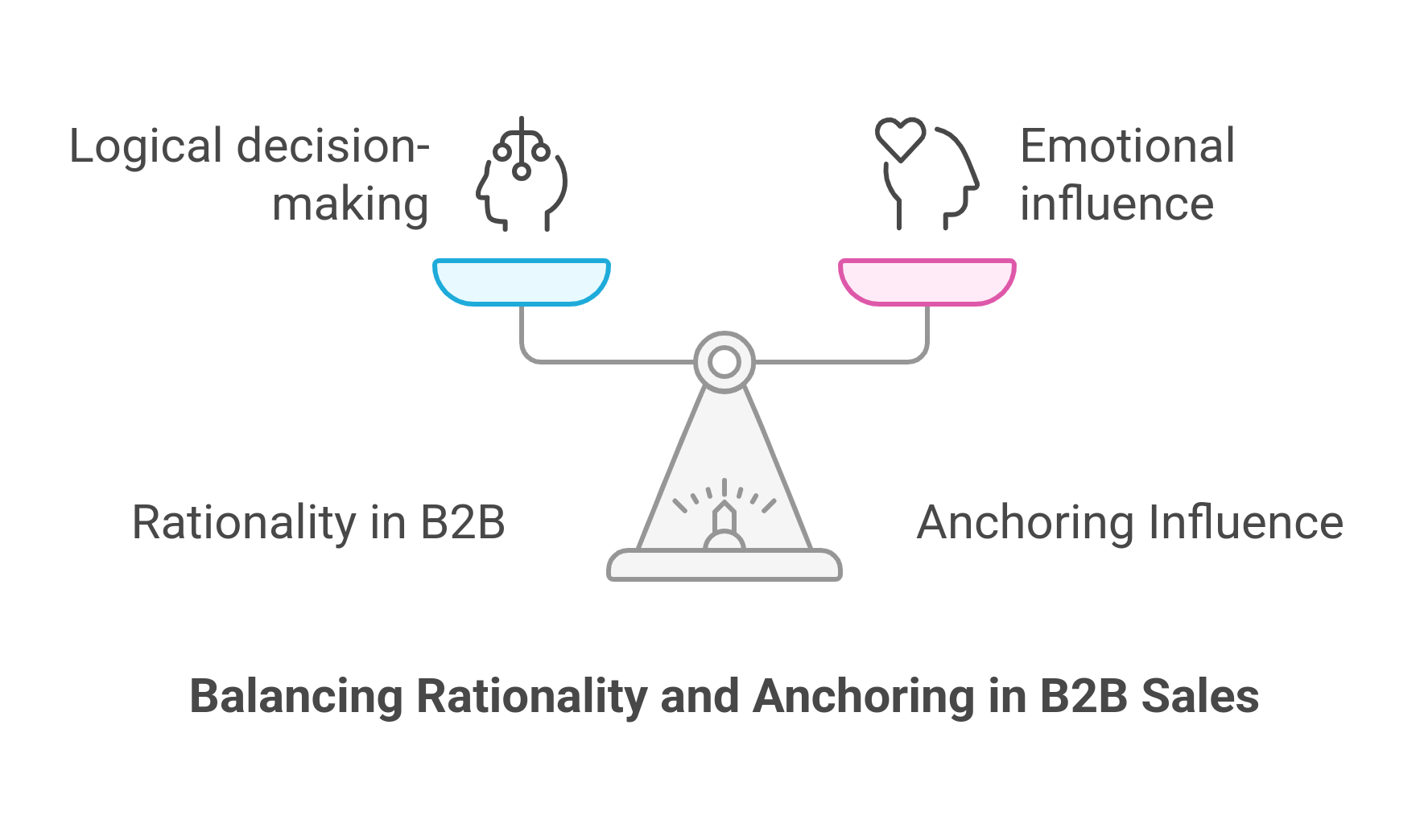
The anchoring effect is no more than an interesting psychological phenomenon; it is a powerful strategic tool in B2B selling. Most assume that B2B buying exists within the overriding rationality of ROI evaluation; in truth, B2B is a whirling dance between logic and emotion. Anchors play a major role in helping stakeholders frame problems, compare vendors, and internally justify decisions. This section will examine how anchoring affects complex B2B purchases, distorts perceptions of value, and quietly works its way into the decision process long before sales teams are aware of its existence.
B2B Buying is Rational, but not entirely
B2B purchasing seems to be organized, involving protocol, technical evaluations, and cooperation across departments. Yet even so, there is a human side to the process of data subject to interpretation, prone to assessing risk, and reaching consensus. Like any set of humans, no matter how exalted the title or from whatever industry, they will be susceptible to cognitive shortcuts. Anchoring is highly relevant because buyers look at such ambiguity—there is no universal benchmark for what a custom implementation should cost or what the length of time to get an ROI would be. So with this uncertainty, buyers latch on to the first piece of information that they receive. This is where selling begins: by holding the first argument as the anchor, sellers start to shape the judgments of everything else regarding a sale.
Anchoring in higher-stakes decisions, complex purchase decisions
As decisions become more complicated, buyers turn to more such deliberation-easing strategies like anchoring. In enterprise sales, where solutions cross departments, affect business continuity, and entail significant change management, buyers become anxious and look for something to ease decision making. That "something" is usually an anchor: a competitor's quote, a price tossed around in discussions of a previous deal, a Gartner Magic Quadrant, or even a metric from a compelling case study. These initial reference points easily represent value and feasibility. If for a similar platform, the buyer first has a $200K benchmark in mind, even a $140K proposal, well-scoped, may look like a "steal" just because it is below that mental benchmark, even though it could still be the most expensive option on the table.
Influence on value perception, ROI, and alignment of a solution
Anchorage not only influences pricing; rather, it determines how buyers perceive value and fit. For instance, the first proposal a buyer sees, promising them a 3x ROI, will, irrespective of the context, have future vendors against it. It distorts the lens, and buyers do not evaluate each solution from its own merits but compare everything to the first number they heard. In the same way, the original feature list or implementation schedule can set the gold standard, perhaps even unrealistically. After the anchor is planted, expectations are hard to realign. If the sales team has not managed that anchor very early on, they might find themselves in a defensive position trying to prove worth against standards that weren't created by them.
Hidden Anchors: How buyers arrive for meetings with preconceived expectations
One of the most underestimated challenges in B2B sales is that buyers do not approach you as blank slates. They accompany well-formed expectations through previously encountered vendor conversations, internal budgeting exercises, online pricing calculators, or even informal peer feedback. Such hidden anchors silently work to shape how buyers perceive your pitch and proposals. This is why discovery is not simply about needs but also about surfacing what anchors the buyer is already using. If you're not the first vendor to have a conversation with them, you are already selling in someone else's shadow. Recognizing those anchors and then trying to reset them is your opportunity to reposition your offer and reframe value on your terms.
How Anchoring Shapes B2B Buyer Behavior
Anchoring influences a pricing strategy; nevertheless, it is a psychological lens that affects the view of all aspects of a solution. Once an anchor is installed, all future information is processed against it-asymptotically, sometimes unconsciously. That is the case in B2B buying journeys, where stakes are high, cycles are long, and decisions involve multiple actors. Anchoring then sneaks in silently yet into the process and ends up making a decision. This section teases apart in detail how anchoring translates into actual behaviors by buyers throughout the entire sales funnel.
The Role of First Impressions in Pricing, Proposals, and Demos
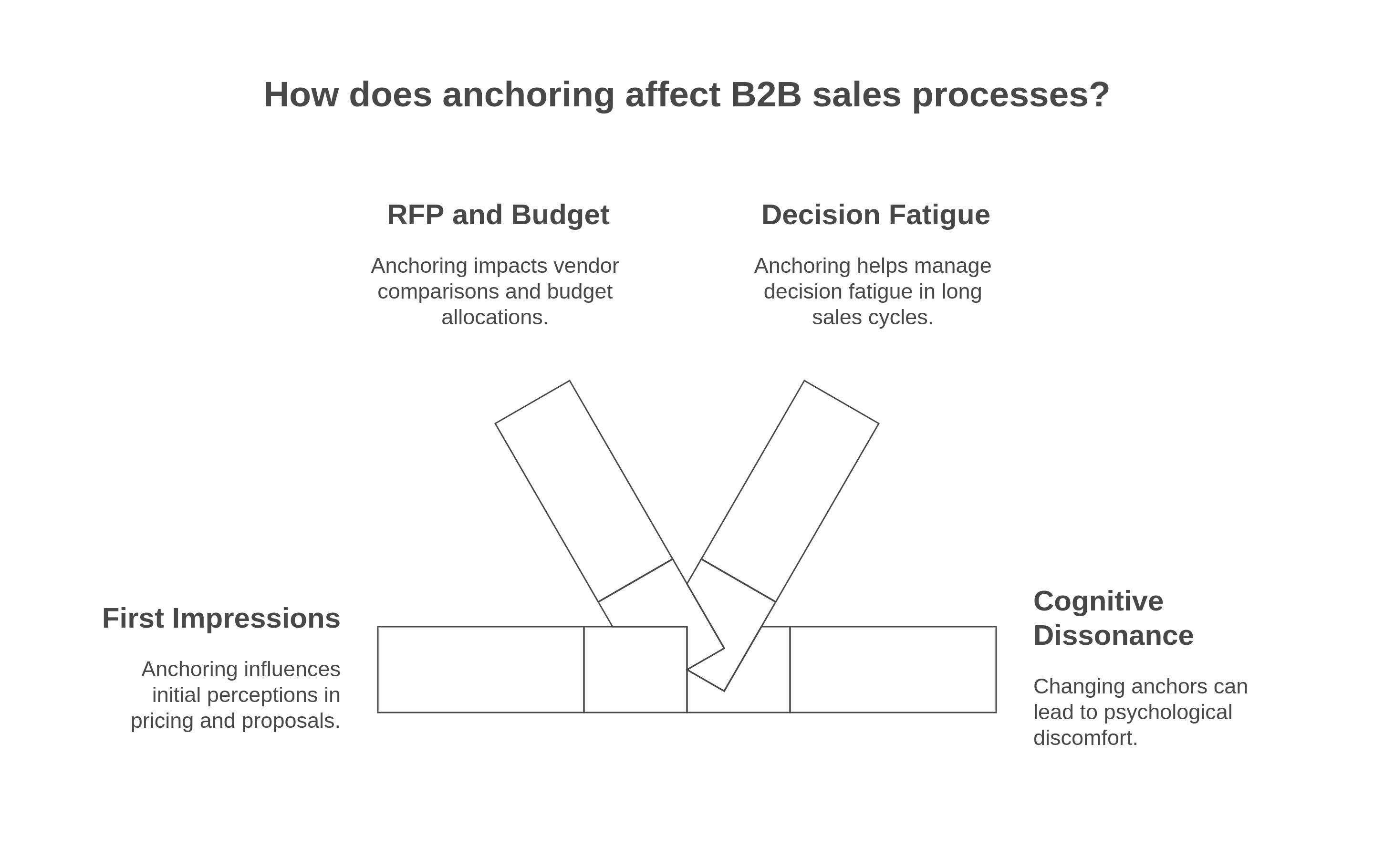
First impressions in B2B sales aren't just about attracting other people; it implies mental anchoring. The moment a buyer sees the pricing, hears the value proposition, or sees the demo, it should be set as the standard for everything else that follows. Whether it has a position as a premium offering, enterprise-grade, cost-efficient, or high-ROI, it has now become your point of comparison. That's why how and when you introduce your pricing matters. If a proposal is introduced too early in the absence of framing, it would serve as an anchor that actually works against you. On the other hand, if pricing is preceded by value framing or quantified benefits and with less-competent competitors, you create an anchor of great value that conditions how the buyer interprets cost-which often makes a premium solution feel worth it.
How the Anchoring Effect Impacts RFPs, Vendor Evaluations, and Budgets
In formal buying processes such as RFPs, the anchoring effect comes into play in a more pronounced structural fashion. The first vendor that submits a price often sets the tone for how all subsequent bids will be perceived, and, should that vendor under-price the solution-whether on purpose or otherwise, that buyer's perception of what actually constitutes "reasonable" may indeed be skewed. This initial price has the ability to anchor the very process of evaluation, thereby compelling competitors to tread an uphill battle in justifying why their proposals seem high. Budget allocation is yet another area vulnerable to anchoring effects. Lots of buyers natureally allocate their respective budgets not on account of actual need or scope of the solution, but based on prior anchors: what a similar tool cost a year before, what was paid by a peer company, or even arbitrary internal limitations. Sales teams that understand this can actively shape the anchor with ROI modeling, tiered pricing options, or by anchoring on business impact rather than just cost.
Decision Fatigue and Reliance on Anchors in Long Sales Cycles
Decision fatigue really becomes an issue with enterprise sales cycles, where decisions are stretched over weeks or months. As cognitive load increases, the stakeholders become increasingly influenced by heuristics, mental shortcuts like anchoring, that facilitate easy choices among many alternatives and further reduce paralysis due to analysis. This implies that the first proposal seen, the first set of success metrics mentioned, or the first brand to submit a solution architecture often remain mentally “sticky,” though there are perhaps better alternatives put forward afterwards. This inertia is also why it's so important to credibly anchor early. Buyers tend to barter with the initial anchor over and over internally, vendor by vendor, budget round by budget round, and so on. So, an early anchor freely discussed and strongly held in value positioning keeps your discussions going in spite of vendor noise.
Practical Ways to Apply the Anchoring Effect in B2B Sales
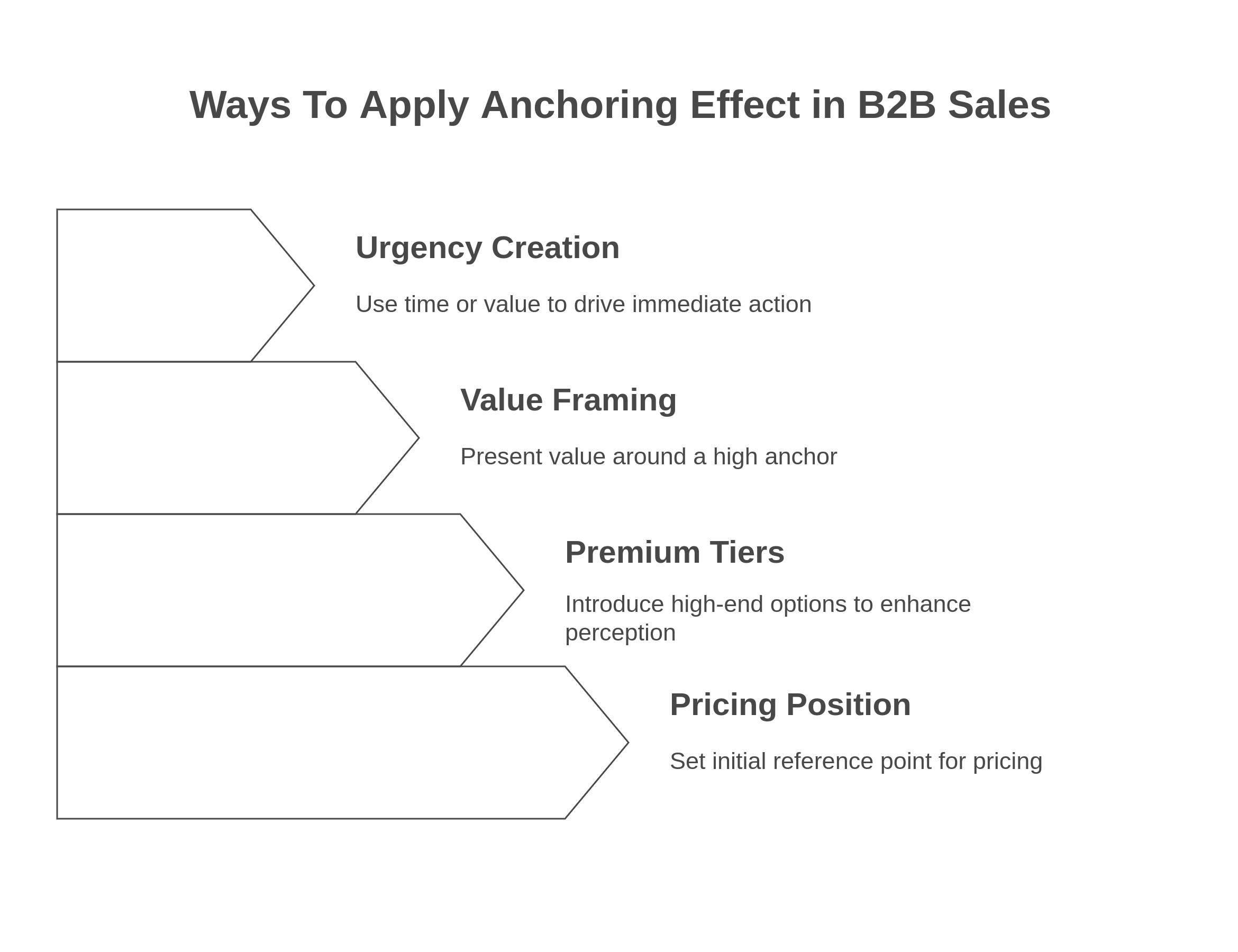
Just understanding the anchoring effect is not enough to apply it effectively in B2B sales; it needs to be deliberately engineered around your buyer journey. Anchors can be introduced through pricing strategy, messaging, demos, or the framing of urgency. Here are four high-impact uses described, each with specific actions your team could take.
Position Your Pricing to Set the First Reference Point
The idea is to make an offer that will serve as the benchmark for the potential customer's decision, not as the basis for comparison by the competition.
Anchor before discovery is over: Don't wait for the buyer to ask about the pricing. Use lines like, "As a rough guideline, solutions in this category cost anywhere from an X to Y amount, depending on the scope. Ours falls toward the higher end because of [unique value]."
Prepare and share a pricing one-pager, or a tiered offer, early in the cycle: Share this after your first discovery call—not only in proposals—to set these expectations.
Use a pricing narrative rather than just a number: "We priced this at $180K because, in most use cases, it recovers $ 500K - $700K of revenue or operational lift over 12 months."
Pro tip: Internally, align the package that the sales team should present first and the way they should frame it as the base value anchor.
Introduce Premium Tiers to Reframe Perceived Value
Use high-value tiers to make other options appear more cost-effective. Actionable Steps:
Create a 'flagship' or 'enterprise' tier, even if it's rarely sold. It should include max value: strategic advisory, top-tier SLAs, advanced integrations, etc.
Design your pricing page or proposal layout to lead with the premium plan. Let the buyer scroll down to see more affordable tiers.
Use clear phrasing: "Our Enterprise tier is built for clients who need 1:1 strategic support, but for most mid-market teams, our Growth plan hits the sweet spot."
Pro tip: If you don't have multiple plans, simulate tiers in the proposal: break the offer into 'Full Scope,' 'Core Scope,' and 'Lite Scope' to create natural anchors.
Frame your Value Proposition around High Anchors
Make your offer feel heavier in value by hanging it around the larger impact on the business. Actionable Steps:
Demonstrate the pain, but just before your solution. For example: "Your churn currently costs you $2 million a year. Our churn solution usually delivers a 15-20% reduction in churn rates."
Compare against a benchmark set by a third party. An example: "According to [industry report], most teams spend 20% of their time on this manually. Our automation reduces that to under 5%."
Make sure that whenever you lead your case study with the biggest number- savings in cost, time saved, or NPS lift, you go further to explain how it was achieved.
Pro tip: Start each ROI or value pitch with a problem cost anchor-then insert your solution to them as a logical way to reduce or reverse it.
Generate Urgency through Time-Bound or Value-Bound Anchoring
Motivate action by anchoring the buyer's mindset around scarcity or timing. Actionable Steps:
Offer a value-based incentive/time-bound. For example, "Sign by [date] and get early access onboarding so you can go live ahead of your Q3 planning cycle."
Anchor the urgency of an internal milestone. Example: "You said streamlining ops is the goal before the next audit—let's make implementation aligned to that timing."
Develop a visual 'Cost of Delay' calculator. Put revenue, efficiency, or competitive ground lost for every month the solution is not implemented.
Pro tip: Avoid setting out discounts-only based urgency (it dilutes the anchors). Would rather stress value gains along the timelines or internal alignment milestones that the buyer already cares about?
Anchoring Techniques for Sales Teams and Marketers
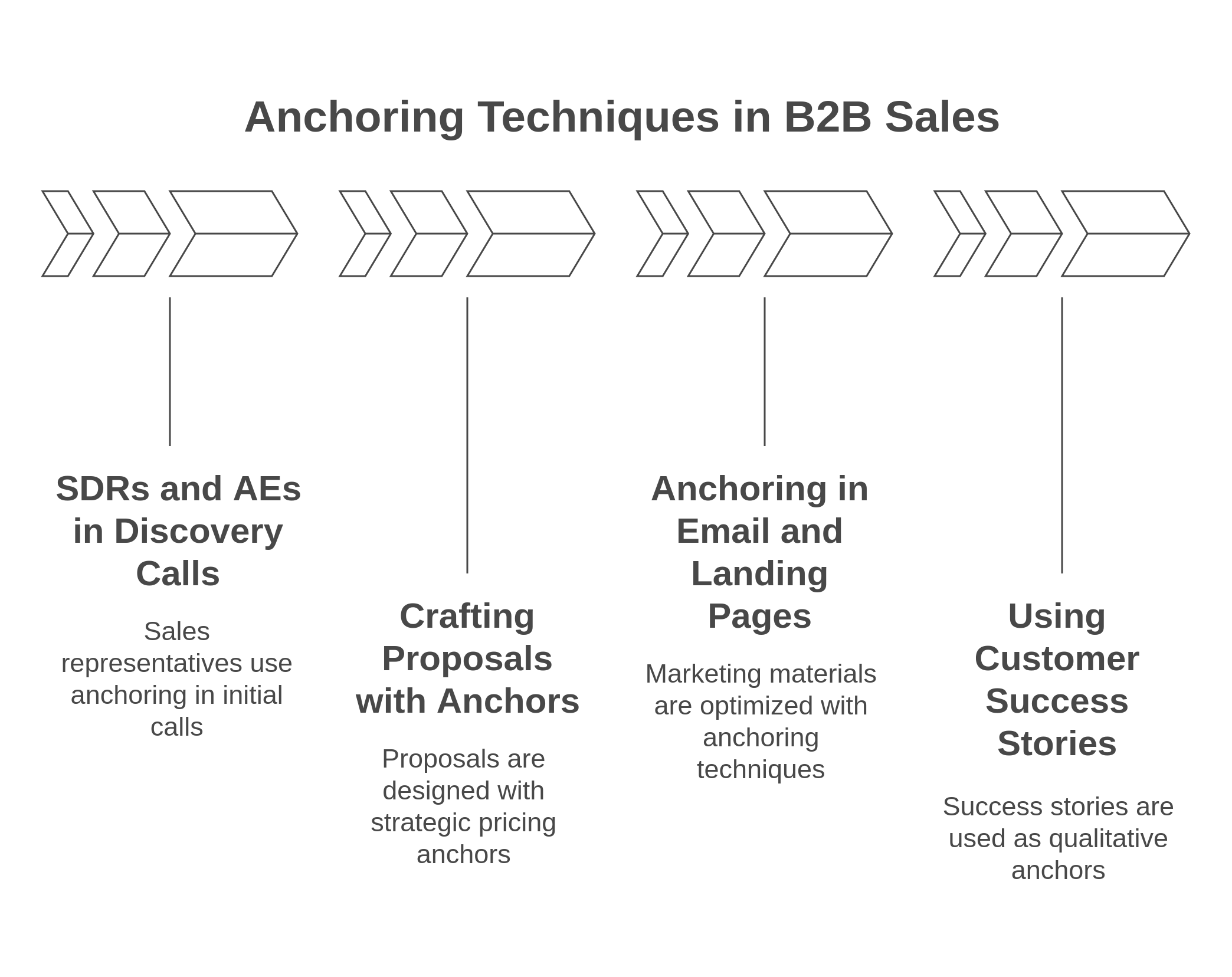
Anchoring can’t be left to chance, it must be embedded across sales motions and marketing content. From the words SDRs use in emails to how AEs present pricing, every moment is an opportunity to shape the buyer’s mental frame of value. This section outlines how different roles in the revenue team can use anchoring to guide perception, frame pricing, and increase win rates, without manipulation or hype.
How SDRs and AEs can use Anchoring in discovery and demo calls
These discovery and demo calls are the earliest, and possibly the most powerful, anchoring moments. The words spoken in this window become the lenses through which the buyers will view every interaction that follows.
Anchoring Moves to Consider: Do some comparative anchoring in discovery. For example, “Most companies we speak with are spending 10–15 hours a week manually compiling this data. Is it the same on your end?”
Begin to seed value ranges early. For example, “Our clients typically see a $ 400K - $700K cost avoidance annually from switching. Would outcomes like that be meaningful to your CFO?”
Start demos with the most differentiated feature, which creates an anchor in capability and raises expectations before demonstrating more ordinary features.
Crafting Proposals with Strategic Anchors
Proposals are the most common opportunity for engineering anchors; however, most teams resort to uncreative flat spreadsheets or rigid templates. Anchoring Moves in Tactics:
Do not lead with the cheapest package. Consider this as "the most recommended offer", even though you may not push hardest for it.
Qualitative paradigms shape anchor. The premium plan must be bold, first in order, and then descriptive as persuasive as "All-In Growth Plan" or a clause like "Most Comprehensive Option".
There must always be an anchor that is justified. For example: "This plan is aligned to your Q3 targets and includes strategic onboarding support we discussed".
Using Anchoring in Email Copy, Landing Pages, and Pricing Tables
Marketing is where anchoring starts — often before sales is even involved. The copy, visuals, and layout of your materials do silent anchoring work long before a buyer talks to a human. Tactical Anchoring Moves:
In email CTAs, a mental benchmark is set. Example: "Join 500+ mid-market companies who switched and cut onboarding time by 60%."
Landing Pages: The highest value outcome should come first. Anchor the page in an outcome success stat, then describe the product.
Pricing Table: Three tiers of pricing; the middle tier is framed as the 'smart choice.' Add badges like "Best Value" or color highlights to visually anchor the buyer.
Leveraging Customer Success Stories as Qualitative Anchors
The most valuable asset a customer success story brings to the equation is that acts as a qualitative anchor. Anchoring, therefore, doesn't always have to be numerical. It could just as well be a potent narrative that will serve as a mental benchmark for what success should look like, utilizing your product. Tactical Moves for Anchoring:
Present the problem with all of the high stakes behind it. "Before working with us, this $200M manufacturing company had been losing $1.2M per year to downtime."
Always include a transformation metric: "They went from 5 days of manual reporting to 4 hours with our automation layer."
Use logos of similar size or higher status. It creates a psychological anchor: "If they got that kind of outcome, so can we."
Using Anchoring in B2B Pricing Strategy
Out of the many applications of the anchoring effect, price strategy is arguably the most powerful and least exploited in B2B. Pricing structure and communication are the very influences on a buyer's impression of value, fairness, and return on investment. This segment discusses how companies can leverage anchoring in design to clarify, enlarge the average deal size, and avoid pitfalls that create distrust in pricing.
Good-Better-Best Positioning Pricing: When Anchoring Works
The simple but best way to apply anchoring in price is good-better-best; that is a structure with three tiers that leads the buyer to self-select themselves based on how individual values the product instead of looking at cost. Why it Works:
The best option is the one with the highest price; that price reframes the mid plan into something that almost looks very balanced and high value. The good plan makes an anchor for contrast that causes both of the other plans to appear standardly better.
Customers avoid extremes; they would rather want to be somewhere in the middle, and most likely they will when it is the recommended or most popular option.
Actionable Tips:
The middle tier should be designed after what a perfect deal is or even probably at a sweet spot for a return on investment.
Make sure that as you name and differentiate tiers, it is based on outcome-and not just features (e.g. Growth, Scale, Enterprise).
Using visual cues: for instance, premium badges such as "Best Value," layout hierarchy, or relating customer logos tied to each tier.
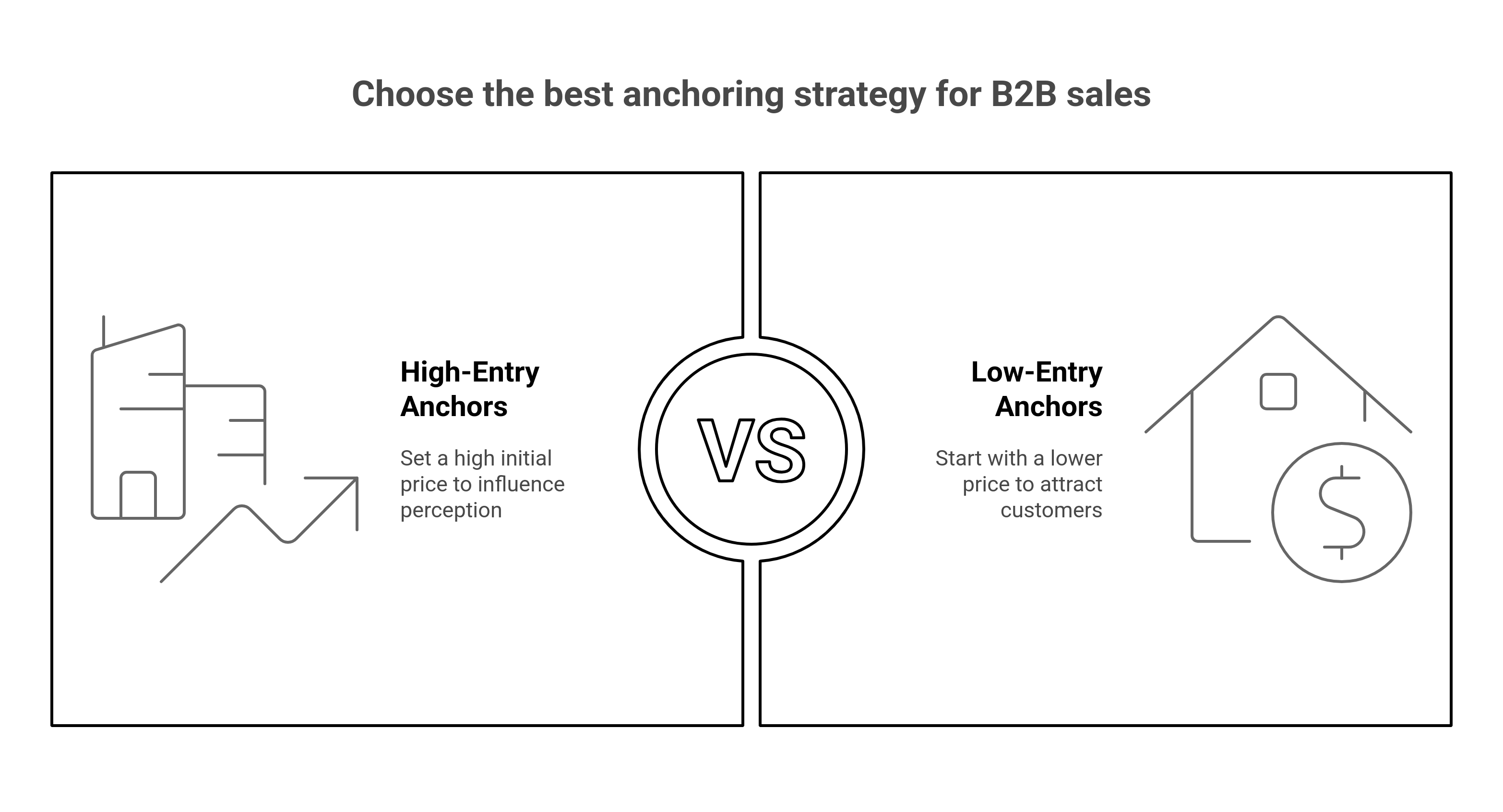
The Psychology Behind High-Entry vs. Low-Entry Anchors
The choice of whether to lead with high-entry or low-entry price point essentially falls into a subjective judgment. A high-entry or low-entry anchor will fix buyers in opposite directions.
High-entry anchor (premium-first):
This is useful in transformational cases or instances where strong differentiation can be invoked in the transaction.
It sets a very high-value reference, making almost every other offer feel available.
Works best in consultative sales, wherein pricing is arrived at through clever conversation.
Low-entry anchor (budget-first)
This is useful when it comes to budget-conscious buyers or when trying to drive a product-led entry.
It lessens friction but could also risk anchoring the buyer to lower perceived value or smaller deal sizes.
Actionable Tips:
Use high-entry anchors when you have the strongest proof of ROI, a more strategic solution, or a more complex implementation.
Use low-entry anchors to land and expand, but be very intentional about how you later introduce premium tiers and justify them.
Conclusion
Anchoring is no sleight of hand; it is a well-known psychological paradigm. This paradigm influences human perception of value, consideration of options, and ultimately decision-making, even for the most rational-seeming B2B buyers. Whether applying pricing tiers, running discovery calls, developing proposals, or designing packaging for ROI narratives, anchoring is a potent lever for you to skew buyer judgment in your favor. With power comes responsibility. Manipulation and obfuscation should never be either the intent or the result of anchoring applications. Instead, it holds the true potential of allowing for the better contextualization of what buyers are evaluating, which allows sellers to coherently frame their value propositions. The most astute B2B selling and marketing teams never leave perception up to chance. They shape it ethically, intentionally, and consistently. Learn to anchor well, and you'll begin winning more deals, at the right value, with the right expectations, and with stronger long-term partnerships.