Introduction
In digital marketing, the smallest changes have the biggest effect, but testing one small change here and one small change there leaves you with the thinking cap on. Multivariate testing comes to the rescue. Rather than outwardly isolated experiments, multivariate testing lets you interactively test multiple variables, from headlines to images to buttons and layouts, and measure the effect of the combinations on user behavior.
This blog will delve deeper into what multivariate testing is, why it is an effective method for conversion optimization, and how to go about designing experiments to derive insights that can be reliable and data-driven. This will give insight into some of the good advantages that this testing method has when applied, the kind of practical steps you would want to consider when setting up your multivariate test, and some helpful best practices designed to keep such testing on the right track and safe from typical pitfalls. Multivariate testing can uncover the winning formulas behind higher engagement, better user experience, and improved conversions, whether you're just starting with experimentation or fine-tuning your CRO strategy.
What is Multivariate Testing?
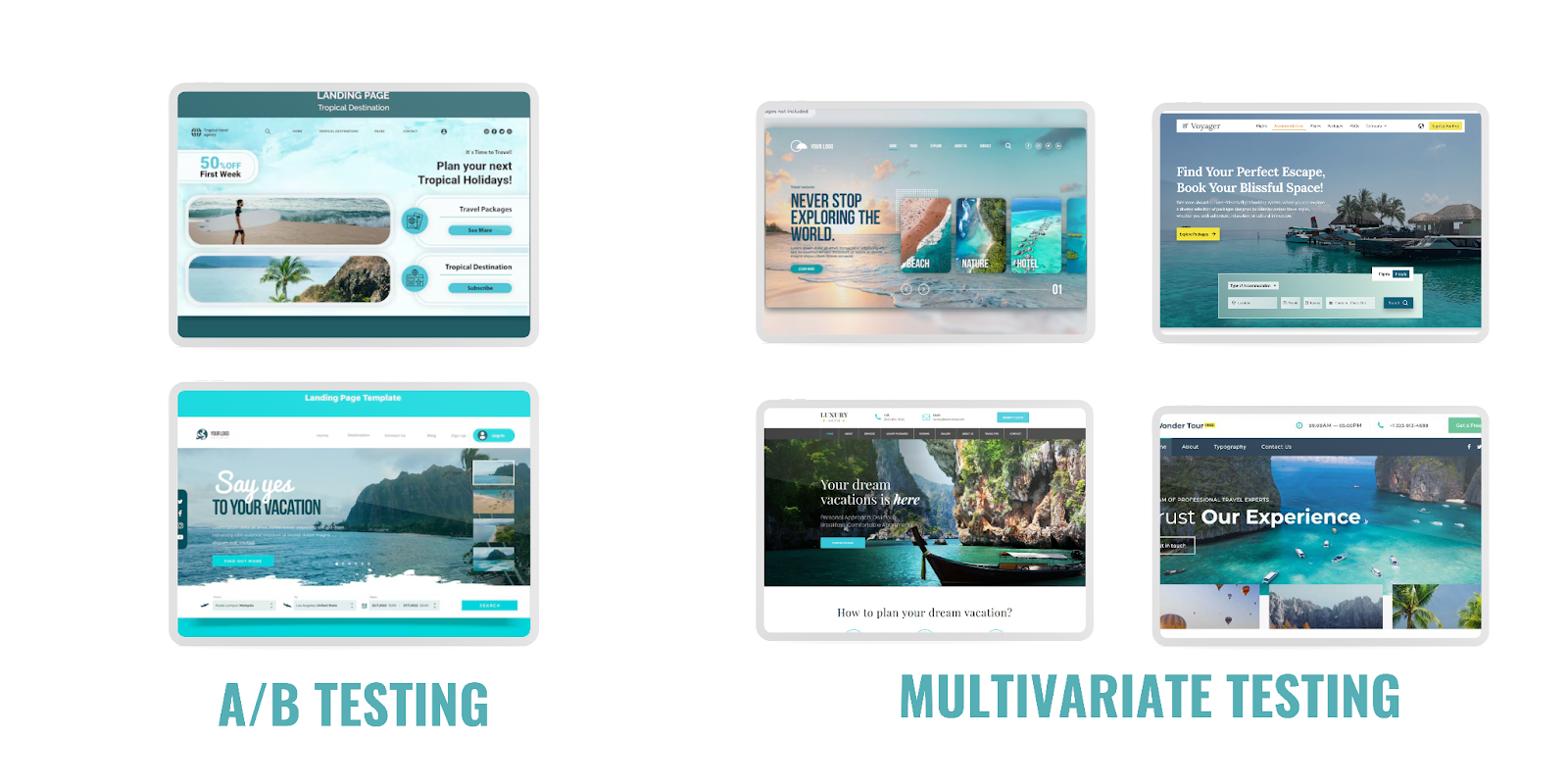
Multivariate testing is an advanced experimentation method that allows marketers to test multiple elements of a webpage or campaign at the same time. Instead of focusing on a single change like in A/B testing, multivariate testing evaluates combinations of different variables — such as headlines, hero images, calls-to-action, layouts, or color schemes — to see how they collectively influence user behavior and conversions. For example, if you test two different headlines, two images, and two CTA buttons, multivariate testing generates eight variations (2 × 2 × 2). By running all combinations together, you don’t just find out which single element works best — you uncover how elements interact with one another to create the highest-performing experience.
This makes multivariate testing a powerful tool for marketers who want deeper insights than a simple A/B test can provide. By analyzing multiple factors simultaneously, businesses gain a more nuanced understanding of what drives clicks, sign-ups, and purchases. When applied correctly, multivariate testing best practices help optimize entire experiences rather than isolated elements, leading to more meaningful improvements in conversion rates.
Benefits of Multivariate Testing
The biggest advantage of multivariate testing is that it shows you how multiple elements work together — not just in isolation. Instead of learning whether a headline or a button works better, you discover the exact combination of elements that drives the highest conversions.
- Deeper insights into user behavior: Multivariate testing doesn’t just tell you which version wins; it explains how different elements interact. For instance, a headline may only perform well when paired with a specific hero image and call-to-action. These layered insights are far more powerful than what A/B testing alone can provide.
- Improved personalization opportunities: By uncovering patterns across different test combinations, you can identify preferences for specific audience segments. This allows you to move beyond generic messaging and design experiences that feel more tailored and relevant.
- Optimization efficiency: Running A/B testing and multivariate testing separately can be time-consuming. With MVT, you gather insights on multiple changes in a single experiment, reducing the number of sequential tests required.
- Data-driven decision making: Every winning variation discovered through multivariate testing best practices is backed by statistical significance. This means your optimizations are based on reliable data rather than assumptions or opinions.
Ultimately, the benefit of multivariate testing lies in its ability to uncover the “winning recipe” for higher engagement, more conversions, and better user experiences — all while saving time in the optimization process.
How is Multivariate Testing Different?
In conversion rate optimization, marketers often ask the same question: Should I run A/B testing or multivariate testing? The difference lies in scope, complexity, and the type of insights you gain. While there are several testing approaches — A/B testing, split URL testing, and sequential testing — multivariate testing offers a uniquely powerful way to analyze how multiple elements work together.
Multivariate Testing vs A/B Testing
A/B testing and multivariate testing are closely related but serve different purposes:
- A/B testing compares two versions of a single variable. For example, you might test one CTA button color against another. The result tells you which performs better in isolation.
- Multivariate testing takes things further by evaluating multiple elements simultaneously. For instance, if you test two headlines, two images, and two CTAs, you’ll run eight unique combinations at once. This shows not only which individual variable matters, but also how they interact to influence conversions.
Key takeaway: A/B testing is simpler and faster, but multivariate testing provides deeper, more nuanced insights. If your goal is to understand complete user experiences instead of single changes, MVT is the stronger approach.
Multivariate Testing vs Split URL Testing
Split URL testing — also called redirect testing — is used when you want to test entirely different page designs. Visitors are redirected to separate URLs, and their performance is compared.
- Use Split URL testing when you want to test a brand-new landing page, redesigned layouts, or major changes that require different templates.
- Use multivariate testing when you want to optimize within the same page by fine-tuning elements like headlines, form fields, or button placements.
Both approaches are useful, but multivariate testing is best when you’re refining specific page elements instead of testing full redesigns.
Multivariate Testing vs Sequential Testing
Sequential testing involves making changes one after another, testing them individually over time. While this approach is easier to manage, it has significant drawbacks:
- It takes longer to reach meaningful conclusions, since each change must be tested in sequence.
- Results may be less reliable if external conditions (traffic patterns, seasonality, or campaigns) change during the test window.
Multivariate testing eliminates this delay by running all variations at once. This means you get quicker, more holistic insights, even though it requires more traffic to reach statistical significance.
Why Multivariate Testing Stands Out
Compared to these other methods, multivariate testing best practices combine speed, depth, and accuracy:
- It shows how multiple elements interact, not just which one works in isolation.
- It reduces guesswork by revealing the winning combinations of elements.
It gives marketers confidence to make data-driven design and messaging decisions that lift conversion rates.
In short, A/B testing is great for small, quick experiments. Split URL testing is ideal for major redesigns. Sequential testing is easy but slow. Multivariate testing brings it all together, delivering the most comprehensive insights for optimizing user experiences.
How to Set Up a Multivariate Testing Experiment
Running multivariate testing successfully requires more than just changing elements and waiting for results. To get reliable insights, you need a clear framework. Here’s a step-by-step breakdown of how to set up and execute a strong experiment:
Define Clear Objectives
Before you begin, decide what success looks like. Do you want to improve conversion rates, increase sign-ups, reduce bounce rates, or optimize click-through rates? A well-defined objective ensures your multivariate test stays focused and measurable.
Identify the Variables to Test
Choose elements that are most likely to influence user behavior. In multivariate testing, these variables might include:
- Headlines
- Hero images or product visuals
- Calls-to-action (CTA)
- Button colors or placements
- Layout structures
Prioritize high-impact variables instead of testing too many at once — this keeps the experiment manageable and statistically reliable.
Formulate Hypotheses
Every test should begin with a prediction. For example: “Changing the CTA from ‘Learn More’ to ‘Get Started’ will increase sign-ups when paired with a stronger headline.” These hypotheses guide your test design and make it easier to interpret results later.
Design Test Variations
Create multiple versions of the page or campaign asset, each combining different variations of your chosen elements. For example, 2 headlines × 2 CTAs × 2 images = 8 combinations. This is the core of A/B testing and multivariate testing differences — MVT measures all interactions at once.
Choose a Multivariate Testing Platform
Use a trusted platform like Optimizely, VWO, Adobe Target, or Google Optimize alternatives. These tools let you:
- Set up test variations
- Split traffic accurately
- Track user behavior in real time
Measure performance against your objectives
Determine Sample Size and Test Duration
Multivariate testing requires more traffic than A/B testing because of the number of combinations. Use a sample size calculator to determine how many visitors are needed to achieve statistical significance. Run the test long enough to cover normal fluctuations in traffic (at least 2–3 weeks in most cases).
Launch and Monitor the Test
Once everything is in place, start your multivariate test. Monitor it regularly to ensure data is being captured correctly and that variations are rendering properly across devices and browsers.
Analyze Results and Identify Winning Combinations
When the test reaches statistical significance, review the results. Instead of just seeing “which CTA worked,” you’ll see which combination of CTA, headline, and layout created the highest lift. This is the unique power of multivariate testing best practices — actionable insights that reflect the complexity of real user behavior.
Implement and Iterate
Apply the winning variation to your live site or campaign, and then document the findings. Every test becomes part of a growing library of insights you can use to guide future experiments.
How to Design Effective Multivariate Tests
Running multivariate testing isn’t just about picking random elements to change — it requires thoughtful design to ensure the results are accurate, meaningful, and scalable. The way you design your test directly impacts the quality of your insights. Here’s how to set up effective multivariate tests that give you reliable answers and actionable data.
Select High-Impact Elements to Test
Not every page element deserves to be part of a multivariate test. Since each variable adds complexity, focus only on changes that directly influence user behavior and conversions.
- Headlines: Strong headlines can determine whether users stay or bounce.
- Hero images or graphics: Visuals play a key role in setting tone and trust.
- Calls-to-action (CTAs): The wording, size, and placement of CTAs often make or break conversions.
- Forms or layouts: Optimizing fields, length, or arrangement can dramatically affect sign-ups or purchases.
- Color schemes or button designs: Subtle but impactful — these often complement other tested elements.
Tip: Align elements with your business goal. If you want more demo requests, prioritize forms and CTA text. If engagement is the goal, focus on headlines and visuals.
Define Clear Hypotheses Before Testing
Every variation should be backed by a clear hypothesis. Without it, results become difficult to interpret. For example:
- Hypothesis: “A shorter headline combined with a stronger CTA (‘Get Started Now’) will increase sign-ups compared to a longer headline with a softer CTA.”
Hypotheses keep your testing process structured and ensure you’re not just testing for the sake of testing.
Ensure Statistical Significance and Adequate Sample Size
One of the biggest differences in A/B testing and multivariate testing is traffic requirements. Since MVT runs multiple combinations at once, you need larger sample sizes to reach reliable conclusions.
- Calculate sample size: Use a calculator to estimate how many visitors are needed per variation.
- Reach statistical significance: Don’t stop tests too early; aim for a confidence level of 90–95%.
- Test duration: Allow 2–4 weeks, depending on traffic volume, so you capture normal fluctuations in user behavior.
Without proper sample sizes, you risk drawing the wrong conclusions — one of the most common mistakes in multivariate testing.
Set Realistic Test Duration and Frequency
To design effective multivariate tests, timing matters as much as setup.
- Run long enough: A test should cover different traffic cycles (weekdays, weekends, campaigns).
- Avoid overlapping tests: Running multiple experiments on the same page at once can skew data. Instead, stagger your tests.
- Balance speed vs reliability: Too short = inconclusive. Too long = wasted opportunity cost.
Following these multivariate testing best practices ensures results you can trust.
Segment Audiences for Deeper Insights
Not all users behave the same. For example, first-time visitors may respond differently from returning users. By segmenting results, you’ll uncover patterns that a broad analysis might hide.
- Segment by device type (desktop vs mobile).
- Segment by traffic source (organic vs paid vs referral).
- Segment by audience type (new vs returning visitors).
Segmentation makes your multivariate test results more actionable and helps personalize optimizations for specific groups.
Avoid Common Pitfalls in Multivariate Testing Design
Even well-planned tests can fail if common mistakes creep in. Watch for:
- Overcomplicating tests: Too many variables create dozens of combinations, slowing tests and diluting insights.
- Unclear hypotheses: Without predictions, you won’t know why one variation worked better.
- Poor technical setup: Ensure all variations load correctly on every device and browser.
- Stopping too early: Don’t declare winners before statistical significance — it leads to false positives.
Effective multivariate testing design is about balance — testing enough high-impact elements to get meaningful insights, but not so many that results become unmanageable. By carefully choosing variables, segmenting audiences, and following multivariate testing best practices, marketers can uncover the precise combinations that drive higher conversions and more engaging user experiences.
Analyzing and Interpreting Multivariate Testing Results
Analyzing and interpreting multivariate testing results requires statistical analysis and the ability to identify meaningful patterns and trends in the data.
Interpreting Test Data and Results
Begin by examining the performance metrics you defined before starting the test, such as conversion rates, click-through rates, or engagement levels. Look for statistically significant differences between the various combinations to identify which elements drive the desired outcomes.
Identifying Winning Combinations and Patterns
The next step is to identify the winning combinations. Look for patterns in the successful variations to understand why certain combinations performed better. For example, a particular headline combined with a specific image and CTA button consistently outperforms other combinations. These insights can reveal the underlying preferences and behaviors of your audience, helping you to fine-tune your marketing assets for maximum impact. It's also important to consider the context of your findings—what works for one segment of your audience might not be as effective for another.
Using Data to Inform Future Marketing Strategies
The insights gained from your multivariate test should directly inform your future marketing strategies. Use the data to optimize your current campaigns and to develop new ones that leverage the winning combinations and patterns you've identified. Additionally, these insights can guide your broader marketing strategy, from content creation to user experience design.
Advanced Multivariate Testing Techniques
Let’s have a look at some advanced testing techniques under Multivariate testing:-
Fractional Factorial Design for Complex Tests
Fractional Factorial Designs are experimental designs that strategically select a subset (fraction) of all possible combinations of variations, rather than testing every single one.
When dealing with a large number of variables and combinations, a full factorial design can become impractical due to the sheer volume of possible tests.
It offers a solution by testing a carefully selected subset of all possible combinations.
This approach allows you to gain insights into the most influential variables and their interactions without running every single test.
By strategically choosing which combinations to test, you can still uncover significant trends and patterns, reducing time and resource expenditure while maintaining the accuracy and reliability of your results.
Segmentation and Personalization Through MVT
Multivariate testing becomes even more powerful when combined with audience segmentation and personalization strategies. By segmenting your audience, you can tailor your tests to specific groups. This allows you to understand how different segments respond to various combinations and optimize experiences for each group. For instance, younger audiences might prefer dynamic, vibrant layouts, while older segments might favor simpler, more straightforward designs. Personalization through MVT ensures that you deliver the most relevant and engaging experience to each user group, enhancing overall effectiveness.
Combining MVT with A/B Testing, Heatmaps, and User Feedback
By blending MVT with A/B testing, heatmaps, and user feedback, you can create a robust testing framework.
Start with A/B testing to identify which broad changes have the most impact, then use MVT to dive deeper into the interactions between multiple variables.
Heatmaps can visually represent user interaction data, indicating which areas of the page attract the most attention or where users drop off.
Complement this quantitative data with qualitative insights from user feedback to understand the 'why' behind user behaviors.
This synergy of methods provides a more complete picture of user experience, enabling more precise and effective optimizations.
Practical Tips and Best Practices
Continuous Optimization and Iterative Testing
Multivariate testing is not a one-time effort but a continuous process of optimization. Regularly run new tests based on the latest insights to keep improving your marketing strategies. Iterative testing allows you to build on past successes and refine your approach over time, ensuring that your marketing efforts stay relevant and effective. Set a schedule for periodic reviews and updates to your tests, and always be on the lookout for new variables to test.
Balancing Creativity and Data-Driven Decision-Making
While data is crucial in guiding your multivariate testing efforts, it's important to balance it with creativity. Innovative ideas and creative approaches can lead to unique test combinations that data alone might not suggest. Encourage your team to brainstorm and think outside the box, then use data to validate and refine these ideas. This balance ensures that your marketing strategies are both original and effective, leveraging the best of both worlds.
Collaboration Between Marketing, Design, and Development Teams
Successful multivariate testing requires collaboration across multiple teams. Marketing professionals, designers, and developers must work together to design, implement, and analyze tests. Clear communication and defined roles are key to ensuring everyone is aligned and working towards the same goals.
Keeping Up with the Latest Trends and Technologies in MVT
The field of multivariate testing is constantly evolving, with new tools, techniques, and best practices emerging regularly. Stay informed about the latest trends and technologies by following industry news, attending conferences, and participating in professional networks. Continuous learning and adaptation will ensure your multivariate testing strategies remain cutting-edge and effective.
Conclusion
Multivariate testing is one of the most powerful CRO tools available to marketers. While A/B testing is perfect for testing single elements, multivariate testing reveals the interaction between multiple variables, enabling smarter, data-driven optimization. If you’re new to experimentation, start with simple A/B tests. But as your traffic grows, integrate multivariate testing best practices to scale your CRO strategy. Done right, it will help you uncover winning combinations, boost conversions, and deliver personalized digital experiences that actually resonate with your audience.