Introduction
Marketing today is no longer about just crafting the perfect campaign; it’s about orchestrating seamless, personalized experiences across multiple channels. This is where API-driven integration comes in. APIs (Application Programming Interfaces) have evolved from being mere developer tools to essential building blocks of modern marketing ecosystems. They enable different platforms—CRMs, customer data platforms, ad networks, analytics tools, and automation software—to talk to each other, making real-time, data-driven marketing possible. In a world where customer expectations are skyrocketing, the ability to connect, analyze, and act on data instantly is a competitive advantage that businesses cannot afford to ignore.
Historically, marketers struggled with data silos—disconnected systems that housed fragmented customer information. Campaigns were often based on outdated or incomplete data, leading to impersonal and ineffective messaging. The shift toward interconnected ecosystems, powered by APIs, has changed this reality. Now, customer interactions across websites, mobile apps, social media, email, and even offline touchpoints can be seamlessly integrated into a unified profile. This connectivity allows marketers to anticipate needs, personalize offers, and automate interactions in ways that were previously impossible.
As we move toward an era where first-party data is king, privacy regulations are stricter, and AI-driven personalization is the standard, API literacy will be just as crucial for marketing leaders as creative storytelling.
The Rise of API-Driven Marketing
Marketing today isn’t just about creativity—it’s about precision, speed, and personalization at scale. Consumers expect brands to anticipate their needs, deliver relevant messages, and create seamless omnichannel experiences. This is where API-driven marketing comes into play. APIs act as digital connectors, allowing different marketing tools to exchange real-time data and work together as a unified system. Instead of fragmented customer interactions, brands can now create fluid, personalized journeys that feel effortless.
But what does this look like in practice? From syncing customer behavior across multiple platforms to automating personalized outreach, APIs ensure that marketing isn't just reactive—it’s proactive. Let’s break down the key components that make this possible.
Role of APIs in Enabling Seamless Customer Experiences
Every great customer experience is built on data—what a customer browses, clicks, purchases, and engages with. But without APIs, this data sits in silos, disconnected across platforms. APIs allow different systems to communicate in real-time, ensuring that every customer interaction—whether online or offline—feels coherent.
For example, imagine a customer who browses sneakers on a retailer’s website but doesn’t make a purchase. Without APIs, this data remains locked in the website’s analytics tool. But with API-driven integration, this browsing data instantly updates the retailer’s CRM and ad platforms. The result? The customer might receive a personalized email with a discount, see a relevant Instagram ad, or get a chatbot reminder—all based on real-time behavior.
APIs remove friction from the customer journey. They enable:
- Omnichannel consistency – Customers experience a unified brand message across web, mobile, email, and ads.
- Real-time personalization – Offers and content adapt dynamically based on customer behavior.
- Automation of repetitive tasks – Marketers can trigger workflows without manual intervention, making personalization scalable.
In short, APIs ensure that every touchpoint feels interconnected rather than disjointed, leading to a better, more engaging customer experience.
Key API Integrations
APIs power the marketing stack by allowing core platforms to work together. Here’s how key integrations shape API-driven marketing:
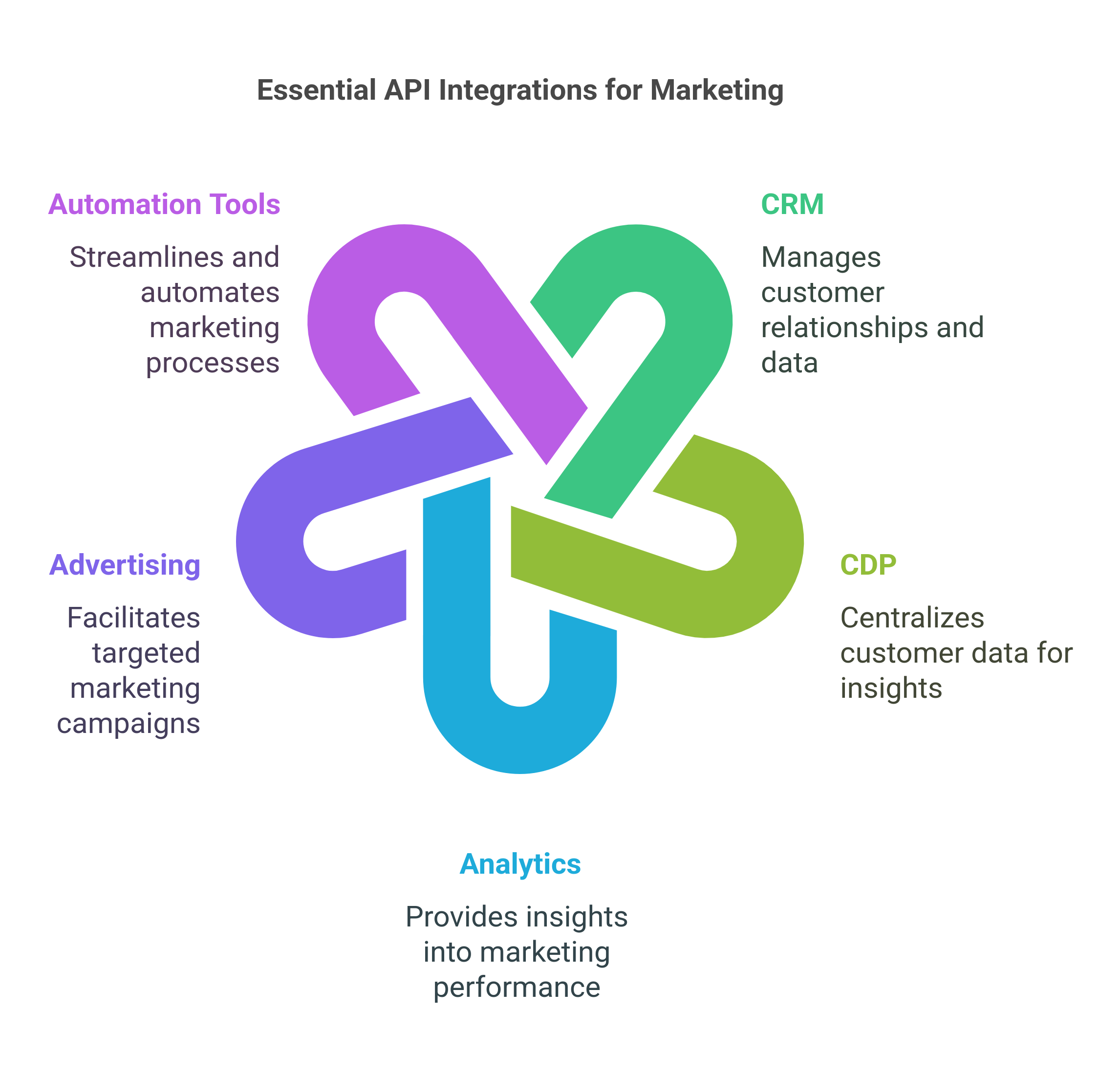
- CRM (Customer Relationship Management) APIs Sync customer interactions across sales, support, and marketing teams. For example, when a customer submits a query via live chat, an API updates their CRM profile, ensuring sales teams have full context for follow-ups.
- CDP (Customer Data Platform) APIs – Aggregate customer data from multiple sources to create unified customer profiles. For example, a CDP API pulls data from social media, web visits, and offline purchases, ensuring marketers have a 360-degree view of the customer.
- Analytics APIs – Deliver real-time insights by connecting website, app, and campaign data to a single dashboard. For example, Google Analytics APIs enable brands to track user behavior across platforms and automatically adjust content recommendations.
- Advertising APIs – Automate ad targeting and optimize campaign performance. For example, Facebook’s Marketing API allows brands to dynamically update ad creatives based on inventory changes or customer behavior.
- Marketing Automation APIs – Trigger workflows and personalize customer communication at scale. For example, a marketing automation API sends an abandoned cart email when a customer leaves items in their cart without checking out.
Case Studies: Brands Leveraging APIs for Hyper-Personalization
Leading brands have already embraced API-driven marketing to deliver highly personalized experiences. Here are some standout examples:
- Netflix – Uses APIs to personalize recommendations based on viewing history. Every time a user watches a show, APIs update their profile and adjust recommendations in real time.
- Starbucks – Integrates APIs between its mobile app, loyalty program, and point-of-sale systems. Customers can order ahead, collect rewards, and receive personalized promotions—all powered by seamless API connectivity.
Airbnb – Uses APIs to dynamically adjust search results and pricing based on user behavior, location, and availability. The result? A hyper-personalized booking experience tailored to each customer.
Role of APIs in Hyper-Personalization
Gone are the days when personalization meant adding a first name to an email. Today, hyper-personalization is about delivering dynamic, one-to-one experiences by analyzing behavioral patterns, transaction history, and contextual signals. APIs make this possible by pulling data from multiple touchpoints—website visits, mobile apps, customer support interactions, past purchases, and even IoT devices—and ensuring that every marketing decision is informed by the most up-to-date information available.
Let’s break down how APIs are revolutionizing personalization at every stage of the customer journey.
APIs as the Foundation for Real-Time, Data-Driven Personalization
At its core, personalization depends on the ability to access and act on customer data in real time. APIs facilitate this by:
- Syncing customer data across platforms – APIs ensure that every touchpoint, from a website visit to an email open, updates in real time across all systems.
- Triggering automated responses – If a customer adds an item to their cart but doesn’t check out, an API-driven system can instantly send a reminder email or push notification.
- Enhancing recommendation engines – APIs allow businesses to analyze a user’s past behavior and serve personalized product, content, or service recommendations.
For example, Amazon’s recommendation engine relies on APIs to fetch user behavior data, compare it with millions of other users, and serve highly relevant product suggestions within milliseconds. Without API-driven data exchange, this level of personalization would be impossible.
Integrating Behavioral Data, Transaction History, and Contextual Signals
Hyper-personalization isn’t just about knowing what a customer bought last—it’s about predicting what they might need next. APIs enable marketers to go beyond basic transactional data and integrate multiple signals for a more holistic understanding of each individual.
- Behavioral Data – APIs track how users interact with a brand (e.g., pages viewed, products browsed, and time spent on-site). This data informs content recommendations, ad targeting, and retargeting strategies.
- Transaction History – APIs sync purchase data across CRM, CDP, and analytics platforms, allowing brands to tailor future offers based on past spending habits.
- Contextual Signals – APIs integrate external data such as location, device type, weather conditions, and even time of day to personalize messaging in real-time.
Consider how Spotify curates playlists. APIs pull together listening history, mood-based categorization, trending data, and even contextual signals (e.g., time of day) to generate customized playlists like Discover Weekly or Your Daily Mix. This level of personalization fosters deep user engagement.
Moving from Static Segmentation to AI-Driven Individualization
Traditional marketing segmentation grouped customers into broad categories based on demographics or predefined behaviors. But with the rise of AI-driven APIs, personalization is shifting from static segmentation to dynamic, one-to-one individualization.
- Static Segmentation (Old Model): A clothing retailer segments customers into “Men 18-34” and sends the same promotional email to all of them.
- AI-Driven Individualization (New Model): APIs analyze browsing history, past purchases, and even weather conditions in the customer’s location to suggest specific outfits suited to their style and needs.
AI-powered APIs continuously refine user profiles based on new interactions, ensuring that personalization evolves in real time. This shift enables businesses to:
- Deliver highly relevant product or content recommendations.
- Optimize messaging based on customer preferences and engagement patterns.
- Predict future behavior and proactively engage customers with tailored offers.
Netflix is a prime example of this in action. Its API-powered personalization engine doesn’t just suggest popular content; it dynamically changes thumbnails, descriptions, and recommendations based on a user’s unique viewing habits. Each experience is tailored, not just based on broad categories but on deep, real-time insights.
Emerging Trends in API-Driven Integration
From the rise of composable marketing stacks to the integration of blockchain for data integrity, these trends will define how brands interact with customers in the coming years. Marketers who understand and leverage these innovations will gain a significant competitive edge, delivering seamless, personalized, and compliant experiences at scale. Let’s explore the key API-driven trends shaping the future.
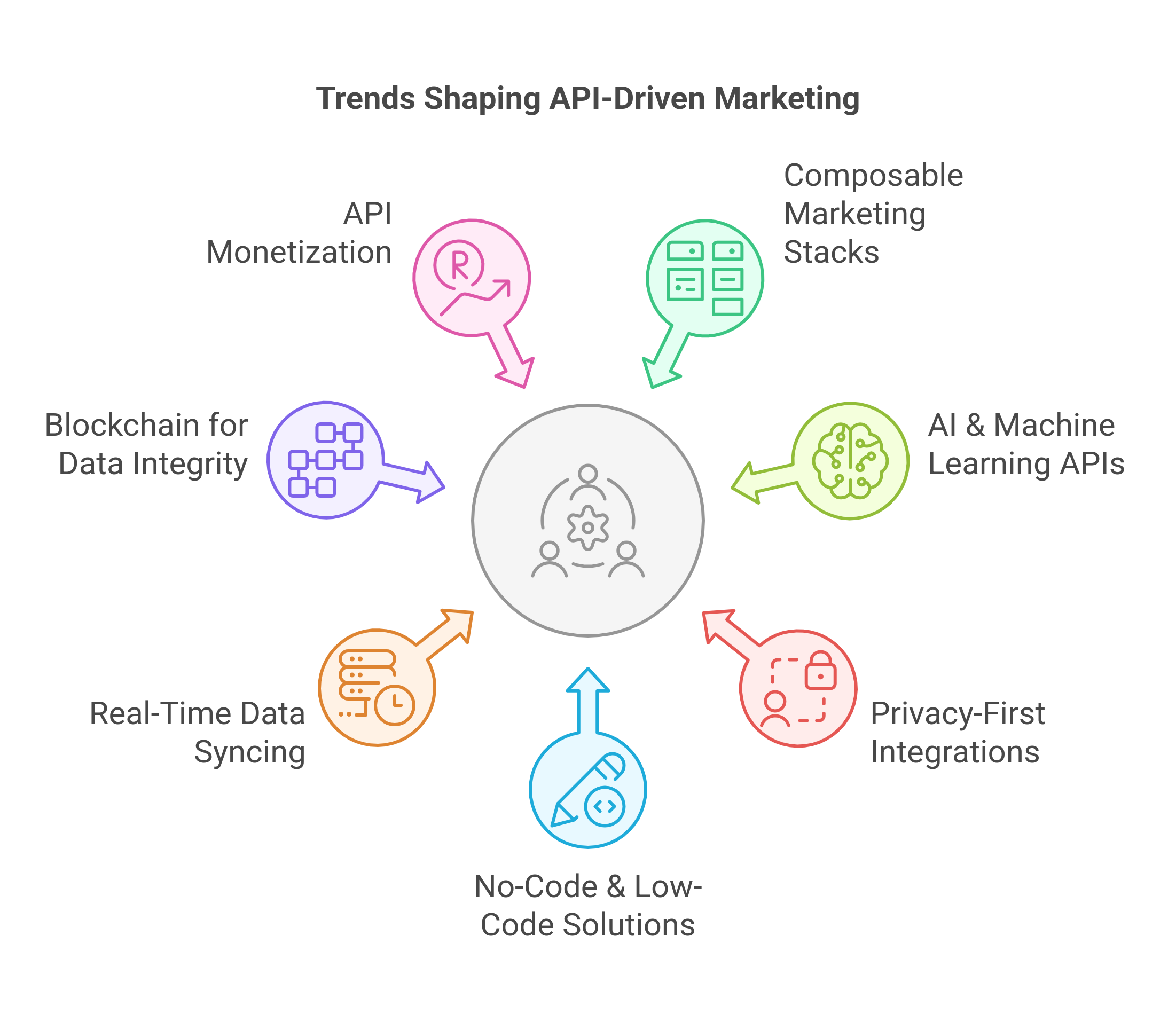
Composable Marketing Stacks
The monolithic marketing suite is becoming a thing of the past. Instead of relying on a single all-in-one platform, businesses are embracing composable marketing stacks, where best-in-class tools are connected through APIs to create highly customized ecosystems.
How It Works: APIs allow marketers to integrate specialized tools—like best-of-breed CRMs, analytics, and automation platforms—into a seamless, interoperable system.
Why It Matters: This modular approach ensures that businesses are not locked into rigid platforms but can adapt quickly by swapping out tools as technology evolves.
Example: A company may use HubSpot for email marketing, Fragmatic as a CDP, Google Analytics for insights, and Twilio for SMS—all integrated through APIs.
Composable marketing stacks give brands greater agility, enabling them to future-proof their tech without costly migrations.
AI & Machine Learning APIs
AI-driven marketing is only as good as the data fueling it—and APIs serve as the bridge between AI engines and real-time customer interactions. In 2025, AI & ML APIs will take personalization to new heights, allowing brands to:
Use predictive analytics to anticipate customer behavior. Example: APIs pull customer interaction data into AI models that predict churn risk and recommend retention strategies.
Enhance chatbots with real-time contextual awareness. Example: A chatbot API integrates with CRM data to offer tailored support based on previous customer interactions.
Generate dynamic content on the fly. Example: AI-powered APIs personalize website headlines, product descriptions, and even ad creatives based on user preferences.
APIs make AI more accessible, enabling marketers to leverage machine learning for smarter decision-making and automation.
Privacy-First Integrations
With increasing data privacy regulations (like GDPR, CCPA, and the death of third-party cookies), marketers are shifting toward privacy-first API strategies. This includes:
Zero-party data collection: APIs help brands collect data directly from users via preference centers, surveys, and interactive content.
Server-side tracking: Instead of relying on browser-based tracking (which is being phased out), APIs enable direct server-to-server data transfers for more accurate measurement.
Stronger API security: As data privacy concerns grow, brands must implement stricter API authentication, encryption, and compliance standards to prevent breaches.
No-Code & Low-Code API Solutions
Traditionally, API integrations required developer expertise, but no-code and low-code solutions are changing the game. With intuitive drag-and-drop interfaces, marketers can now:
Integrate APIs without coding. Example: Tools like Zapier, and Workato allow marketers to automate workflows by connecting apps visually.
Launch API-driven campaigns faster. For instance, a marketer can set up an API-triggered email workflow based on CRM data without writing a single line of code.
Gain independence from IT teams. No-code solutions reduce dependency on developers, enabling faster experimentation and execution.
Real-Time Data Syncing
Speed is everything in modern marketing. Real-time API syncing ensures that customer data is always up to date across all platforms, enabling:
Instant personalization. Example: A customer browses a product on a website, and within seconds, APIs update their email and ad preferences for hyper-relevant targeting.
Automated ad optimization. Example: Ad platforms like Google and Meta use API integrations to adjust bids and targeting in real-time based on audience behavior.
Faster campaign adjustments. Marketers can make data-driven decisions on the fly, ensuring that campaigns remain relevant and effective.
Real-time APIs enable marketing teams to move from static, pre-planned campaigns to always-on, responsive engagement.
API Monetization
APIs aren’t just internal tools—they’re becoming products in their own right. Forward-thinking companies are now monetizing their APIs by offering them as services to partners and third-party developers.
E-commerce example: Shopify’s API ecosystem allows developers to build apps that extend Shopify’s core functionalities, generating revenue for both Shopify and the developers.
Marketing platform example: HubSpot offers API-based integrations that allow third-party apps to plug into its ecosystem, creating a marketplace of interconnected tools.
Predictions for 2025
APIs are no longer just a technical necessity; they’re the backbone of modern marketing. As we move into 2025, their role will only expand, powering real-time customer interactions, automating decision-making, and reshaping data privacy strategies. From API-first customer journeys to AI-driven campaign automation, marketing will increasingly rely on seamless, intelligent, and privacy-compliant integrations. Here’s what the future holds for API-driven marketing in 2025 and beyond.
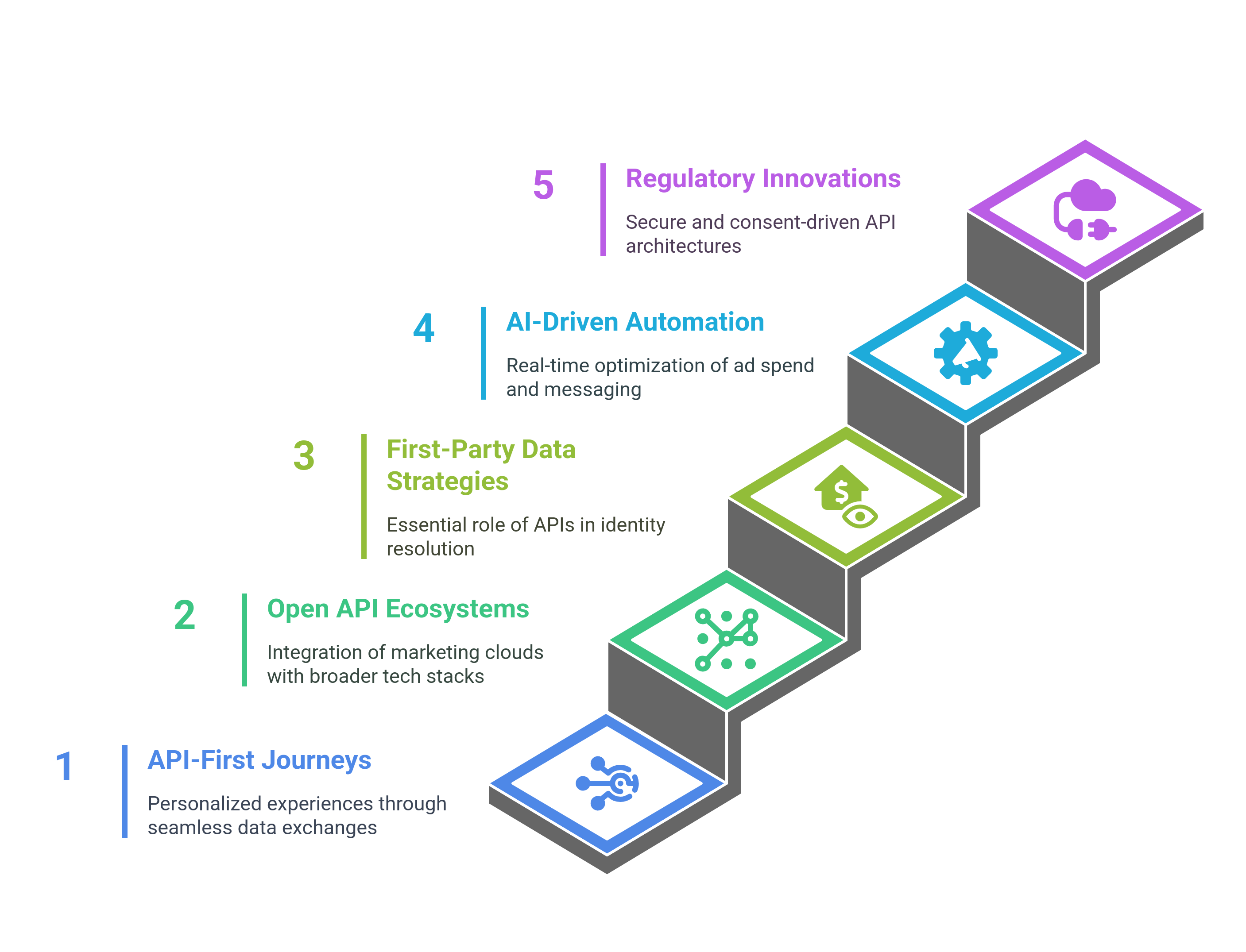
API-First Customer Journeys Becoming Standard
Consumers no longer tolerate fragmented experiences. They expect a seamless transition between online and offline touchpoints, hyper-personalized interactions, and immediate responses across all platforms. This expectation is driving the rise of API-first customer journeys, where every interaction is powered by real-time data synchronization across multiple systems. APIs ensure that when a customer engages with a brand—whether on a website, a chatbot, an app, or in-store—their preferences, behavior, and history are instantly accessible and actionable. This means no more repeated questions from customer support, no generic marketing messages, and no disjointed experiences between digital and physical environments.
For example, if a customer browses a pair of sneakers on a retailer’s mobile app but doesn’t make a purchase, an API instantly updates their customer profile in the brand’s CDP. Within seconds, personalized product recommendations appear in the customer’s email inbox, a retargeting ad is triggered on social media, and a chatbot message offers a time-sensitive discount. By 2025, API-first customer journeys won’t be an innovation—they will be the industry standard. Brands that fail to build seamless, API-driven experiences will struggle to retain customers in an era where convenience, speed, and personalization dictate loyalty.
Shift Towards Open API Ecosystems in Marketing Clouds
For years, major marketing platforms like Google, Meta, Salesforce, and Adobe have operated as walled gardens, making it difficult for brands to freely exchange data between systems. This closed approach has given these tech giants control over customer data, but businesses are now demanding more flexibility and interoperability. In response, we are witnessing a shift towards open API ecosystems, where marketing clouds are integrating with external platforms to offer brands greater control over their martech stacks. This transition is being fueled by both regulatory pressures and the increasing need for seamless cross-platform marketing automation.
Open API ecosystems will allow brands to connect best-in-class tools rather than being locked into a single vendor’s suite. Imagine a scenario where an e-commerce brand uses Adobe Experience Cloud for content management, Google Analytics for insights, and Braze for customer engagement. In an open API world, these platforms would seamlessly communicate with each other in real-time, eliminating data silos and enabling more efficient marketing automation. By 2025, more marketing clouds will be forced to embrace API-driven interoperability, ensuring that brands can build agile, modular marketing stacks tailored to their unique needs rather than relying on rigid, closed systems.
First-Party Data Strategies Centered on APIs
As the death of third-party cookies reshapes digital marketing, brands are shifting toward first-party data strategies to maintain personalization and audience targeting. APIs are becoming the backbone of this transition, enabling brands to collect, unify, and activate customer-consented data from owned channels like websites, apps, and CRM systems. Rather than relying on external ad networks, businesses will leverage APIs to build direct relationships with their audiences through zero-party and first-party data collection mechanisms, such as preference centers, surveys, and interactive content.
For instance, an API can sync customer interactions from multiple sources—website visits, past purchases, email engagement, and customer support chats—into a central repository like a CDP. This allows marketers to create privacy-compliant audience segments for personalized email marketing, loyalty programs, and ad targeting. With regulations like GDPR, CCPA, and the phasing out of third-party cookies, first-party data APIs will be non-negotiable for identity resolution and omnichannel personalization. By 2025, brands that fail to implement API-driven first-party data strategies will face diminishing audience insights, weaker ad performance, and declining marketing ROI.
Regulatory-Driven API Innovations
With data privacy regulations tightening worldwide, APIs will need to evolve to ensure compliance with stricter security and consent frameworks. Laws like the EU’s Digital Markets Act, California’s CPRA, and other global privacy regulations are placing greater restrictions on how customer data is collected, stored, and shared. This is pushing brands to develop more secure, consent-driven API architectures, incorporating server-side tracking, data encryption, and privacy-enhancing technologies (PETs) to maintain compliance while still delivering personalized experiences.
One major trend emerging in 2025 is the rise of privacy-preserving APIs, which allow brands to process customer data without directly accessing personally identifiable information. For example, differential privacy techniques enable APIs to aggregate behavioral insights without exposing individual user data. Additionally, server-to-server APIs are replacing traditional browser-based tracking, reducing reliance on cookies and third-party trackers. By 2025, API security and privacy compliance won’t just be an IT concern—they will be a core marketing strategy, ensuring that brands build trust while staying ahead of evolving regulatory requirements.
Actionable Strategies for Marketers
APIs are shaping the future of marketing, but understanding their potential isn’t enough—marketers need a clear, practical roadmap for implementation. The challenge is bridging the gap between marketing objectives and API-driven capabilities without getting lost in technical complexity. By selecting the right tools, fostering collaboration with technical teams, and adopting API-first workflows, marketers can unlock new levels of efficiency, personalization, and automation.
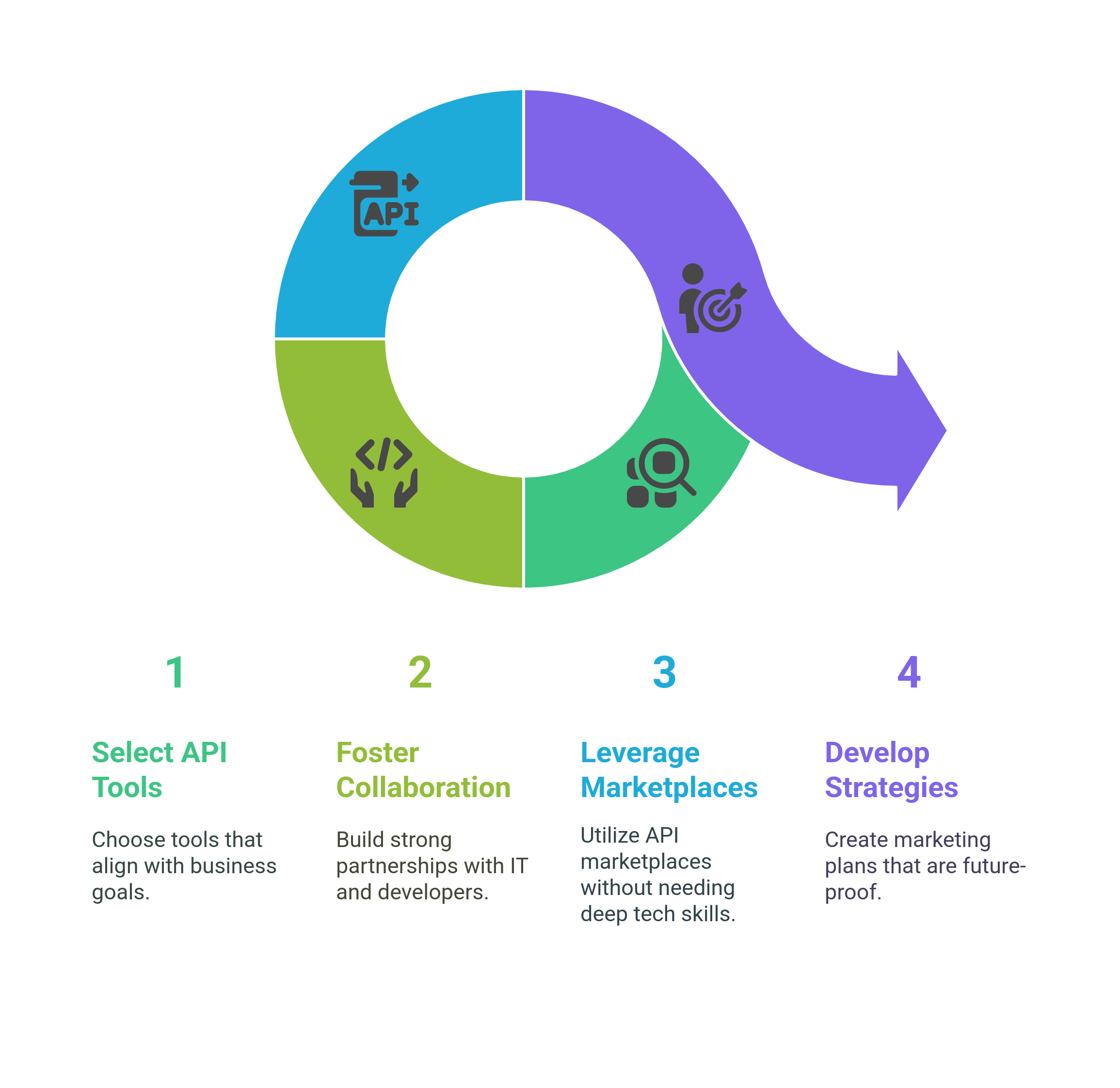
Here’s how marketing leaders can take tangible steps toward an API-first strategy that drives real business impact.
Selecting Appropriate API-First Marketing Tools
Not all APIs are created equal, and choosing the right API-driven tools can make or break a marketing strategy. The key is to focus on solutions that seamlessly integrate with your existing tech stack while aligning with business objectives. Whether it’s an API-powered Customer Data Platform for real-time personalization, an AI-driven automation tool for campaign optimization, or a server-side tracking API for privacy-compliant analytics, the right selection depends on your brand’s specific needs.
To make informed decisions, marketers should evaluate API-first platforms based on scalability, ease of integration, and support for real-time data syncing. Tools like Segment, HubSpot, Braze, and Zapier offer pre-built API integrations that allow marketers to leverage powerful capabilities without deep technical expertise. Prioritizing plug-and-play APIs with no-code or low-code interfaces can significantly reduce dependency on IT teams while enabling greater agility in campaign execution.
Fostering Effective Collaboration with Developers and IT Teams
Successful API-driven marketing isn’t just about tools—it’s about collaboration. Many marketers hesitate to engage with developers, fearing technical complexity, but fostering a strong working relationship with IT teams is crucial for API adoption. Marketing and IT should work together to identify integration opportunities, streamline workflows, and ensure data flows smoothly across systems.
One of the most effective ways to build this collaboration is by establishing cross-functional API strategy sessions, where marketers define business needs while developers provide insights into technical feasibility. Creating clear documentation, leveraging API management platforms (such as Postman or Swagger), and using API monitoring tools help ensure transparency and smooth execution. By breaking down silos between marketing and IT, brands can maximize the impact of API-driven initiatives.
Leveraging API Marketplaces and Integrations Without Deep Technical Expertise
Marketers don’t need to code to harness the power of APIs—API marketplaces and low-code/no-code solutions are making integration easier than ever. Platforms like RapidAPI, AWS Marketplace, and Google Cloud API Hub provide ready-to-use APIs that marketers can plug into existing workflows with minimal effort. For instance, a marketer looking to enhance customer segmentation can use an API from an AI-driven audience analytics provider without writing a single line of code. Similarly, automation tools like Zapier or Make allow non-technical teams to connect CRMs, email platforms, and ad tools through pre-configured API workflows. By leveraging these platforms, marketers can scale their efforts without waiting on developer bandwidth, accelerating time-to-market for new campaigns and innovations.
Developing Future-Proof Marketing Strategies with API-Driven Workflows
The future of marketing belongs to brands that can adapt, automate, and personalize at scale—and APIs are the key to this evolution. To stay ahead, marketers should build API-driven workflows that allow for real-time data activation, dynamic content generation, and predictive personalization. This means moving beyond static marketing strategies and embracing automation powered by AI, machine learning, and real-time customer insights.
For example, a real-time pricing API can dynamically adjust product prices based on demand, competitor pricing, and customer behavior. Similarly, a conversational AI API can personalize chatbot interactions based on past purchases and browsing history. By designing marketing strategies around API-driven automation, brands can ensure their campaigns remain adaptive, scalable, and resilient to industry shifts.
Conclusion
Marketing is no longer about guesswork, delayed insights, or fragmented customer experiences. The future belongs to brands that seamlessly integrate, automate, and personalize at scale—and APIs are the foundation that makes it all possible. From hyper-personalized customer journeys to AI-driven campaign optimization and privacy-first data strategies, APIs are reshaping marketing at an unprecedented pace. The question is no longer if brands should adopt an API-first approach, but how quickly they can pivot to stay ahead of the competition.
Marketers who embrace API-driven strategies will unlock unparalleled agility, intelligence, and efficiency, while those who hesitate risk falling behind in a rapidly evolving digital landscape. This is not just a technological shift—it’s a fundamental redefinition of how marketing works, how data flows, and how brands engage with customers. The brands that win in 2025 and beyond won’t just use APIs; they will build their entire marketing ecosystems around them. The future is here. The question is: Will you lead the transformation, or struggle to catch up?