

Introduction
In today’s data-driven marketing landscape, consumer information powers every personalization, ad, and automation workflow. But with growing concerns over the misuse of personal data, marketers are facing a defining moment. The California Consumer Privacy Act (CCPA) — the landmark data privacy law — reshaped how businesses collect, process, and use consumer information. Under CCPA regulations, marketers must now balance personalization with privacy, offering transparency and control while still delivering relevant experiences. This shift marks the transition from unchecked data harvesting to responsible, consent-based engagement.
Understanding what CCPA means, how it defines data compliance, and how it applies to marketing isn’t just a legal requirement — it’s an essential step toward building customer trust in a privacy-first world.
Understanding CCPA Compliance and Its Impact on Businesses
Understanding CCPA compliance is essential for every business that collects or processes consumer data. The California Consumer Privacy Act (CCPA) introduces strict regulations that redefine how personal information can be gathered, shared, and stored. These rules not only protect consumer privacy but also reshape marketing strategies — requiring brands to operate with transparency, consent, and accountability at every stage of data usage.
What is CCPA Compliance?
The California Consumer Privacy Act (CCPA) is a data privacy regulation enacted in 2020 to protect the personal information of California residents. In simple terms, CCPA compliance means ensuring that your business collects, uses, and shares consumer data in a transparent, permission-based manner. Under CCPA regulations, companies must disclose what data they collect, how they use it, and whether they share or sell it to third parties. Consumers have the right to access, delete, or opt out of the sale of their data — making CCPA a powerful framework for user-centric privacy.
Who Needs to Comply With CCPA?
CCPA applies to for-profit businesses that meet any of these criteria:
- Annual gross revenue of $25 million or more
- Handle personal data of 100,000 or more California residents, households, or devices
- Earn 50% or more of their revenue from selling or sharing personal data
Even if your company isn’t physically located in California, CCPA regulations apply if you collect data from California residents — meaning most U.S.-based marketers must take note.
What CCPA Compliance Means for Marketers
For marketing teams, what CCPA means goes beyond a legal checklist — it transforms how campaigns are planned and measured.
- You must update privacy policies to reflect data use with clarity.
- All forms and tracking mechanisms (cookies, pixels, ad IDs) must be paired with opt-out links or cookie banners.
- CRM and marketing automation platforms must support data access and deletion requests.
Transparency isn’t optional — every touchpoint (email, form, ad) needs a visible connection to user consent.
Adapting to CCPA compliance forces marketers to re-evaluate lead generation, targeting, and personalization tactics — but it also builds trust. When customers understand how their information is handled, engagement improves and long-term brand credibility grows.
CCPA vs GDPR: Understanding the Key Differences in Data Privacy Regulations
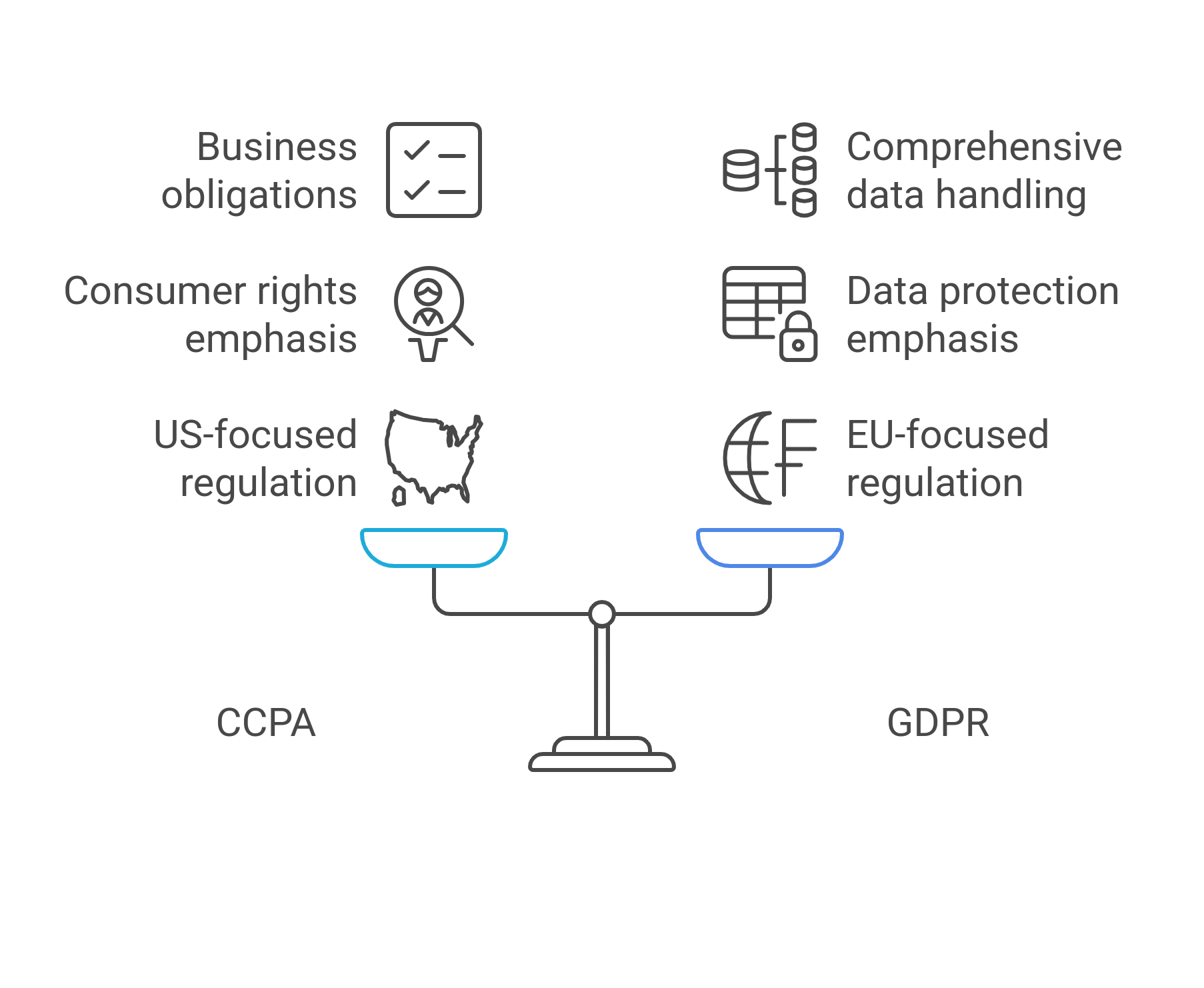
While CCPA and GDPR (General Data Protection Regulation) share a common goal—protecting consumer data—their approaches differ significantly:
- Consent Model: GDPR requires explicit opt-in consent before data collection, whereas CCPA allows businesses to collect data by default but mandates an opt-out option.
- Scope & Applicability: GDPR applies globally to any business handling EU residents’ data, while CCPA primarily affects businesses operating in California.
- Consumer Rights: Both laws give users access to their data and the right to request deletion, but CCPA specifically introduces the "Do Not Sell My Personal Information" requirement.
- Penalties & Enforcement: GDPR violations can lead to fines of up to €20 million or 4% of global revenue, while CCPA fines start at $2,500 per violation and escalate to $7,500 for intentional violations.
For marketers navigating both regulations, compliance isn’t just about avoiding penalties—it’s about building trust. A privacy-first approach not only meets legal requirements but also enhances customer relationships in an era where data transparency is a brand differentiator.
Why Marketers Need to Understand Both Frameworks
For global or U.S.–EU-hybrid marketing teams, complying with CCPA regulations while also meeting GDPR standards is essential. Both laws reflect a single trend — data transparency is the new marketing currency.
Knowing what CCPA compliance means allows marketers to:
- Design consent flows that respect regional privacy expectations.
- Avoid campaign interruptions due to non-compliance penalties.
- Strengthen user trust by clearly communicating data use and preferences.
Instead of seeing these laws as limitations, marketers can use them to build credibility and differentiate their brands in an era where respecting privacy defines loyalty.
CCPA Compliance 101: What Marketers Need to Know About CCPA Regulations
For marketers, CCPA compliance isn’t just a legal requirement—it’s a fundamental shift in how consumer data is handled. With stricter regulations on data collection, transparency, and consumer control, brands must adapt to a privacy-first approach while still delivering personalized experiences. Ignoring compliance isn’t an option, as violations can lead to hefty fines and, more importantly, eroded consumer trust.
The Key Rights CCPA Grants Consumers
The California Consumer Privacy Act (CCPA) gives consumers specific rights that reshape how businesses — especially marketers — collect and handle personal information. Understanding these rights isn’t just about legal compliance; it’s about rethinking how data powers every stage of your marketing strategy.
The Right to Know
Consumers have the right to know what personal data a company collects, how it’s used, and whether it’s shared with third parties. For marketers, this means your privacy policy and data collection forms must clearly outline what information is captured and for what purpose — whether for analytics, email marketing, or advertising.
The Right to Delete
Individuals can request the deletion of their personal information, with some exceptions (e.g., fraud prevention or legal obligations). From a marketing perspective, this affects CRM systems and automation tools — every request must trigger a clean-up across platforms to ensure no data remains in use for segmentation or retargeting.
The Right to Opt Out of Data Sales
If a business “sells” consumer data (even indirectly through ad targeting or data sharing), it must allow users to opt out. For marketers, this includes scenarios like sharing leads with ad platforms, affiliates, or data enrichment tools. A clear, accessible “Do Not Sell My Personal Information” link is mandatory under CCPA regulations.
The Right to Non-Discrimination
Businesses cannot penalize users who exercise their privacy rights. This means no reduced service quality, pricing changes, or restricted access to content for those who opt out of tracking. In marketing, it reinforces the importance of designing equitable experiences — ensuring privacy preference does not affect content personalization or user engagement.
Why These Rights Matter to Marketers
Each of these rights fundamentally changes how data-driven marketing operates. To maintain compliance, teams must:
- Keep consent and data request workflows easily accessible.
- Audit all marketing tools and vendors for CCPA alignment.
- Build transparent data practices that communicate respect and control to users.
When users see your brand actively protecting their privacy, they’re more likely to trust you with their data voluntarily — creating stronger engagement over time.
What Qualifies as “Selling” Data?
(Hint: It’s Broader Than You Think!)
Under CCPA, the definition of “selling” personal information extends far beyond direct transactions. It includes:
- Sharing consumer data with third-party advertisers, data brokers, or analytics providers in exchange for monetary compensation or other benefits.
- Allowing third-party tracking technologies (such as cookies and pixels) to collect user data for ad targeting.
- Transferring user information to partners or affiliates that use it for marketing purposes.
Even if a brand doesn’t directly sell data for cash, it could still be considered a data seller if it shares data in ways that benefit its business. This is why many companies now provide explicit opt-out options, rethink their retargeting strategies, and shift towards first-party data collection.
How CPRA (California Privacy Rights Act) Strengthens CCPA Enforcement
The California Privacy Rights Act (CPRA)—which took effect in 2023—further expands CCPA’s consumer protections and introduces tougher enforcement measures. Here’s what marketers need to know:
- New Category: “Sensitive Personal Information” – CPRA places additional restrictions on collecting and processing highly personal data (e.g., race, religion, health data, and precise geolocation).
- Stronger Opt-Out Rules – Businesses must now provide a “Limit the Use of My Sensitive Personal Information” option in addition to the “Do Not Sell” link.
- Stricter Enforcement – CPRA establishes the California Privacy Protection Agency (CPPA), a dedicated regulator with greater authority to investigate and fine non-compliant businesses.
- Data Retention & Minimization – Companies must now disclose how long they retain consumer data and cannot keep it longer than necessary.
With CPRA in full force, marketers must tighten their data practices, reduce reliance on third-party tracking, and ensure they provide clear, compliant opt-out mechanisms. Navigating CCPA and CPRA may seem like an obstacle, but brands that embrace privacy-first marketing will build deeper trust, stronger engagement, and long-term customer loyalty. Up next: How to align your marketing strategy with CCPA compliance without sacrificing personalization.
How CCPA Affects B2B Marketers
When the California Consumer Privacy Act (CCPA) was first introduced, many B2B marketers assumed it primarily applied to consumer-facing businesses. However, with the passage of the California Privacy Rights Act (CPRA), which strengthens and expands CCPA, B2B companies are now subject to the same data privacy regulations. This means that even if a business is targeting other businesses, it must still comply with CCPA when handling personal data related to employees, leads, or business contacts.
Does CCPA Apply to B2B Marketing?
Yes, CCPA applies to B2B marketing, and here’s why. The law covers any business that processes the personal information of California residents, including individuals acting in a professional capacity. Initially, B2B transactions were granted a temporary exemption, but as of 2023, that exemption has expired. Now, B2B marketers must offer data access, deletion, and opt-out rights just as B2C businesses do.
This means that if a B2B marketer collects contact details through lead generation forms, tracks website visitors for retargeting, or shares business contact information with third parties, they must ensure compliance with CCPA regulations. Transparency in data collection and clear opt-out mechanisms are now required, regardless of whether the data is used for direct consumer marketing or professional outreach.
What Counts as Personal Data Under CCPA?
Under CCPA, personal data is broadly defined to include any information that can be linked to an individual. For B2B marketers, this includes:
- Work email addresses and direct phone numbers
- Job titles and company affiliations, when linked to a specific person
- IP addresses and browsing behavior collected from company websites
- Lead lists acquired from third-party data providers
- Behavioral tracking data from interactions with emails, ads, or websites
Even though this information is often used for professional purposes, it is still considered personal data under CCPA if it can be connected to a specific individual.
Common Marketing Practices Impacted by CCPA
CCPA affects several key aspects of B2B marketing, particularly those involving digital advertising, lead generation, and customer relationship management.
- Retargeting and digital ads: Marketers who use tracking technologies, such as cookies or pixels, to serve personalized ads must now provide a clear mechanism for users to opt out of data sharing. This is especially relevant for LinkedIn Ads, Google Ads, and other platforms that rely on behavioral targeting.
- Email lists and lead generation: If a business collects contact details through gated content, such as whitepapers, webinars, or newsletter sign-ups, it must disclose how the data will be used and provide an option for users to request deletion of their information.
- Third-party data sharing: Many B2B marketers use third-party platforms, such as customer relationship management (CRM) software or marketing automation tools, to store and process lead data. If these tools involve sharing data with external vendors, it may be classified as a “sale” under CCPA, requiring an opt-out option.
With the enforcement of CCPA and CPRA, B2B marketers must take a more privacy-conscious approach to data collection and usage. By implementing transparent data practices, businesses can ensure compliance while maintaining trust with their prospects and customers.
The Personalization vs. Privacy Dilemma
Personalized marketing has long relied on extensive data collection to deliver tailored experiences. However, with the introduction of CCPA and evolving consumer expectations around privacy, marketers now face a fundamental challenge: how to provide relevant, data-driven experiences without violating privacy regulations or losing consumer trust. As third-party cookies phase out and new compliance requirements take hold, businesses must find alternative strategies to balance personalization and privacy.
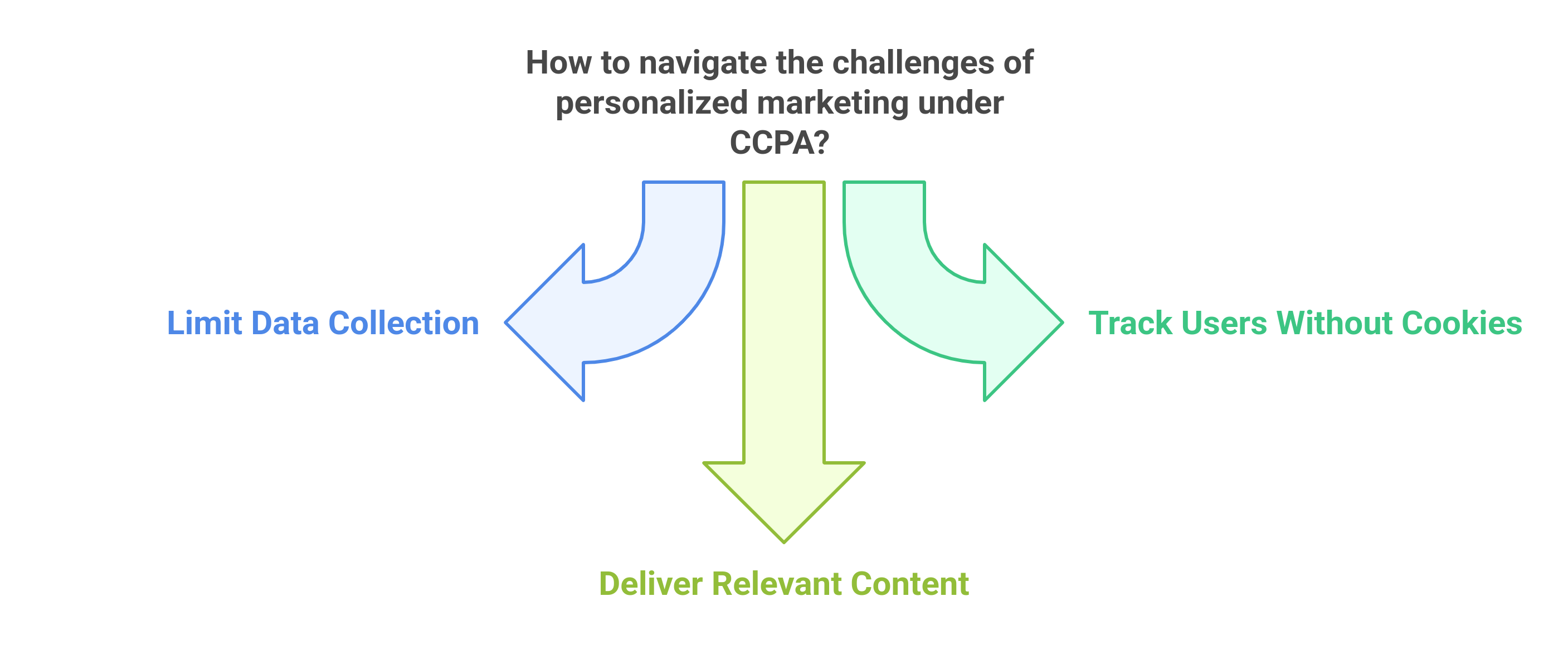
How CCPA Limits Traditional Data Collection for Personalized Marketing
CCPA restricts the way businesses collect, store, and share consumer data, significantly affecting traditional personalization tactics. Companies must disclose what data they collect, provide opt-out mechanisms for data sales, and honor user requests for data deletion. As a result, marketers can no longer rely on unrestricted access to third-party data sources to fuel targeted campaigns.
Under CCPA, even sharing customer data with ad platforms, analytics providers, or third-party vendors could be classified as a "sale" of data, requiring explicit opt-out options. This makes it more difficult to track user behavior across websites and tailor content based on browsing history, ad interactions, or demographic insights obtained from external sources.
The Challenge of Tracking Users Without Third-Party Cookies
The loss of third-party cookies, accelerated by privacy laws like CCPA and browser restrictions from companies like Google and Apple, further complicates personalized marketing. Traditionally, third-party cookies enabled businesses to track users across different websites, build detailed customer profiles, and deliver hyper-targeted ads. Without them, many traditional tracking and retargeting strategies are no longer viable.
CCPA also prohibits businesses from penalizing users who opt out of data collection, meaning marketers must find new ways to engage their audience without relying on invasive tracking techniques. This shift forces brands to invest in first-party data strategies, contextual targeting, and privacy-compliant personalization methods.
Strategies for Delivering Relevant Content While Respecting User Privacy
To maintain personalization without compromising compliance, marketers must rethink their approach to data collection and audience engagement. Some effective strategies include:
- Leveraging first-party data: Collecting information directly from users through website interactions, surveys, email subscriptions, and loyalty programs allows businesses to personalize experiences while maintaining full control over data usage.
- Contextual targeting: Instead of tracking users across multiple sites, contextual advertising places ads based on the content of the page a user is currently viewing, ensuring relevance without requiring personal data.
- Privacy-first personalization: Using artificial intelligence and machine learning, brands can analyze aggregated and anonymized data to identify trends and deliver relevant content without tracking individuals.
- Transparent data exchange: Consumers are more willing to share data when they understand how it benefits them. Offering clear incentives—such as exclusive content, discounts, or personalized recommendations—while maintaining transparency about data usage builds trust and encourages voluntary data sharing.
- Consent-driven marketing: Implementing clear opt-in mechanisms and respecting user preferences ensures compliance while maintaining a positive customer experience. Brands that prioritize transparency and control will foster stronger customer relationships over time.
CCPA Compliance Checklist for Marketers
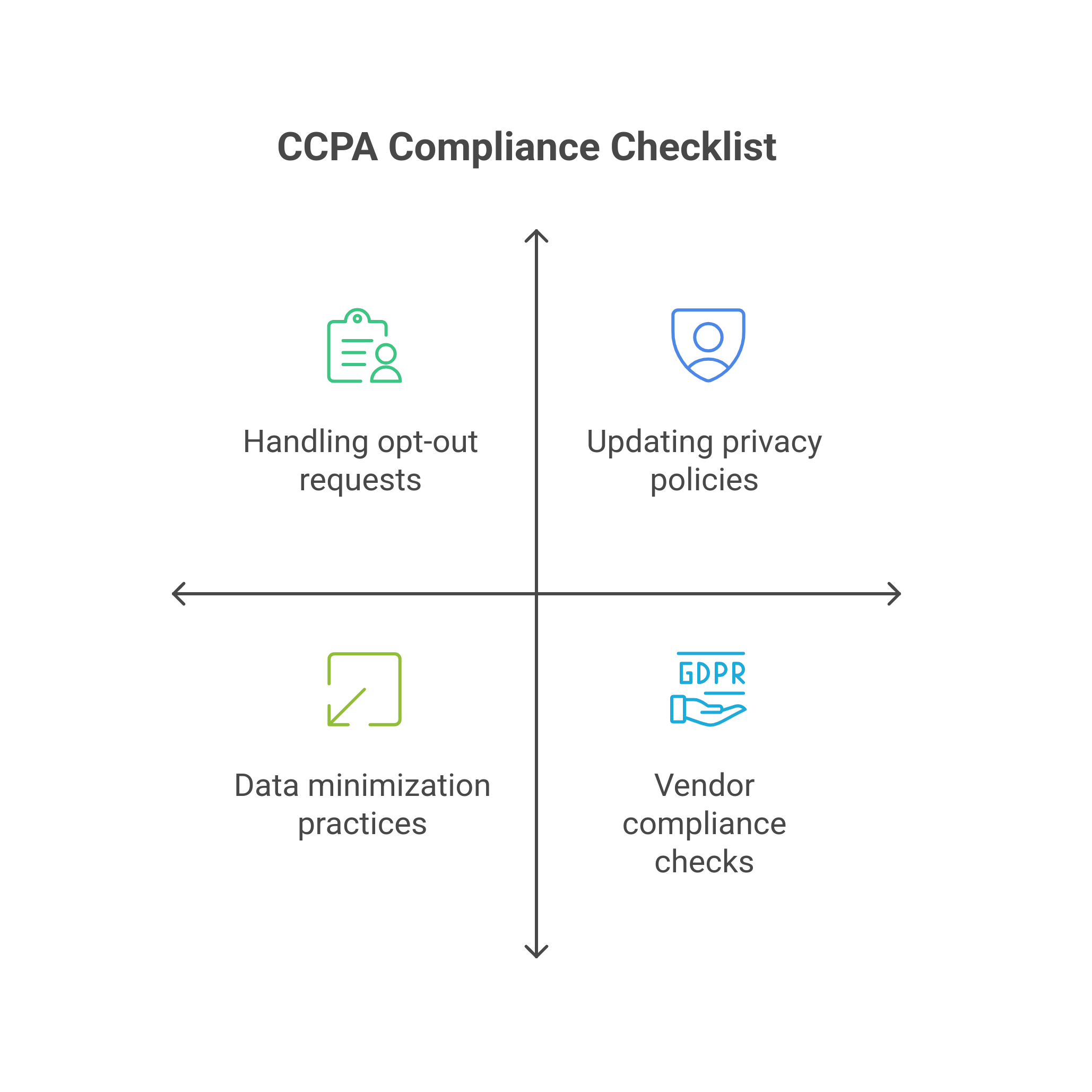
Ensuring compliance with the California Consumer Privacy Act (CCPA) requires a structured approach to data handling, transparency, and consumer rights. For marketers, this means not only adjusting how data is collected and used but also reassessing relationships with vendors and technology providers. Below is a detailed compliance checklist to help marketers align their strategies with CCPA requirements.
Transparency
Review and Revise Your Privacy Policy: Under CCPA, businesses must provide clear and accessible information about how they collect, use, and share personal data. Marketers should ensure that their privacy policy includes:
- A clear list of the types of personal data collected (e.g., names, emails, browsing activity).
- Details on how consumer data is used (e.g., for targeted advertising, analytics, or email marketing).
- Information on third-party sharing (whether data is sold or shared with external vendors).
- Instructions on how consumers can exercise their CCPA rights (opt-out, data access, and deletion requests).
A “Do Not Sell or Share My Personal Information” link if the business engages in data sales.
Improve Consent Management: While CCPA does not require opt-in consent for most data collection (unlike GDPR), businesses must offer clear opt-out options and honor user preferences. Key actions include:
- Implementing a cookie consent banner that informs users about tracking technologies and provides opt-out controls.
- Ensuring email marketing sign-up forms clearly state how subscriber data will be used.
Allowing users to update their consent preferences easily (e.g., via an account settings page or a preference center)
Consumer Rights
CCPA grants consumers several rights over their data, and businesses must have processes in place to respond to requests within 45 days.
- Handling Opt-Out Requests: If a business sells or shares personal data, it must provide an opt-out mechanism that is:
- Clearly visible on the website (often as a footer link labeled “Do Not Sell or Share My Personal Information”).
- Easy to use, requiring minimal steps for consumers to opt out.
Applied to all applicable marketing activities, including retargeting and audience sharing with third-party ad platforms.
- Processing Data Deletion Requests: Consumers have the right to request the deletion of their personal information unless an exemption applies (e.g., legal compliance or fraud prevention). Marketers should:
- Establish a user-friendly request process, such as an online form or a designated email address.
- Verify the identity of requesters before processing deletions.
- Ensure that CRM systems, email lists, and marketing automation platforms can execute data deletion requests.
Notify third-party partners (such as data processors and ad networks) about deletion requests if applicable.
- Responding to Data Access and Portability Requests: Consumers can request a copy of the personal data a business has collected about them. Marketers must:
- Provide a structured and readable report of collected data, including sources and purposes of use.
- Ensure data access requests are handled securely to prevent unauthorized disclosures.
Offer at least two methods for consumers to submit data requests (e.g., a toll-free number, email, or online form).
- Handling Opt-Out Requests: If a business sells or shares personal data, it must provide an opt-out mechanism that is:
Data Minimization
CCPA encourages businesses to limit data collection to what is strictly necessary for legitimate business purposes. This means:
- Reviewing lead capture forms and eliminating unnecessary fields. If only an email address is required for a newsletter, avoid requesting full names, phone numbers, or job titles.
- Reducing reliance on third-party data brokers by focusing on first-party data collection through direct customer interactions.
- Ensuring that tracking pixels and cookies are configured to collect only essential data, especially for retargeting and analytics.
- Regularly purging outdated or unused customer data to minimize exposure in case of a data breach.
By prioritizing data minimization, marketers can reduce compliance risks while maintaining consumer trust.
Vendor Compliance
Marketers rely on a range of third-party tools, including CRM systems, email marketing platforms, analytics providers, and ad networks. Under CCPA, businesses are responsible for ensuring their vendors comply with data privacy laws.
- Conduct Vendor Assessments
- Identify all third-party services that process consumer data, including email platforms (e.g., Mailchimp, HubSpot), ad networks (e.g., Google Ads, Meta), and customer databases (e.g., Salesforce, Marketo).
- Request data processing agreements (DPAs) that outline how vendors handle personal data.
Confirm whether vendors classify data sharing as a “sale” under CCPA and if they offer built-in compliance tools (e.g., opt-out mechanisms for targeted advertising).
- Ensure Proper Data Security Measures
- Verify that vendors implement encryption, access controls, and secure storage to protect consumer data.
- Limit data access within your organization to only those employees who need it for marketing operations.
- Regularly review data retention policies to ensure that customer information is not stored longer than necessary.
- Conduct Vendor Assessments
Future-Proofing Your Marketing: Privacy-First Personalization
As privacy regulations tighten and third-party tracking methods phase out, marketers must rethink how they deliver personalized experiences. The future of marketing lies in privacy-first personalization, where businesses balance compliance with delivering relevant, engaging content. This requires shifting away from traditional data collection practices and embracing ethical, transparent, and consumer-controlled data strategies.
How Zero-Party and First-Party Data Can Drive Compliant Personalization
With restrictions on third-party cookies and heightened scrutiny over data sharing, marketers must prioritize zero-party and first-party data to fuel their personalization efforts.
- Zero-party data refers to information willingly shared by consumers, such as preferences, interests, and purchase intentions. This data is typically collected through:
- Preference centers where users select topics of interest.
- Interactive content like quizzes and surveys.
Customer profiles and loyalty programs where users voluntarily input data.
First-party data is collected directly from user interactions with a company’s digital properties. This includes:
- Website and app behavior (e.g., pages visited, content consumed).
- Transactional data from past purchases.
- Email engagement metrics (e.g., opens, clicks, subscriptions).
Unlike third-party data, zero-party and first-party data are collected with full user consent, making them fully compliant with CCPA while still enabling personalized marketing. Businesses that invest in direct relationships with their customers will have a competitive advantage as privacy regulations evolve.
- Zero-party data refers to information willingly shared by consumers, such as preferences, interests, and purchase intentions. This data is typically collected through:
AI-Driven Personalization Without Invasive Tracking
Artificial intelligence (AI) is playing a key role in privacy-first personalization, allowing businesses to tailor experiences without tracking individuals across the web. AI-driven strategies help analyze aggregated and anonymized data while preserving privacy. Key AI-powered approaches include:
- Predictive analytics: Instead of tracking users across different websites, AI models can analyze behavioral trends within a company’s own ecosystem to anticipate customer needs and personalize content accordingly.
- Natural language processing (NLP): AI can analyze search queries, chat interactions, and customer feedback to understand intent and deliver relevant recommendations.
- On-device machine learning: Some companies are shifting personalization to the user’s own device rather than relying on cloud-based tracking, reducing the need for external data collection. Apple’s on-device intelligence for Siri and recommendations in Safari are prime examples.
- Cohort-based marketing (Privacy Sandbox): Google's Privacy Sandbox initiative is moving toward group-based targeting rather than tracking individuals, enabling privacy-compliant ad targeting.
AI-driven personalization allows businesses to maintain relevance without violating privacy laws, making it an essential tool for future-proofed marketing strategies.
Preparing for the Broader U.S. Privacy Law Landscape Beyond California
While CCPA (and its expansion under CPRA) sets a strong precedent for data privacy, marketers must recognize that California is just the beginning. Several U.S. states, including Virginia, Colorado, Connecticut, and Utah, have already enacted their own privacy laws, with more states expected to follow. At the federal level, discussions around a national privacy framework are gaining traction. Key considerations for marketers:
- Monitor evolving state laws: Compliance strategies must be scalable to accommodate different state regulations. Some laws, like Virginia’s CDPA, have opt-in consent requirements similar to GDPR.
- Adopt a unified privacy framework: Rather than addressing each state law separately, businesses should develop a comprehensive privacy strategy that aligns with the strictest requirements.
- Enhance data governance: Centralizing privacy policies, user consent management, and data security measures will help future-proof compliance efforts.
- Prepare for federal regulation: A potential national privacy law could standardize data protection across the U.S., requiring businesses to be flexible in adapting their marketing strategies.
The future of digital marketing is privacy-first, consumer-centric, and built on trust. By investing in zero-party data, AI-driven personalization, and proactive compliance measures, marketers can stay ahead of regulatory changes while continuing to deliver impactful, personalized experiences.
Conclusion
CCPA is more than just a legal requirement—it’s a signal of a broader shift in how businesses must approach data privacy. Marketers who continue to rely on invasive tracking and unchecked data collection will find themselves at odds not only with regulators but also with increasingly privacy-conscious consumers. Instead of seeing compliance as a limitation, forward-thinking marketers should view it as an opportunity to build stronger, trust-based relationships with their audience.
The key to future-proofing marketing lies in embracing first-party and zero-party data, leveraging AI for privacy-compliant personalization, and adopting transparent data practices. As more states enact privacy laws and federal regulations loom on the horizon, businesses that proactively prioritize ethical data usage will gain a competitive edge. Ultimately, the brands that thrive in this new era will be the ones that understand a simple truth: respecting consumer privacy isn’t a barrier to effective marketing—it’s the foundation of it.


