Why Personalized Landing Pages Matter Nowadays
Landing pages are powerful when it comes to conversions because, these days, the B2B market varies in so many niches that a static, one-size-fits-all page can't convert everyone into buyers. In general, visitors expect that what they see should be relevant to the type of entry they used to get there, whether through ads, through a product launch, or through an email nurture stream. Personalized landing pages, on the other hand, are capable of delivering individualized content, messaging, and CTAs to convert general experiences into highly converting ones. In this blog, we will define personalized landing pages, best practices, and give examples of some real personalized landing pages from which you can draw inspiration.
Personalized Landing Pages Definition
A personalized landing page is a tailored web page designed to deliver specific content based on the unique characteristics, preferences, and behaviors of a visitor. Unlike generic landing pages, these pages use data-driven insights to adjust messaging, visuals, and calls-to-action (CTAs) to meet the needs of individual users or segments. The goal is to create a more relevant, engaging experience that aligns with the visitor’s intent—whether that’s to make a purchase, sign up for a newsletter, or request a demo. These dynamic landing pages can personalize content based on multiple factors such as geographic location, industry, past interactions, referral source, or behavior on the site. The idea is simple: the more relevant the content, the higher the likelihood of a desired action.
Key Benefits
Higher Conversion Rates
The most obvious advantage of personalized landing pages is their ability to significantly boost conversion rates. When visitors see content that speaks directly to their needs and preferences, they’re far more likely to take action. Tailored experiences reduce friction and uncertainty, making users feel understood and valued.
Better User Experience
By offering user experience personalization, businesses can craft landing pages that feel intuitive to users. These pages reduce the cognitive load by presenting only the most relevant information, guiding visitors smoothly through the decision-making process. The result is a better overall user experience, leading to stronger engagement and brand loyalty.
Increased Relevance
Personalized landing pages ensure that the content aligns with the visitor’s context—whether they’re exploring solutions for the first time or ready to buy. This increased relevance allows brands to deliver the right message at the right time, enhancing the page’s effectiveness. In a crowded online space, relevance is key to cutting through the noise and grabbing attention.
Static Landing Pages vs Personalized Landing Pages

While personalized landing pages dynamically adjust to suit different user profiles, static landing pages remain the same for every visitor, regardless of their intent, background, or interaction history. Static pages follow a one-size-fits-all approach, often leaving potential customers disengaged or overwhelmed by irrelevant content.
In contrast, personalized landing pages are built to be dynamic and adaptable. This flexibility creates a more meaningful journey for users, addressing their specific pain points and increasing the likelihood of conversion. While static pages may still be effective in certain cases, they lack the precision and impact that user experience personalization offers in today’s marketing landscape.
Best Practices for Personalized Landing Pages
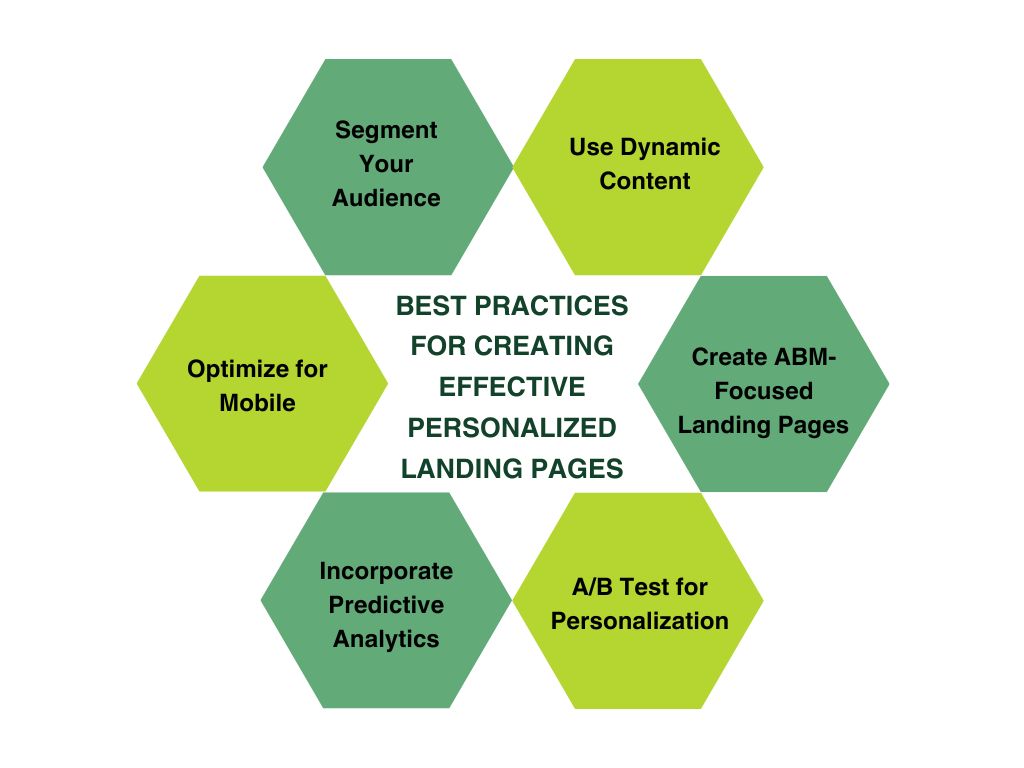
Creating personalized landing pages is a strategic process beyond slapping a name onto a headline. To truly optimize performance and create meaningful experiences, it’s essential to follow these best practices for personalized landing pages:
Segmenting Your Audience
Personalization starts with understanding who your visitors are. You can break your audience into distinct segments by using customer data such as demographics, browsing behavior, and purchase intent. These segments could be based on age, location, industry, or previous interactions with your site. For example, a first-time visitor from an email campaign may need an introduction to your product, while a returning user might respond better to a promotion. Tailoring your content to these segments ensures users get a relevant experience that addresses their unique needs and preferences. The more granular your segmentation, the better. While broad segments are a good starting point, diving deeper into behavior and intent data can significantly enhance personalization.
Using Dynamic Content
One of the most effective ways to personalize landing pages is through dynamic content that changes based on user data. This could include personalized headlines, images, or CTAs that reflect the visitor’s specific characteristics or actions. For example, an e-commerce brand could display product recommendations based on the customer’s previous purchases. At the same time, a B2B company could adjust messaging depending on whether the visitor is in the tech industry or finance. Dynamic content helps make the page more tailored and relevant, driving engagement and improving conversion rates.
Examples of Dynamic Content:
Personalized Headlines: Tailor the headline to reflect the visitor's industry or problem. For example, "Get Custom Marketing Solutions for Financial Services" vs. "Improve Your Tech Firm’s Lead Generation."
Custom CTAs: Adjust the call to action based on the visitor’s familiarity with your brand. Example: "Request a Demo" for new users and "Explore Advanced Features" for returning ones.
Create ABM-Focused Landing Pages for Key Accounts
Incorporating Account-Based Marketing (ABM) into your landing pages elevates personalization by targeting specific high-value accounts with tailored experiences. By segmenting content blocks to feature industry-relevant data or unique solution features, you can capture attention more effectively. For instance, a healthcare prospect might see HIPAA compliance benefits, while a finance sector lead could be shown features relevant to data security. This level of segmentation ensures each account cluster sees content that resonates directly with their needs, making your landing page more compelling.
A/B Testing for Personalization
While personalized landing pages offer a high potential for conversion, it’s essential to continuously test different elements to understand what resonates most with your audience. A/B testing allows you to experiment with variations of personalized headlines, images, or CTAs to find the best-performing combination. For example, you might test two different personalized messages—one focused on product features and another on case studies. By measuring success rates (conversions, click-throughs, etc.), you can make data-driven adjustments that refine your personalized approach over time.
Best Practices for A/B Testing:
Test one element at a time for clear insights (e.g., headline vs. CTA).
Run tests long enough to gather significant data but avoid over-complicating the process.
Use A/B testing data to inform future personalization strategies.
Incorporating Predictive Analytics
One of the more advanced techniques for creating personalized landing pages is leveraging predictive analytics. AI-powered tools analyze user behavior data to predict what kind of content, layout, or CTAs will drive the best outcomes. Predictive heatmaps, for example, can help identify areas of a page where users are most likely to engage, allowing you to place important elements like CTAs or key information in optimal spots. This type of AI-driven personalization enhances the user experience and improves overall landing page performance.
Mobile Optimization
With mobile devices now accounting for a significant portion of web traffic, ensuring that your personalized landing pages are fully optimized for mobile is essential. A seamless mobile experience is critical for both engagement and conversion rates, especially when dealing with personalized content.
Best Practices for Mobile Optimization:
Ensure that dynamic content adapts fluidly to mobile screen sizes.
Prioritize fast load times to avoid frustrating users with slow pages.
Simplify CTAs and ensure they are easily clickable on smaller screens.
Use clean, minimal designs to avoid clutter that might overwhelm mobile users.
Mobile-friendly personalization is key to capturing the growing number of users who browse and shop on their phones, ensuring that your landing pages perform well across all devices.
Examples of Personalized Landing Pages
Salesforce Uses Geo-Targeting to Personalize Landing Pages
Salesforce, a global CRM giant, demonstrates a powerful use of geo-targeting on its personalized landing pages. By tailoring its homepage based on a visitor’s geographic location, Salesforce creates a more relevant experience for users in different regions.
Salesforce Homepage, India
Salesforce Homepage, US
For example, the Salesforce homepage in India prominently features localized content and services specific to the Indian market, such as relevant case studies. In contrast, the US version of their homepage showcases products and features that resonate more with the American audience, including specific tools for industries that dominate the US market.
This level of personalization not only makes the visitor feel understood but also improves engagement by aligning content with local business needs and cultural preferences. The result? A higher likelihood of conversions and an enhanced user experience.
Key Personalization Techniques:
Geo-Targeting: Customizing content based on the visitor’s location.
Localized Messaging: Crafting headlines, images, and CTAs that resonate with regional audiences.
ConvertFlow’s Dynamic Demo Scheduling Landing Page
ConvertFlow takes personalization to the next level with its dynamic demo scheduling page, creating a truly personalized landing page that adapts in real-time based on the visitor’s responses.
When a prospect lands on ConvertFlow's demo page, they’re greeted with a straightforward form to enter their information. However, as they begin interacting with the page, its dynamic nature comes to life.
For example, once a visitor submits their name, the headline updates automatically to address them personally: "Welcome, [Visitor's Name]! Ready for a personalized demo?"
The real brilliance of ConvertFlow’s approach lies in its on-page segmentation. Based on the visitor’s responses, the page directs them down different funnels:
Agency Prospects: If a visitor indicates they work at a marketing agency, they’re asked additional qualifying questions about how many clients they plan to use ConvertFlow with. They are then directed to book a demo of the Partner Program, which caters specifically to agencies.
Non-Agency Prospects: For visitors who don’t work at agencies, ConvertFlow further segments them based on their website traffic tier. Smaller businesses are shown demos for the Pro or Teams plans, while larger enterprises are guided to a demo tailored for the Business Plan.
This on-page segmentation ensures that visitors are led down the most relevant path based on their specific needs, helping them find the right solution faster. The dynamic page also boosts engagement by creating a unique, personal experience with each interaction, thereby increasing the likelihood of conversion.
Key Personalization Techniques:
Dynamic Content: The page’s content changes as the visitor interacts with it, such as updating headlines or adjusting demo options.
On-Page Segmentation: Prospects are segmented in real-time, leading them down the most relevant path based on their answers.
Tailored CTAs: Different CTAs are displayed based on the visitor’s responses, ensuring a more personalized call to action.


Tools and Technologies for Building Personalized Landing Pages
Creating effective personalized landing pages requires the right tools and technologies to handle data collection, segmentation, and dynamic content delivery. Here’s an overview of some of the top platforms that can help businesses create engaging, tailored experiences for their users:
Fragmatic

Fragmatic is a robust web personalization platform designed specifically for B2B marketers looking to optimize their websites for conversions. It offers powerful features that enable businesses to deliver personalized landing pages based on user behavior, demographics, and intent. Fragmatic allows for seamless segmentation and dynamic content creation, making it easy to tailor customer experiences in real-time. Fragmatic’s ability to deliver real-time personalized experiences helps businesses create high-converting landing pages without the hassle of complex setups.
Unbounce

Unbounce is another popular landing page builder that focuses on providing personalized landing pages through its easy-to-use platform. Known for its drag-and-drop interface, Unbounce makes it simple for marketers to create custom landing pages without needing a developer. With Unbounce, businesses can deliver a personalized user experience and easily test different approaches to find the most effective content for their audience.
ConvertFlow

ConvertFlow is an intuitive platform for building personalized landing pages and customer funnels. With a focus on dynamic content and segmentation, ConvertFlow allows businesses to create interactive landing pages that adapt to user behavior in real-time. Its ability to combine dynamic content with on-page segmentation makes it an excellent choice for companies looking to guide users down the right path based on their individual needs.
Key Metrics to Track Performance
Measuring the success of personalized landing pages is essential to understanding the effectiveness of your personalization efforts and maximizing ROI. Here are some of the most relevant metrics to track:

Conversion Rates
The ultimate goal of any personalized landing page is to convert visitors into leads, customers, or subscribers. Tracking conversion rates helps you assess whether your personalization strategies effectively drive the desired action.
Key questions to consider:
Are specific personalized segments converting better than others?
Does personalization based on referral source or intent result in higher conversions?
A/B tests different personalized elements such as headlines, CTAs, and dynamic content to continually refine and improve conversion rates.
Bounce Rates
Bounce rate measures the percentage of visitors who leave your landing page without interacting. A high bounce rate often indicates the content is not engaging or relevant to the user. Personalizing landing pages to match user intent should reduce bounce rates.
Key considerations:
Is your content aligned with the visitor’s intent or journey stage?
Are your personalized landing pages meeting the user’s expectations based on referral sources like ad campaigns or email links?
Reducing bounce rates through better personalization can improve user engagement and overall landing page performance.
Engagement Metrics
Engagement metrics, such as time spent on the page, scroll depth, and interaction with dynamic content, help you understand how well your personalized landing pages resonate with your audience. A highly personalized landing page should encourage visitors to engage more deeply with the content. Track the following:
Time on Page: Are visitors spending more time engaging with personalized content?
Scroll Depth: Are users scrolling further down the page to explore more information?
Clicks on CTAs: Are personalized calls to action prompting visitors to take the desired steps?
High engagement indicates that your personalized content is capturing attention and meeting the needs of your audience.
Return on Investment (ROI)
Measuring the ROI of your personalization efforts is crucial for evaluating the financial impact of creating personalized landing pages. To calculate ROI, compare the cost of your personalization strategies (tools, design, content development) with the revenue generated from those efforts.
Key metrics to consider:
Cost Per Acquisition (CPA): Are personalized landing pages lowering acquisition costs by improving conversion rates?
Customer Lifetime Value (CLV): Are personalized experiences leading to more valuable, long-term customer relationships?
Calculating ROI helps you justify the investment in personalization and ensures that your landing page optimizations deliver measurable business outcomes.
Lead Quality
Beyond conversions, measuring the quality of leads generated from personalized landing pages is important. Are the leads from personalized experiences more likely to convert into paying customers or qualified leads?
Key performance indicators include:
Lead Qualification Rate: What percentage of leads from personalized landing pages are classified as marketing-qualified or sales-qualified leads?
Lead-to-Customer Conversion Rate: Are visitors from personalized campaigns more likely to become customers?
Tracking lead quality metrics ensures that personalization efforts drive volume and attract the right prospects.
Customer Segmentation Performance
For businesses leveraging audience segmentation, tracking each segment's performance is essential for optimizing personalized content. By analyzing conversion rates, engagement, and bounce rates for each customer segment, you can identify which segments respond best to your personalized landing pages.
Metrics to Track:
Segment-Specific Conversion Rates: Which segments are converting the most? Is there a specific segment that responds particularly well to personalization?
Segment Engagement: Do different segments engage more with certain personalized elements like dynamic CTAs or tailored messaging?
Tracking segmentation performance helps you refine your personalization strategy and target the most responsive groups.
Common Pitfalls and How to Avoid Them
While personalized landing pages can drive impressive results, businesses need to be aware of a few common pitfalls. Understanding these challenges and knowing how to avoid them will help ensure that your personalization efforts are both effective and user-friendly.
Overpersonalization and the “Creep Factor”
One of the most significant risks with personalized landing pages is going too far with personalization, which can make users feel uncomfortable or even creeped out. When visitors feel that a brand knows too much about them, it can lead to a loss of trust and lower engagement.
How to avoid over-personalization:
Use data responsibly: Ensure that your personalization efforts are based on relevant data that enhances the user experience without feeling invasive. For instance, personalizing based on broad behavior (e.g., which page they visited previously) is generally safer than hyper-specific details (e.g., knowing their exact location at every moment).
Limit personal details: Be mindful of making content relevant and respecting user privacy. Instead of overly personal information, stick to data that’s been explicitly shared by the visitor, like their industry or interests.
Test user reactions: Conduct A/B tests to gauge how different levels of personalization impact user behavior. This will help you understand where to draw the line regarding personalization without alienating your audience.
Irrelevant Personalization
Personalization for the sake of personalization can backfire if it’s not directly tied to the user’s needs or intent. Irrelevant personalization can confuse visitors, decrease engagement, and reduce conversion rates. For example, showing visitors irrelevant product recommendations or outdated offers can harm their experience.
How to avoid irrelevant personalization:
Focus on relevance: Ensure that any personalized landing page content aligns with the visitor’s journey and intent. Tailor content based on referral sources (e.g., ad campaigns, emails) or behavioral triggers, like time spent on specific product pages.
Keep personalization updated: Regularly review and update your personalization strategies to stay relevant over time. This might include updating offers, adjusting content based on seasonality, or adapting to changes in customer behavior.
Leverage A/B testing: Test different personalized elements to understand which ones resonate most with your audience. This will help you fine-tune your personalization efforts and avoid making irrelevant changes.
Slow Load Times
Personalization can add complexity to a landing page, which can slow down load times. However, users expect fast, seamless experiences—especially when landing on personalized pages. A slow-loading page can lead to higher bounce rates, frustrated visitors, and lower conversions.
How to ensure fast load times:
Use lightweight personalization tools: Opt for platforms that offer fast, efficient loading without adding unnecessary bulk to your landing pages. Tools like Fragmatic use a lightweight tracker to deliver personalized experiences without affecting page performance.
Optimize images and content: Ensure that any personalized images, videos, or dynamic content are optimized for quick loading. Compress files and minimize elements that could slow down the page.
Leverage caching: Caching techniques can help pre-load personalized content so the page loads quickly, even when dynamic elements are involved. A content delivery network (CDN) can also help deliver fast load times to users across different locations.
Inconsistent User Experiences
Personalized experiences should be seamless across devices and platforms. However, if a user’s experience feels fragmented—e.g., they see a personalized landing page on desktop but not on mobile—this inconsistency can erode trust and reduce the effectiveness of your personalization efforts.
How to ensure seamless user experiences:
Optimize for mobile: Ensure your personalized landing pages are fully responsive and offer a smooth experience on mobile devices. Personalization should work seamlessly on desktop and mobile platforms, with content adjusting dynamically based on the user’s device.
Test across platforms: Regularly test your personalized landing pages on different browsers and devices to ensure consistency. Ensure that the same personalized experience is delivered regardless of how the user accesses the page.
Maintain design consistency: Keep the design elements of your personalized landing pages consistent across different platforms so the look and feel remain cohesive and professional.
Conclusion
Generic landing pages don’t cut it anymore. To convert in today’s competitive environment, you need personalized landing pages that adapt to who’s visiting and why. By following best practices, learning from examples of personalized landing pages, and tracking the right metrics, you can create some of the best personalized landing pages in your industry. Start simple—segment, personalize, and test—and soon your landing pages will be driving more qualified leads and measurable ROI.