Introduction
In a world filled with options but lacking attention on the part of the consumers, marketing psychology and behavioral economics in pricing have become very useful tools in influencing decisions. The Decoy Effect stands out as one of the most intriguing principles in this issue: introduction of a third less attractive choice (decoy pricing) would cause consumers to be drawn toward a larger, more profitable, or acceptable choice. Alteration of choice architecture doesn't instill choice manipulation; rather, an illustration of how smart pricing techniques can align value perceptions with underlying business strategies. Be it choosing between SaaS subscription plans or between sizes of coffee, the impact of effects are visible everywhere, in most cases unnoticed by the buyer.
The Decoy Effect is not an academic pursuit but a huge advantage to marketers, product managers, and pricing strategists wanting to direct consumer behavior more explicitly. It adopts a relatively hands-off approach in nudging prospects toward higher-value decisions, in many instances growing average order value, boosting conversion rates, and increasing preference for premium offerings. By anchoring as part of a wider psychological pricing strategy, decoy pricing works with other marketing tactics like bundling and personalization. Therefore, this blog aims to explain what the Decoy Effect is, how it works, real-world applications of the Decoy Effect, and how modern businesses, particularly in B2B and SaaS, can ethically use the Decoy Effect to optimize their prices and product positioning.
What is the Decoy Effect?
The Decoy Effect is a behavioral-economic theory of pricing in which a consumer's preference between two options is altered by the introduction of a third, less attractive option, the decoy. The Decoy Effect stands as an antithesis to classical economic theory in that it recognizes the possibility that often consumers are not able to appreciate function or objective value and that their behavior is often contextually driven or comparative. In other words, what matters are the products on offer and not just the target product defined by itself.
In practice, decoy pricing seeks to steer decisions while keeping the set of available options the same. By introducing an undesired choice with very specific limitations, marketers direct consumers toward a target choice that, under this light, seems more attractive. The widespread use of decoy pricing and the not-so-fine art of psychological pricing has made the rule very familiar in marketing strategies across several fields of work-from fast food to software as a service. In order to understand the full effect of the Decoy Effect, we need to examine two important psychological processes at work: asymmetric dominance and context-dependent decision-making.
Asymmetric Dominance: The Engine Behind the Decoy Effect
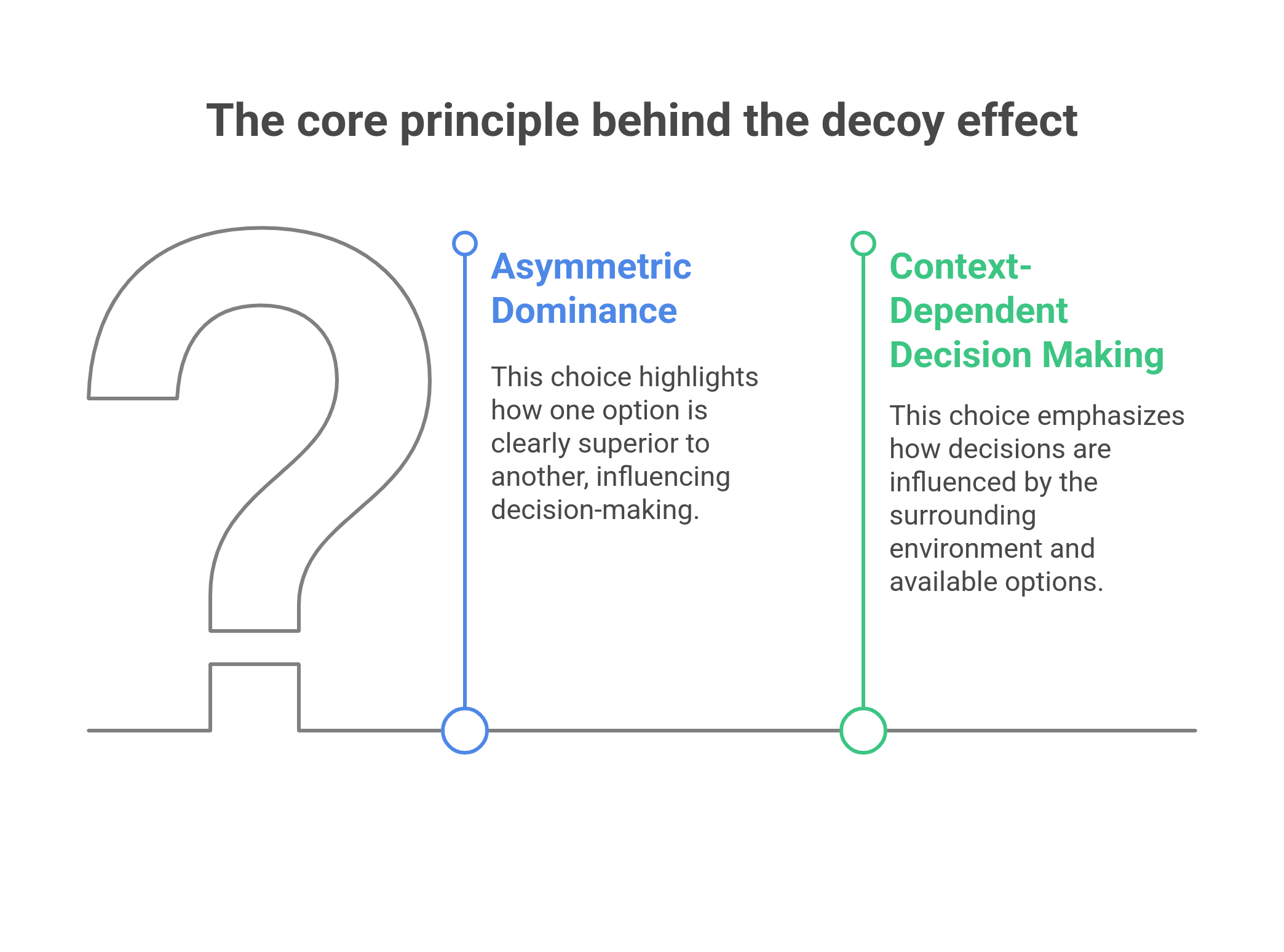
Let's understand the principle at the core of the Decoy Effect, which would be asymmetric dominance. An asymmetric dominance scenario occurs when a third option (the decoy) is clearly worse than one choice (the target) but is only slightly worse than or actually comparable to a second (the competitor). The target dominates the decoy (meaning, it is preferred over it for every attribute), but the decoy is close enough to the competitor to make the competitor look bad in comparison.
Such a contrived imbalance feeds straight into how we simplify decisions in our heads. Where we see complexity, we look for contrast. The decoy makes the target appear to have more value or utility, thus cleverly nudging us toward it, even if we would not pick it in a binary scenario. A case of asymmetric dominance is applied in pricing strategies to badly reposition the perceived value of a product without altering the product itself. In economic theory, this constitutes a classic demonstration of how behavioral pricing often deviates from rationality yet still achieves great results.
Context-Dependent Decision Making: Why Consumers Don’t Choose in a Vacuum
People do not decide in isolation; rather context-dependent, hence why understanding context-dependent decisions: not picking in a vacuum, the very stuff behind the Force of Decoy Effect. In other words, the value of options in themselves does not guide consumer behavior; rather, it is determined by reference to systemic options or framing. Here, marketing psychology takes the stage, since, in this decoy, even the lines of pricing could be moved and changed in regard to how value is perceived by the customer.
Humans don't like to objectively calculate worth; rather, we leave it to heuristic approximations, particularly in environments made complex by many choices. With choice architecture created by decoy pricing, users are guided into the desired behavior while not creating a lot of fatigue. Thus, the Decoy Effect becomes more than a trick, indeed a version of psychological pricing that creates alignment in the pricing structure with how people actually make decisions in real-life settings.
How the Decoy Effect Works: Breaking Down the Mechanics
For one to understand the decoy effect well, one must understand how it works behind the visible working. Here is a breakdown of the mechanics of decoy pricing: how an inferior, well-designed product or plan affects customer choices without the client knowing it. If and when such a third option that isn't generally meant to be picked is added, businesses can easily divert customers to their bottom lines or their preferred offer in a much more effective manner.
What is Decoy Pricing and Why It is Priced to Lose in Making Decisions
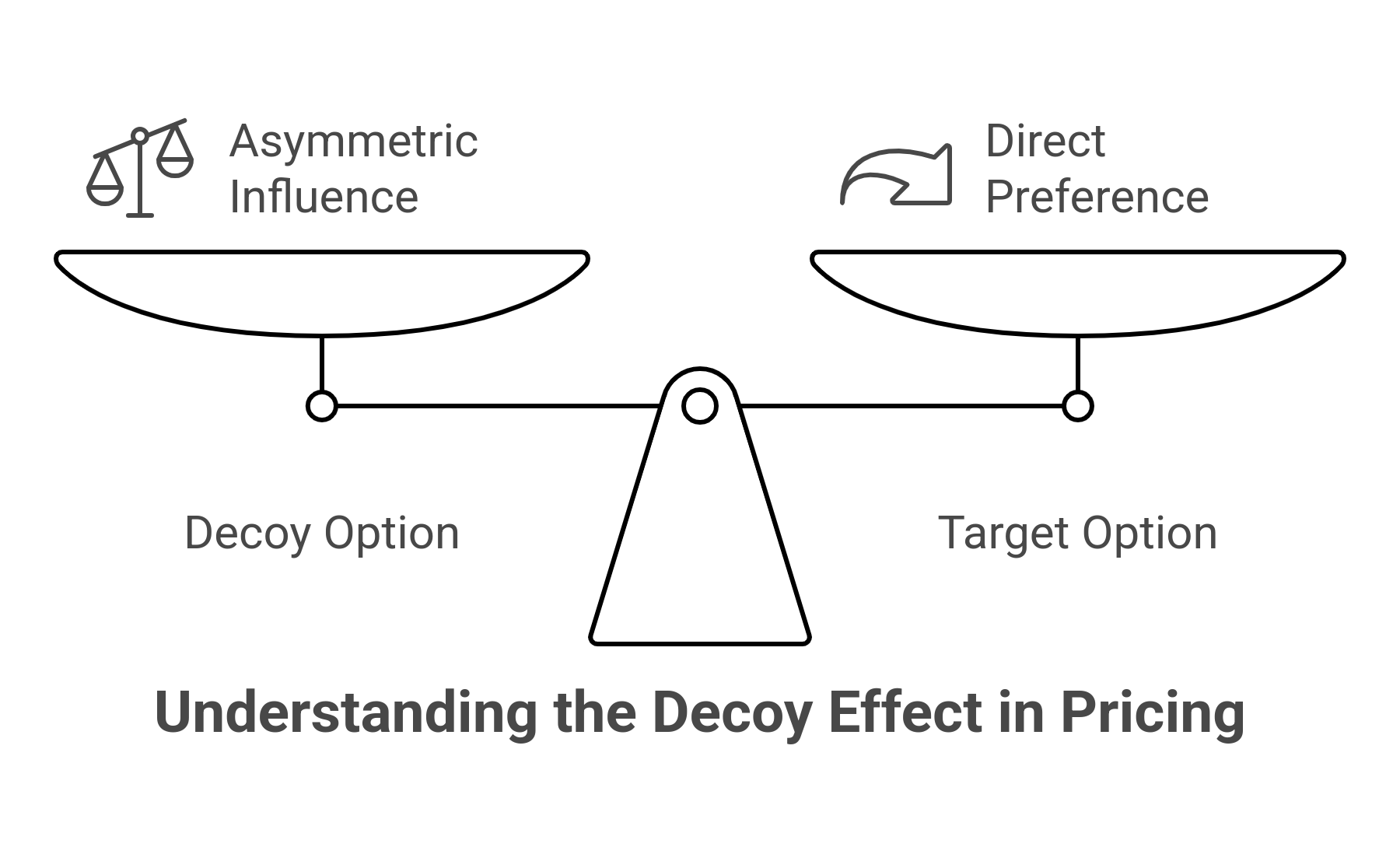
Decoy pricing means having a decoy that will lure the decision-maker into making a choice but not significantly attractive compared to the feature option (the target), with other characteristics that are sufficiently close to making it less daring than another choosing option (the competitor). This asymmetry is critical; the decoy option is not to be selected; it simply exists to change the perception of other options. For example, in the 3-tier SaaS pricing page, the middle option might well be the actual target, while the highest-priced plan serves as a decoy by making the mid-tier seem to be less expensive and worthwhile.
The decoy can achieve different dominance between the target and the decoy. It creates a contrast between the dominant characteristics of the decoy in all dimensions by which the decoy fails to catch up with the target product. This contrast increases not only the probability that the target will be selected, but also the more subtle mechanisms by which it alters the consumer behavior of the buyer so that he or she feels that his or her decision has been made not emotionally but rationally, according to value. In reality, this is effectively how options are being structured more than any intrinsic value that each would have given in an option.
Classic Real-world Examples
The Decoy Effect is far from a theoretical notion; it's one of the best-implemented psychological pricing strategies used by some well-known brands around the globe. From the entertainment and tech sectors to coffee shops, decoy pricing has easily and slyly become a means to influence consumer behavior. These examples show how decoys can steer preferences, enhance perceived value, and aid margins-making it one of the best sound pricing techniques in B2C and B2B. Now we will explain the marketing psychology associated with real-world pricing methods.
The Economist Subscription: Perfect Case Study for Decoy Pricing
Perhaps the most popular example of the Decoy Effect is the historical subscription price setup of The Economist magazine. At one time, the magazine offered three choices:
Web-only for $59
Print-only for $125
Print + Web for $125
To the naked eye, the second and third choices have the same price tag, but the latter serves as the decoy, which is something hardly any person wants. It is merely intended to make the combined Print + Web subscription appear so much better in value for the same price. As a result, users overwhelmingly gravitated toward the third option. This test is frequently referred to in behavioral economics studies relating to pricing and is a brilliant exhibit of how decoys can change preference through relative comparison.
Starbucks Cup Sizes: Pricing Anchors for Implicitly Disguised Decoy
Walk into any Starbucks, and you are invariably greeted by three cup sizes: Tall, Grande, and Venti. Tall generally has a modest foundation for pricing, while the Venti is much too hot to trot, and the Grande just floats in the middle, not just in terms of size, but also in perceived value. But here is where the decoy pricing principle subtly enters: the Venti, while big, may not be the loudest/most robust in value per ounce. It exists partly to make the Grande appear like a smart compromise—not too expensive, not too small. It is a case in point of anchoring plus the Decoy Effect: the costliest one recasts the next-highest one as the most sensible choice. Not just about the coffee; selling that feeling of a value-based decision, this is how psychological pricing works more potently in frequent retail spaces.
Tiering Prices for Apple iPhone: Premium Frame with Decoy Models
iPhones are usually released by Apple in sets of multiple models, typically low, midrange, and higher-end, with differences so insignificant but strategically aligned that an entry-level iPhone might cost $699, Pro models at $999, and Pro Maxes at $1,099. Such a plan has the Pro model as a decoy, drawing consumers to go for the expensive Pro Max, promising a set of significantly better specifications, for just a little bit more. This is where Apple's genius in pricing comes in—they understand quite well how to turn manipulative marketing psychological conditioning. One more middle-tier iPhone, not priced differently from the premium, with fewer features. Hence, encourages the consumer to trade up instead. In this way, Apple enjoys more margins while not alienating customers by sticker shock. That is a masterclass in which the Decoy Effect can sell consumers by pushing up his sales in the higher-end consumer electronics segment.
SaaS Pricing Pages: Crafting Tiers to Influence User Behavior
A typical SaaS pricing scheme would include a Basic plan offering limited features, a Premium plan as the desired plan of choice, and a Pro plan serving as a decoy. The Pro plan dramatically marks up from the Premium plan, offering little more in the way of value for any given user and leaving the Premium plan with the reputation of being the smart choice. For example, the Basic one might cost the user $49 a month for his basic features; the Premium one at $99 a month for most of the functionality; and on the other hand, Pro is going to be an extra frill at $149 a month, for only those types of needs eager beavers might have. The Pro plan isn't featured for selling—it aims to sell even harder into Premium. Behavioral economics in pricing operates at this ground directly: alteration in the perception of value as manipulated by behaviorally famous consumer patterns may be understood as the most balanced perceived value. The Premium plan, by placing unknown pressures brought by the decoy, looks not just favorable but optimal as a value for the highly intent user compared to the options.
The Role of Decoy Effect on Consumer Decision-Making
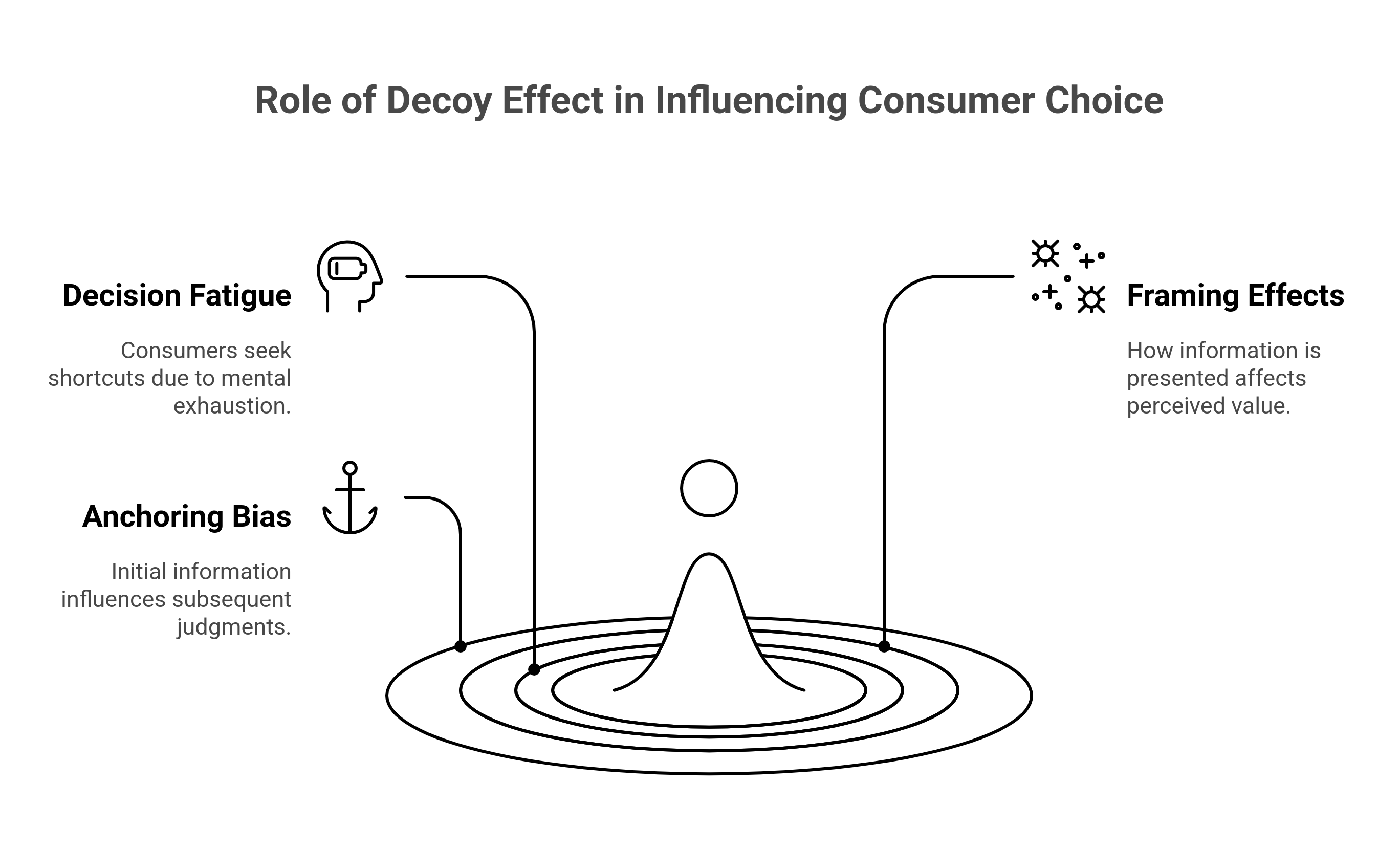
In the modern consumer-saturated world, there is no rational consumer behavior-individual biases, mental shortcuts, and emotional reactions. This is where real marketing psychology and behavioral economics come into play with pricing. By knowing how people interpret value through relative comparisons and emotional framing, marketers can use decoy pricing as a very effective tactic. The following will deal with the three fundamental psychological mechanisms presenting the impact of the Decoy Effect.
Decision Fatigue and Desire for Shortcuts
The modern consumer has so many choices to make throughout the day, such as what type of coffee to buy, which software package to choose, and the like. All these can create an overload in the brain, leading to decision fatigue, the state of the brain giving up making comparative evaluations, and an escapist attitude. The Decoy Effect taps directly into this need. Having an option that is clearly worse than the one to be selected makes the math simple and the appropriate selection so "obvious". The decoy, in essence, reduces cognitive friction. Instead of evaluating all features in all options, consumers tend to choose a dominant one over another, thus saving time and mental energy. This is best suited to the psychology of pricing methods: make the best option feel the easiest and most intuitive to choose, especially with the buyer who is fatigued or pressured.
Framing Effects and Perceived Value
Framing is a rather powerful marketing weapon that relies on the Decoy Effect. This means that options are judged in terms of one another. A product looks bad in isolation until it suddenly finds its worth when put next to an inferior decoy. Psychologists refer to this as the framing effect, which involves a context where the way options are presented can affect choice at the time of decision making. In pricing, this means that the perceived value of any product is not fixed but, instead, highly elastic and molded by the other options surrounding it. This is the ethos behind psychological pricing: it works not only with numbers but also with structuring, sequencing, emotional cues, and other perception-shaping stimuli. The decoy becomes the frame through which the customer communes with the true offer.
Anchoring and Relative Pricing
It is also anchoring bias, a very strong motive force towards the Decoy Effect in decision making, carrying what is the first information. In Pricing, the decoy acts as the anchor and shifts the baseline. Rather than judging whether the product is expensive or cheap, people tend to judge it relative to the other offerings placed in front of them. For example, a SaaS Pro plan priced at $149/month includes a Premium plan that costs $99/month. That reference price now anchors on the $149 price tag. Retrospectively, $99 looks like a deal and not a high price. Subtle but enormously powerful is how this manipulation makes perception, a primary reason decoy pricing is effective across industries. The value for the customer is anchored not by logic but by contrast.
How to Use the Decoy Effect in Your Pricing Strategy
Understanding the Decoy effect and then implementing it are two different things altogether. Marketers and product teams will have to learn how to design pricing schemes that would subtly shape consumer behavior without crossing any ethical line. Here's how to apply the Decoy Effect with intent and integrity.
Strategic Positioning of the Decoy Option
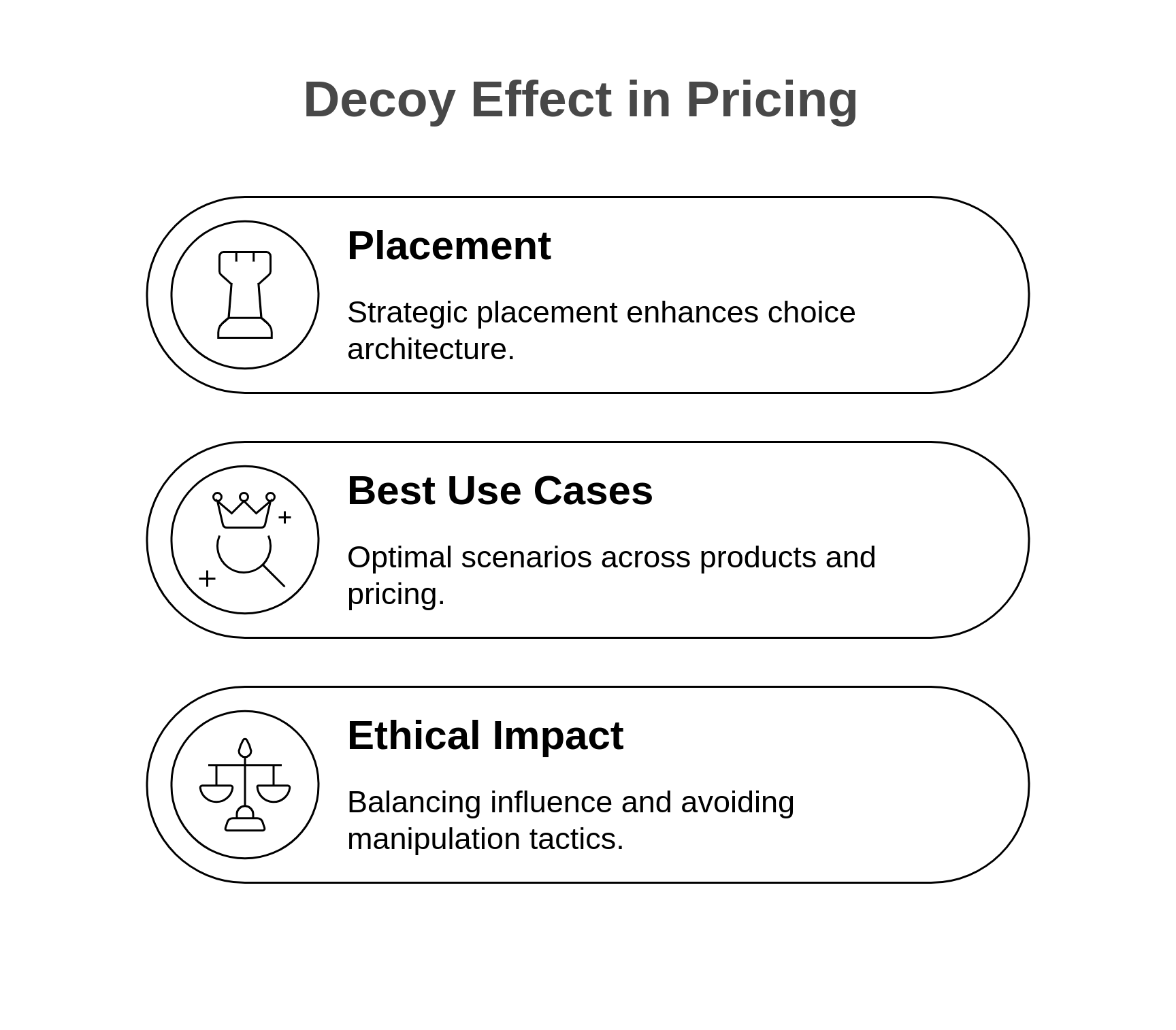
The positioning of the decoy matters for effective decoy pricing. It should be close in price to the target option, but markedly inferior in features, usability, or long-run value. Its job is not to be selected but to serve as a reference that elevates the attractiveness of the target offer. For example, in SaaS pricing, if the Premium plan costs $99/month, a Pro plan can be priced at $129/month and add very few features. This causes the Premium plan to look like the more logical and economical alternative. The decoy should be sufficiently likeable to compare, but definitely less attractive in value, this is what creates the asymmetric dominance required for the Decoy Effect to hold. The arrangement also matters. Always put it in either the highest or middle schema, depending on the objective, and make sure the buyers can see the price and value differences. A sealed nature with the absence of directly comparable options will render the psychological tactic vain.
When and where does it work best?
There is a high impact when a customer is comparing features and evaluating perceived value as against the base price:
Subscription models (SaaS, streaming, productivity tools
Business-to-business pricing tiers (Basic vs. Premium vs. Pro)
Consumer electronics (phones, laptops, wearables)
Retail bundles, examples - coffee sizes, meal plans, apparel sets
Event/service pricing: VIP vs standard vs limited packages
It is most useful in high consideration purchases those purchases that have enough friction in the decision to trigger comparison. On the contrary, in ultra-low-cost or commoditized categories, the Decoy Effect may be less relevant as buyers are impulsively speedy compared to thoughtful evaluation. It also flourishes in tiered pricing environments where three or more options are being offered. Here, a decoy can create the price contrast whereby the "magic" of the technique gets sweet and persuasive.
Influencing vs. Manipulating
People consider decoy pricing to be the practice of deceitful marketing. As long as it is ethically contested, the question of intent and transparency remains. The answers to these do, however, determine what lies on either side of the line that separates influencing from manipulating: Does the pricing decision in question respect the autonomy of the user vis-à-vis the choice made and give true value?
Artificially inflating the decoy so as to have only one option available is one way to go about it, implying that real costs or limitations may be treated undesirably, sketching themselves negatively on a landscape of distrust. When used legitimately, the decoy effect aims at raising the possibility of customers choosing the most relevant option on the basis of differences in values of the choices offered. Marketers who know behavioral marketing understand that it is clarifying and not obfuscating. Rightfully applied, behavioral-economic thinking in pricing encourages customers to feel good about their decision, in particular if that decision suits what they need and what works for the business.
How to Implement Decoy Effect: A Step-by-Step Guide
Using the Decoy Effect for your pricing strategy will require customer insight, proper positioning, and even some psychology. This does not matter whether you are a SaaS, eCommerce, or service provider; below is a framework in which you can apply decoy pricing to your operational model and make sure the consumer behavior impact is maximized. This section provides detailed steps on how to implement the Decoy Effect in one’s psychological pricing strategies.
Step 1: Identify Your Target Offer
Start out by choosing the option you want the most customers to choose: usually the most profitable or balanced tier in your pricing line-up. That target option should offer very strong value and be aligned with your business goals (e.g., upsell rate, retention, or LTV). The decoy option would later make that target option look even better by comparison, so make it very clear what makes this offer attractive in its own right.
Step 2: Define a Less Attractive Decoy Option
Create the third tier in pricing—the decoy—close enough in pricing to the target, but less objectively valuable. This could mean:
- Fewer features.
- Lower limits (e.g., fewer users, limited support).
- The duration of the program is shorter.
- Less flexible or scalable.
The decoy must be perceived as less than the target, but should be comparable. The contrasting effect that comes into play between the two is what triggers the asymmetric dominance mechanism of the Decoy Effect.
Stage 3: Structure Each Option for Comparison
Presentation matters. Organize all options into a neat side-by-side layout for instant visual comparison. As much as possible, use a pricing table, card layout, or checklist for features, ensuring that users can easily see:
- What Each Plan Covers
- The Cost of Each Plan
- Why the True Plan is Better Than the Decoy Plan.
Make that difference between values completely clear; this is the core of relative price perception and what increasingly makes the effect of the Decoy Effect so strong.
Step 4: Anchoring the Target as an "Intelligent Choice"
So position the decoy to anchor the price of the target. For example:
- If the target is $99 per month, then have the decoy at $89-$95 per month.
- Now, make sure that the target appears to be a better offer due to its extra benefits.
That's anchoring bias. It really helps customers see the target as a more intelligent, economical choice compared to the less attractive decoy.
Step 5: Testing Variants and Behavioral Data Analysis
Not every decoy can be effective to the same degree; hence, A/B test the:
- Price Points
- Feature Combinations
- Visual Layouts
- Positioning (e.g., Decoy on the left vs middle)
And when it comes to behavioral metrics, keep track of the following:
- Plan Selection Rates
- Conversion Lift
- Bounce/Hesitation Time for Pricing Pages
Use this data in the refinement of your pricing techniques and optimization of the most effective consumer decision patterns.
Step 6: Keep an Eye on Customer Sentiment and Retention
The Decoy Effect can guide users towards higher plans, but it should not end in regret or churn. Post-purchase feedback and retention metrics are indicators of whether the pricing feels fair and sustainable. Ethics in marketing psychology is about advancing long-term value rather than short-term gains. If users feel deceived, it means your decoy is either too aggressive or poorly deployed. Always ensure transparency and value in the view of a buyer.
Potential Pitfalls and Limitations of the Decoy Effect
The Decoy Effect is not a magic bullet in behavioral economics regarding pricing. Like every psychological pricing technique, it can backfire when misapplied or poorly understood in the demarcation of its boundaries. Knowing the limitations of decoy pricing can help marketers to use it sensibly-without eroding trust or undermining long-term value. These are the most common risks and limitations you should remember while employing this marketing psychology manipulation.
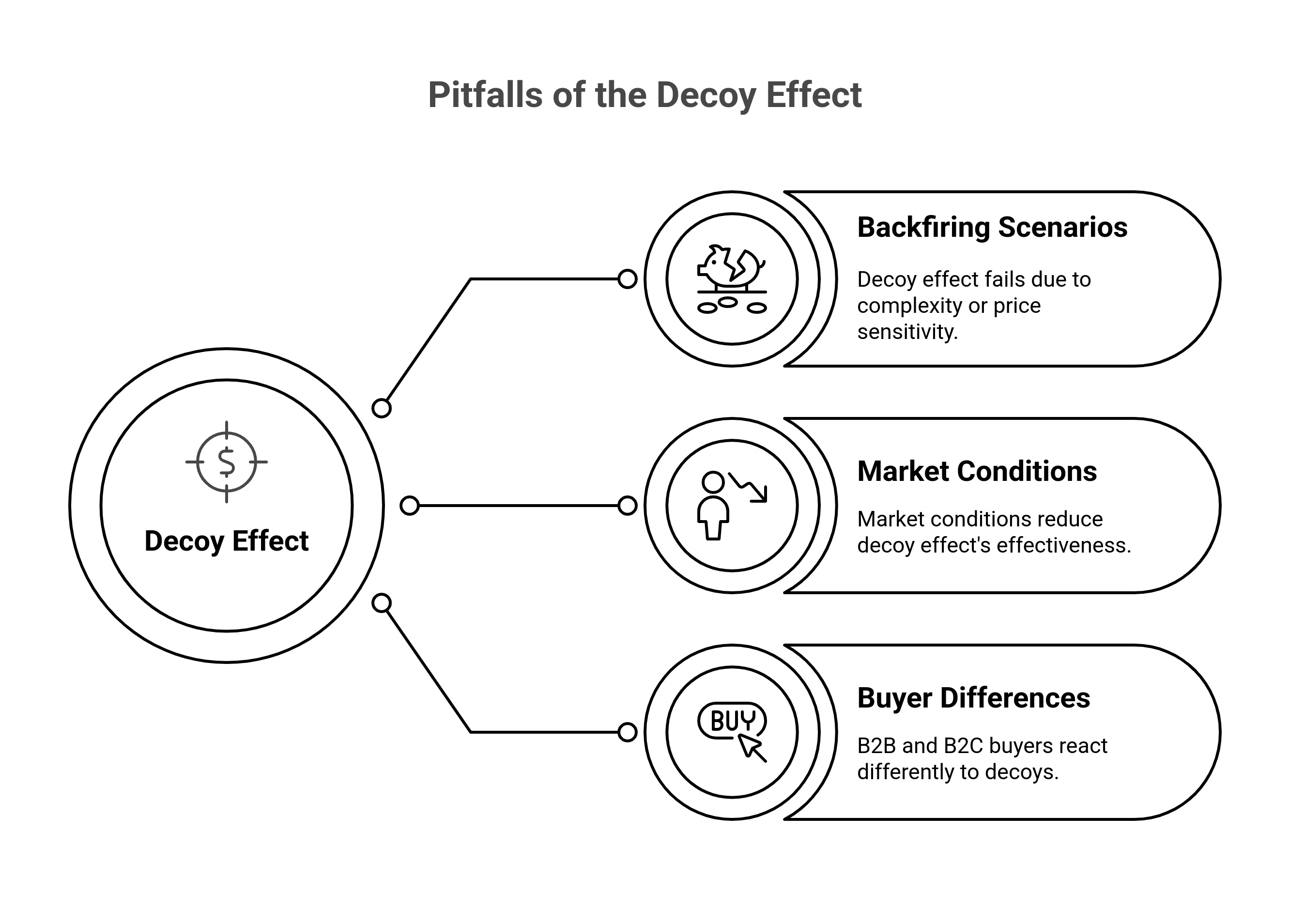
Customers Are Getting Smarter
Modern buyers, in a B2B situation or when entering tech-savvy markets, are growing increasingly aware of pricing strategies. If your decoy pricing is not held up well in front of them, it could incur skepticism rather than persuasion. Also, for sophisticated consumers, any sort of overt decoy could be seen as insulting. This would only destroy the level of trust they had for that brand. This is highly relevant in industries where transparent pricing, easy comparison, and procurement processes are a way of life. As a result, applying the Decoy Effect might backfire in such cases.
Doesn’t Work with All Product Types or Price Points
The Decoy Effect hits hardest when choices are viewed as complicated and high in consideration. It works best with SaaS levels or subscription models, or products with features attached. But it doesn't work as well with:
Impulse purchases are low in cost
Commoditized goods with no differing character
One-price-point offerings
There is not enough perceived complexity in an offering, or the price differential is too vast, and the consumer behavior shift is not activated. The decoy must feel like a real choice to activate asymmetric dominance. Make humanized or even more human words; move things in close-around or around into different dimensions. Of course, also rewrite the text with lower perplexity and higher burstiness without altering the word count or HTML elements:
Too Much of Anything Can Cause Cognitive Overload
While the Decoy Effect makes the choice easier through contrast, an overload of decoy-like options may create great confusion for the customer. If every pricing tier is poorly structured to create more confusion than incentive, why should clients even trust any of the options? This is one of the major pitfalls for marketers: pushing the psychological levers too much. Remember, the purpose is to assist decision-making, not confuse or deceive. Too much cognitive load creates indecision, and indecision kills conversion.
May Create Misalignment with Long-Term Customer Fit
A second possibility of risk could be that consumers may end up selecting plans because of decoy pricing, but end up in tiers that do not really align with their needs. This mismatch can then create:
More churn rates
Less product satisfaction
Higher support costs
In the best-case scenario of psychological pricing, both parties can benefit from it. In case your pricing methodology nudges the users to plans that they regret, you will lose the trust and brand equity in the long run.
Ethical Perception and Brand Risk
This pertains to the ethical aspect. Although decoy pricing is not set up to deceive, perception does matter. If your clients feel they have been manipulated—even in a gentle fashion—then you will probably suffer some sort of reputational backlash, especially considering the degree of transparency that customers now expect. Great brands utilize behavioral economic theories in their pricing in order to illuminate best value for their buyers rather than obscure it. The ethical use of the Decoy Effect means respecting the buyer's intelligence and ensuring that each of the options genuinely offers good value, albeit with some options highlighting the value of others.
Conclusion
In an overflowing marketplace with choices for consumers, the Decoy Effect can guide decisions through a smart, subtle framing advantage. By behavioral economics in pricing, marketers can influence consumer behavior, not by deception but by careful effectiveness, by facilitating meaningful comparisons and clarifying value.
Their simplicity gives the Real Firepower to the Decoy Effect. When applied accurately, it modifies the perception of how buyers value your offer, making the 'middle or premium plan seem the most rational, high-valued choice. Be it SaaS, consumer products, or subscription selling-or otherwise, decoy pricing causes significant lifts in the dimensions of conversions, average order value, and buyer satisfaction. But as we have observed, it is not merely a clever pricing technique; instead, it is a psychological trigger that is rooted in how people make decisions in uncertain conditions. Hence, the success highly depends on ethical implementation, strategic testing, and respect towards customers' intelligence. Push too hard and you risk alienating your audience. Use it carefully and you position your brand as both persuasive and trustworthy. One of the best yet least utilized marketing tactics in today's marketing environment is the Decoy Effect. It marries the marketing psychology with a practical pricing strategy because it offers a scalable lever for growth-focused teams. When used properly, it won't only be a sales increment, but will also help customers make better, more confident decisions.